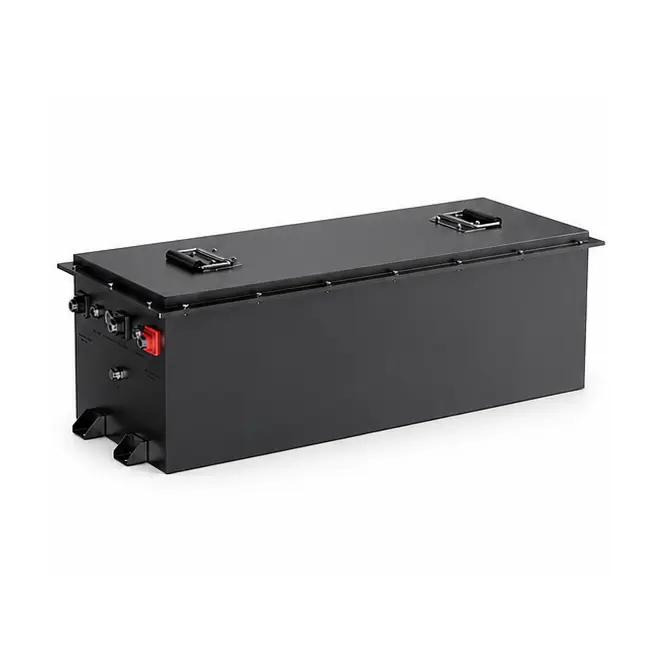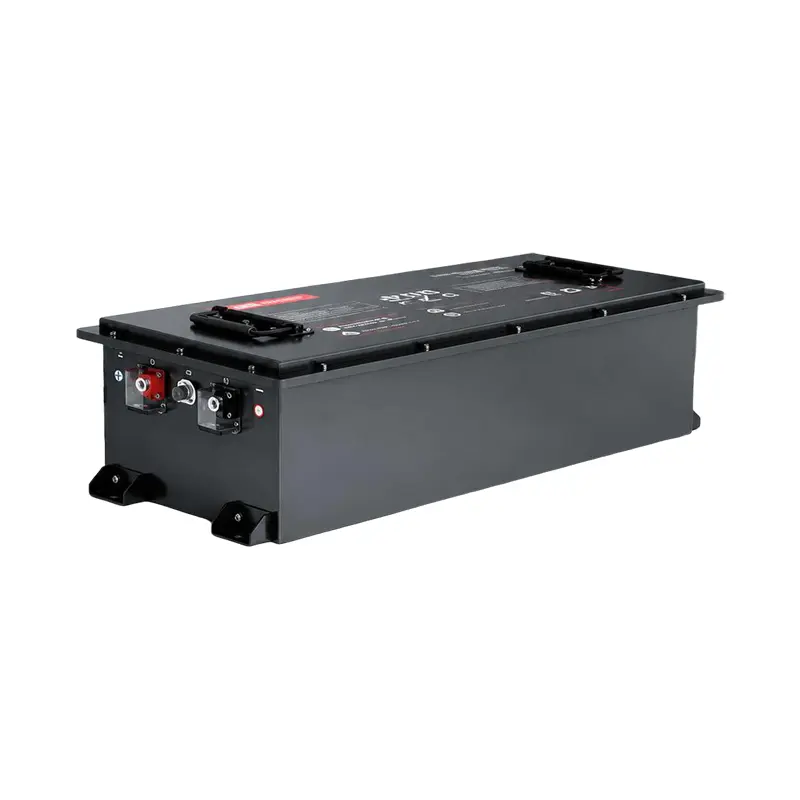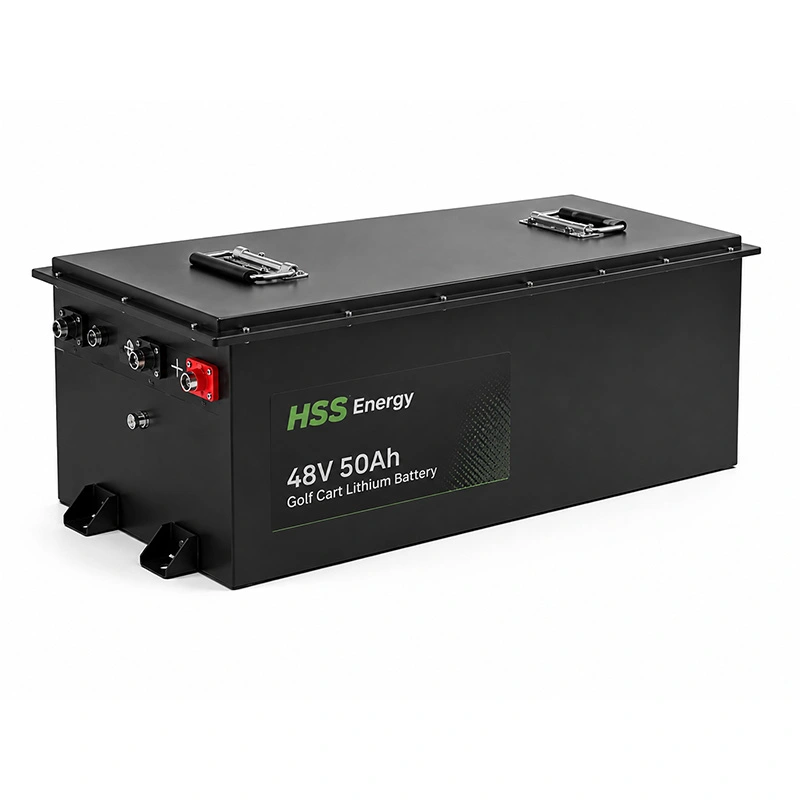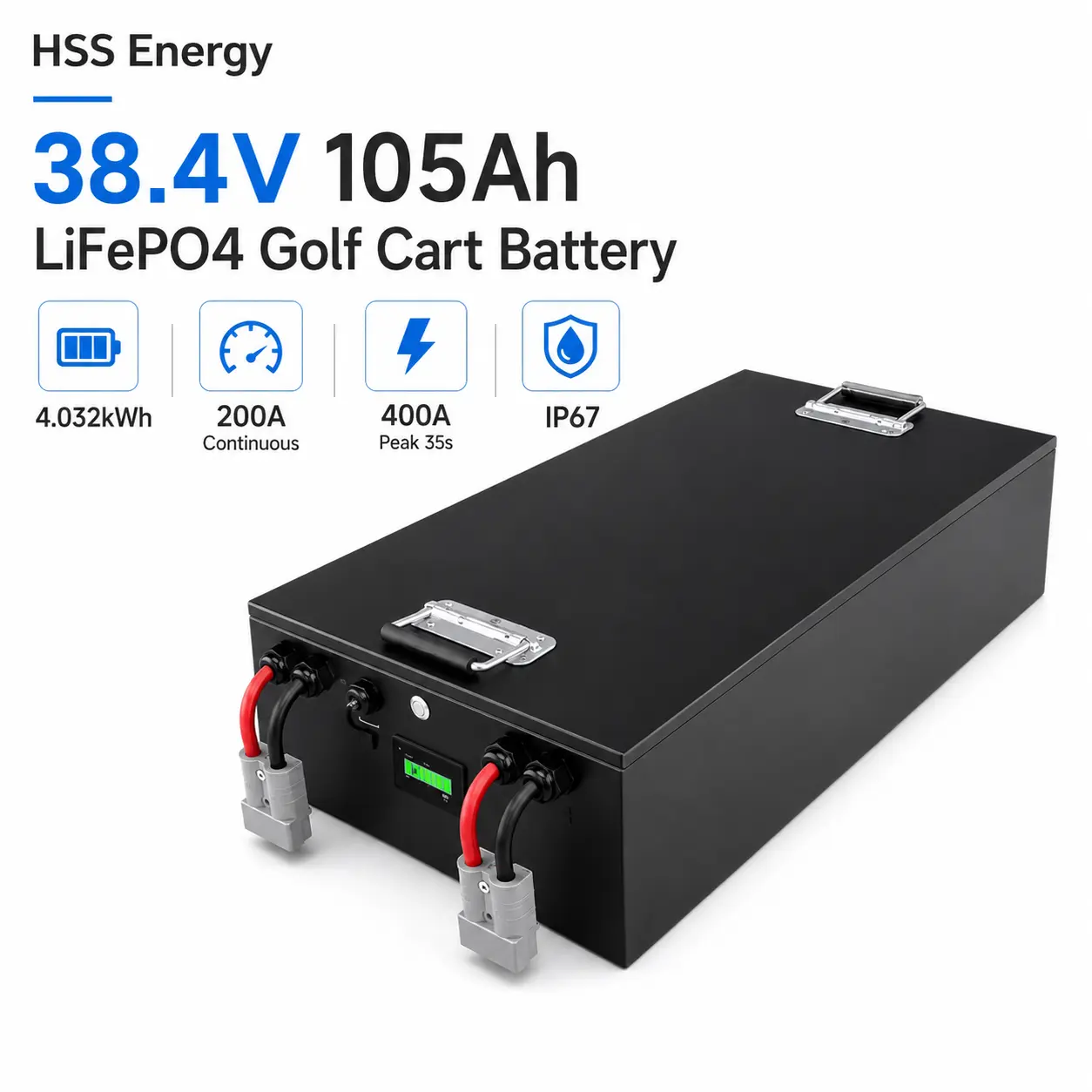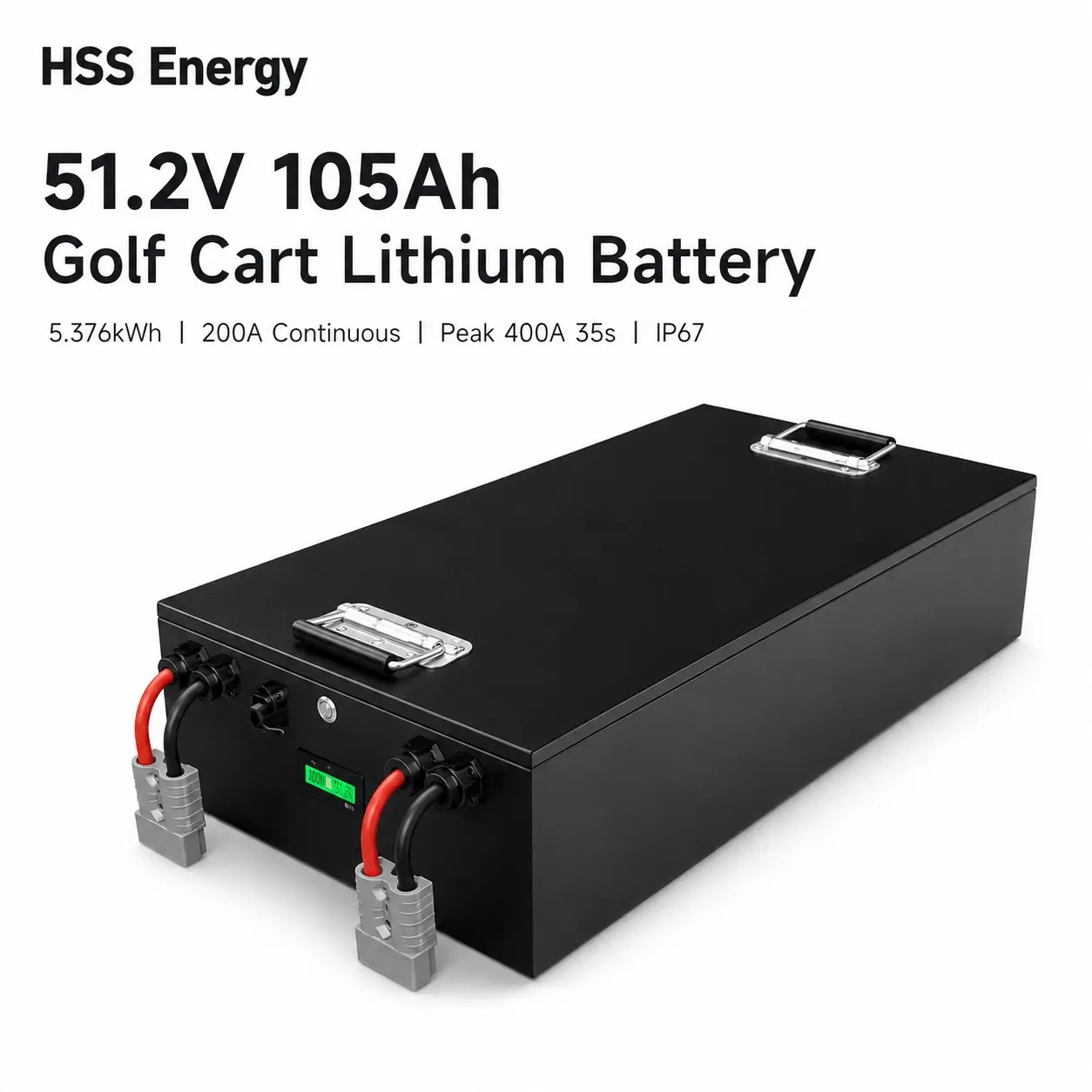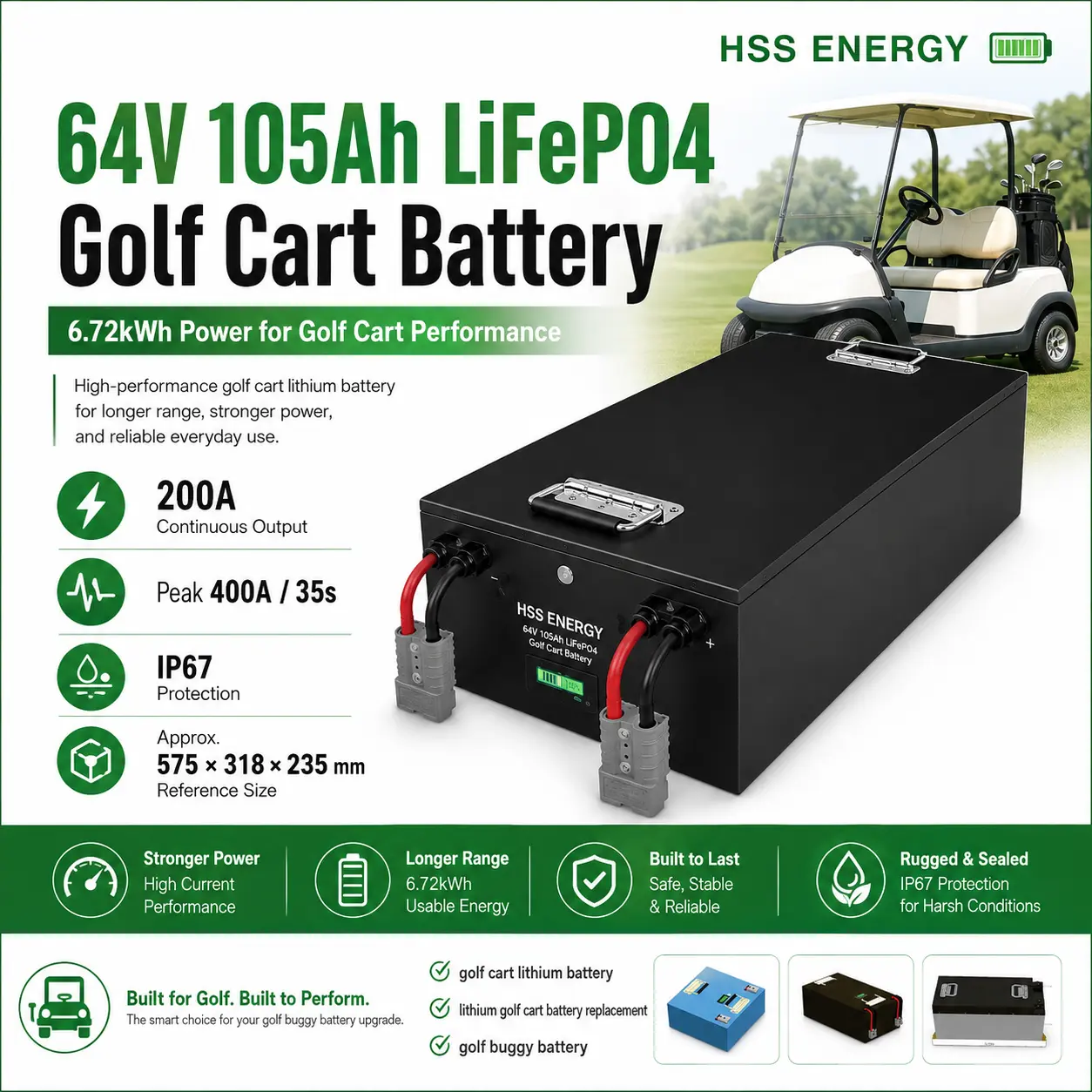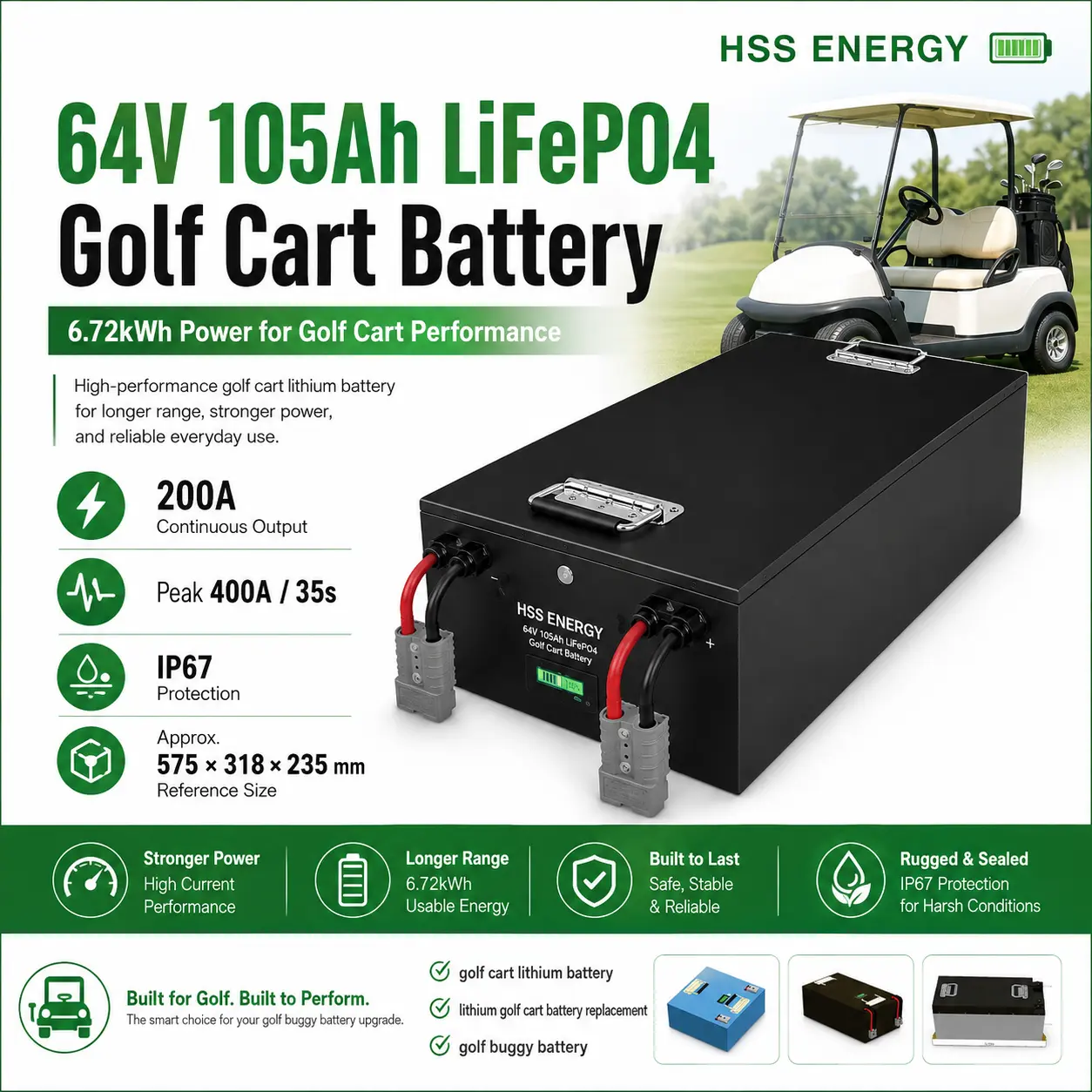
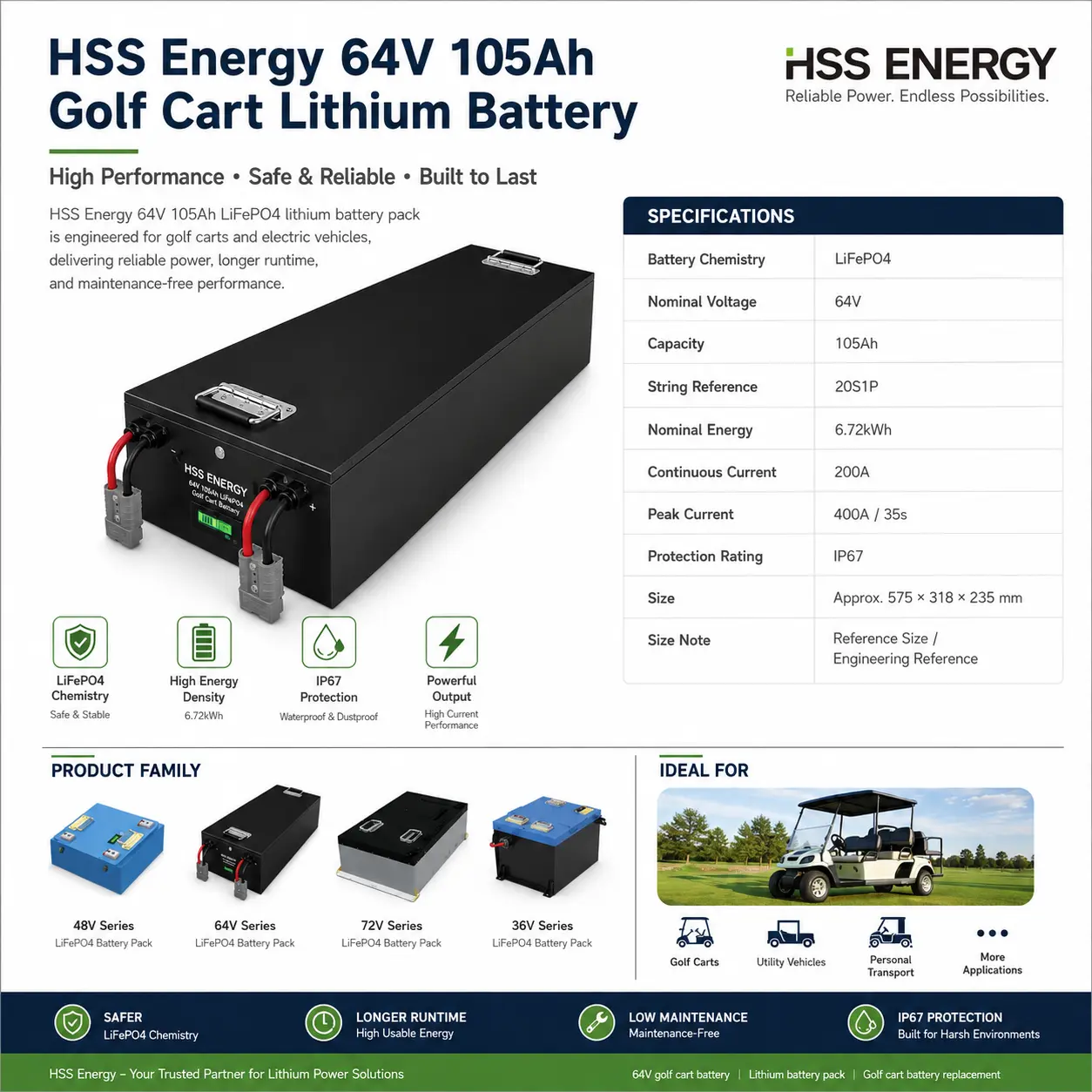
The 60V 105Ah Golf Cart Lithium Battery supplied by HSS Energy is built around a 20S1P 64V nominal architecture with 6.72kWh rated energy for higher-voltage vehicle projects. The design prioritizes current delivery, controller / charger matching and packaging flexibility. Final dimensions, weight, interface and communication are approved against the customer vehicle before production.
|
Specification |
Details |
|
Market Voltage Class |
60V |
|
Nominal Voltage |
64.0V |
|
Cell Configuration |
20S1P LiFePO4 |
|
Rated Capacity |
105Ah |
|
Nominal Energy |
6.72kWh |
|
Reference Continuous Discharge |
200A continuous — series-reference value; final BMS approval required |
|
Reference Peak Discharge |
400A for 35 seconds — series-reference value; project validation required |
|
Reference Charge Voltage |
Approx. 73.0V for 20S LiFePO4; confirm final cell / BMS limits |
|
Project Charger |
73V-class LiFePO4 profile; charge current selected after BMS and charge-time review |
|
BMS |
200A-class Smart BMS; project-specific protection thresholds |
|
Communication |
CAN / RS485 / Bluetooth optional; controller protocol matching required |
|
Ingress Protection |
IP67 |
For customers evaluating a 60V golf cart battery, the 20S architecture, approximately 73.0V full-charge target, controller voltage window and current demand should be reviewed as one electrical system.
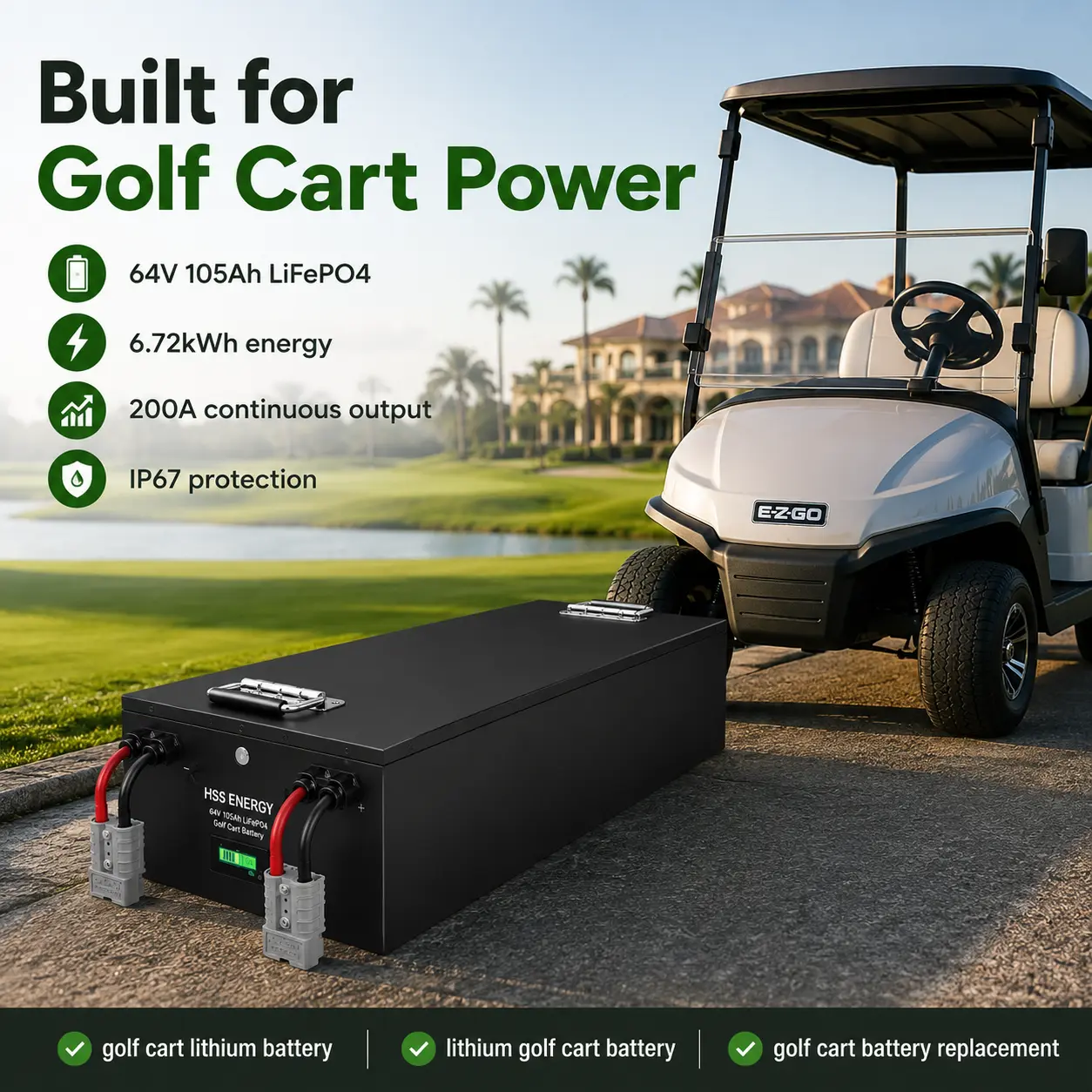
A high voltage golf cart battery should be selected for a compatible electrical architecture, not treated as a universal replacement for lower-voltage carts. This 20S / 105Ah platform is designed to add voltage and energy while keeping enclosure geometry open to tray-specific engineering.
|
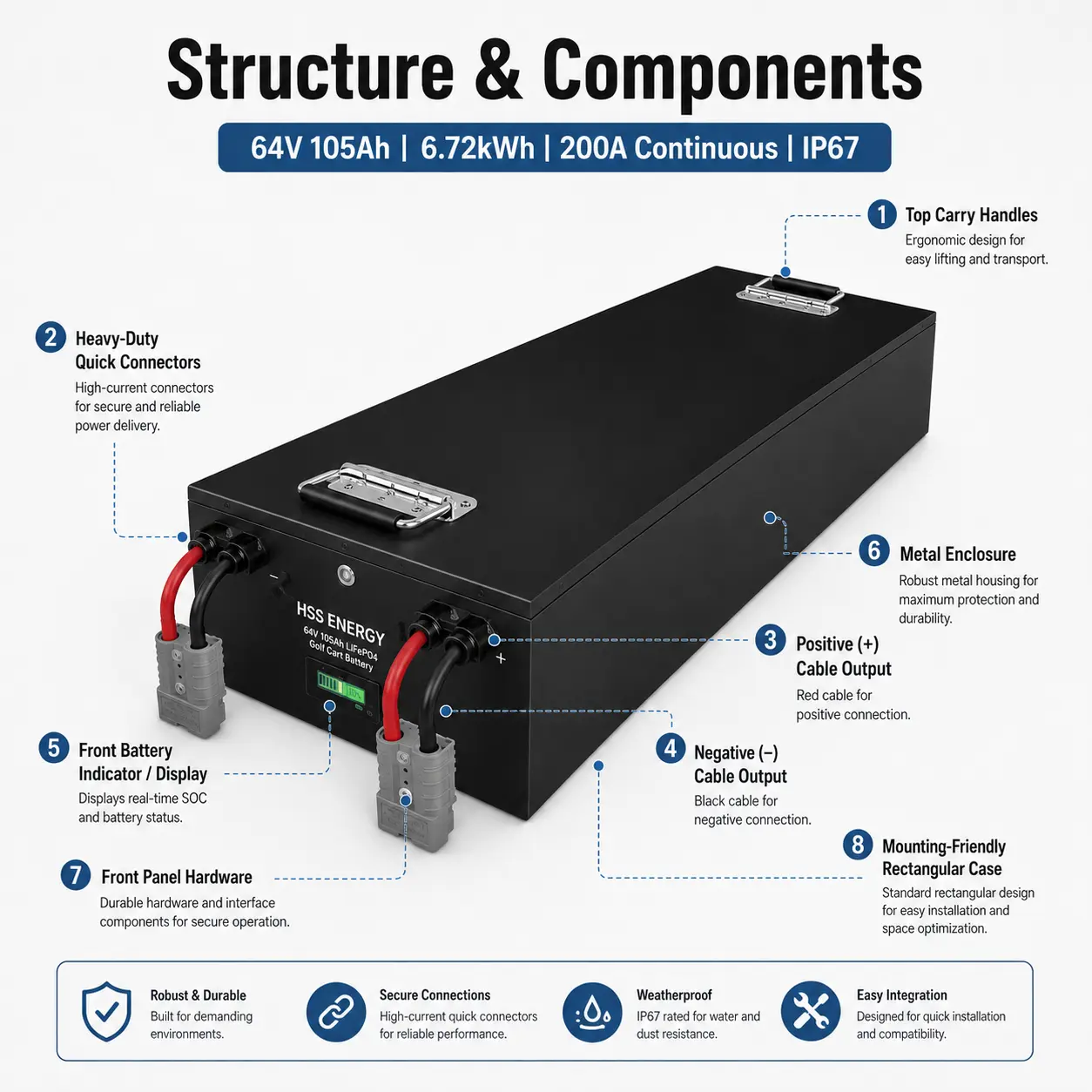
Why the 64V / 105Ah Architecture Matters • 6.72kWh nominal energy is 25% above the 51.2V / 105Ah platform and about 66.7% above the 38.4V / 105Ah platform at the same Ah rating. • Higher bus voltage can reduce the current required for the same power demand when the controller and motor are designed for that voltage range. • 200A continuous and 400A / 35s reference capability provides acceleration and hill-climb headroom inside the approved BMS and thermal limits. • Increasing voltage does not require the battery to become simply longer; cell arrangement and case proportions can be engineered around the vehicle tray. |
Electrical Approval Before Production • Confirm the controller input-voltage ceiling accepts 64V nominal and the approximately 73V full-charge level. • Verify motor / inverter, DC-DC converter and accessory voltage limits. • Select the charger profile and charge current against the final BMS configuration. • Review regenerative-braking current, cable size, fuse strategy and connector ratings before production. |
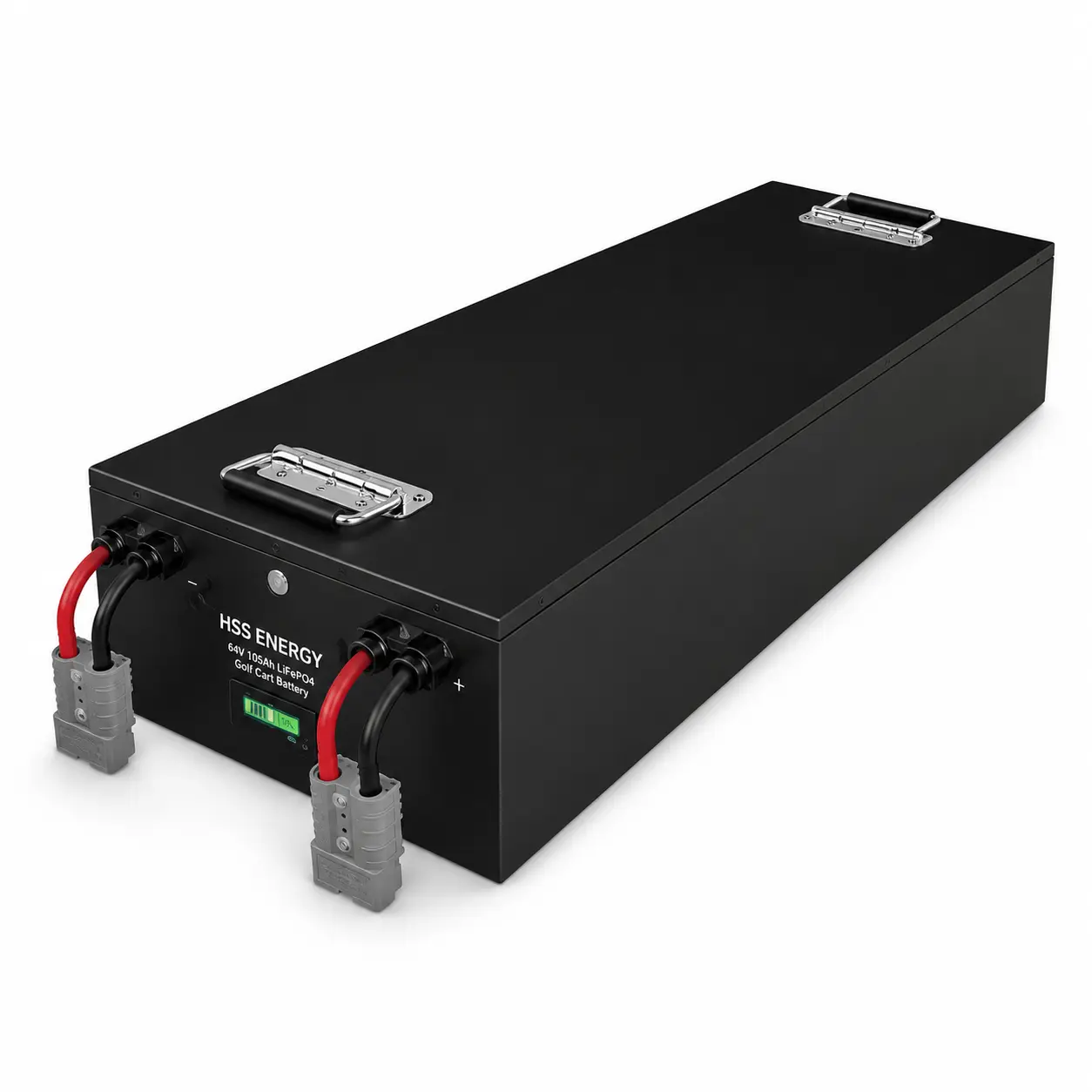
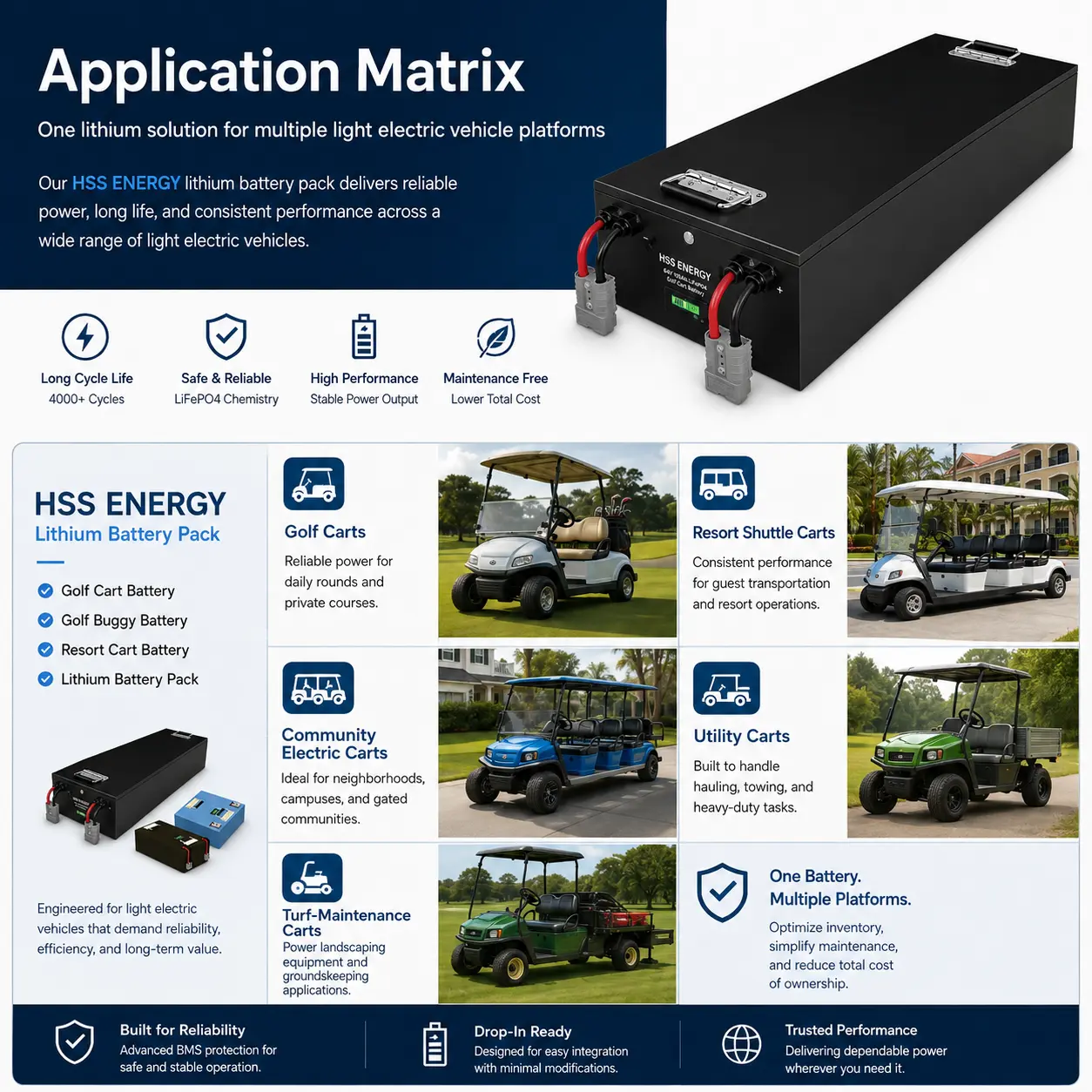
As a performance golf cart battery, this SKU is intended for compatible higher-voltage platforms where route length, passenger load, lifted geometry, larger tires, accessories or utility work justify more energy and voltage headroom than the 38.4V and 51.2V entries.
|
Primary Application Territory • Performance-oriented golf carts using a compatible 64V controller / motor architecture. • Lifted, larger-tire or multi-passenger carts after current and drivetrain review. • Resort shuttle, campus and community carts with longer routes or accessory loads. • Utility and property-maintenance carts where higher-voltage packaging is approved as part of the vehicle system. |
customers Role • Golf-cart builder or modifier developing a higher-voltage performance platform. • Distributor needing a differentiated 64V offering within the 105Ah family. • Fleet or resort operator standardizing a compatible higher-energy vehicle platform. • OEM project customers requiring custom enclosure, connector, BMS, display or communication integration. |
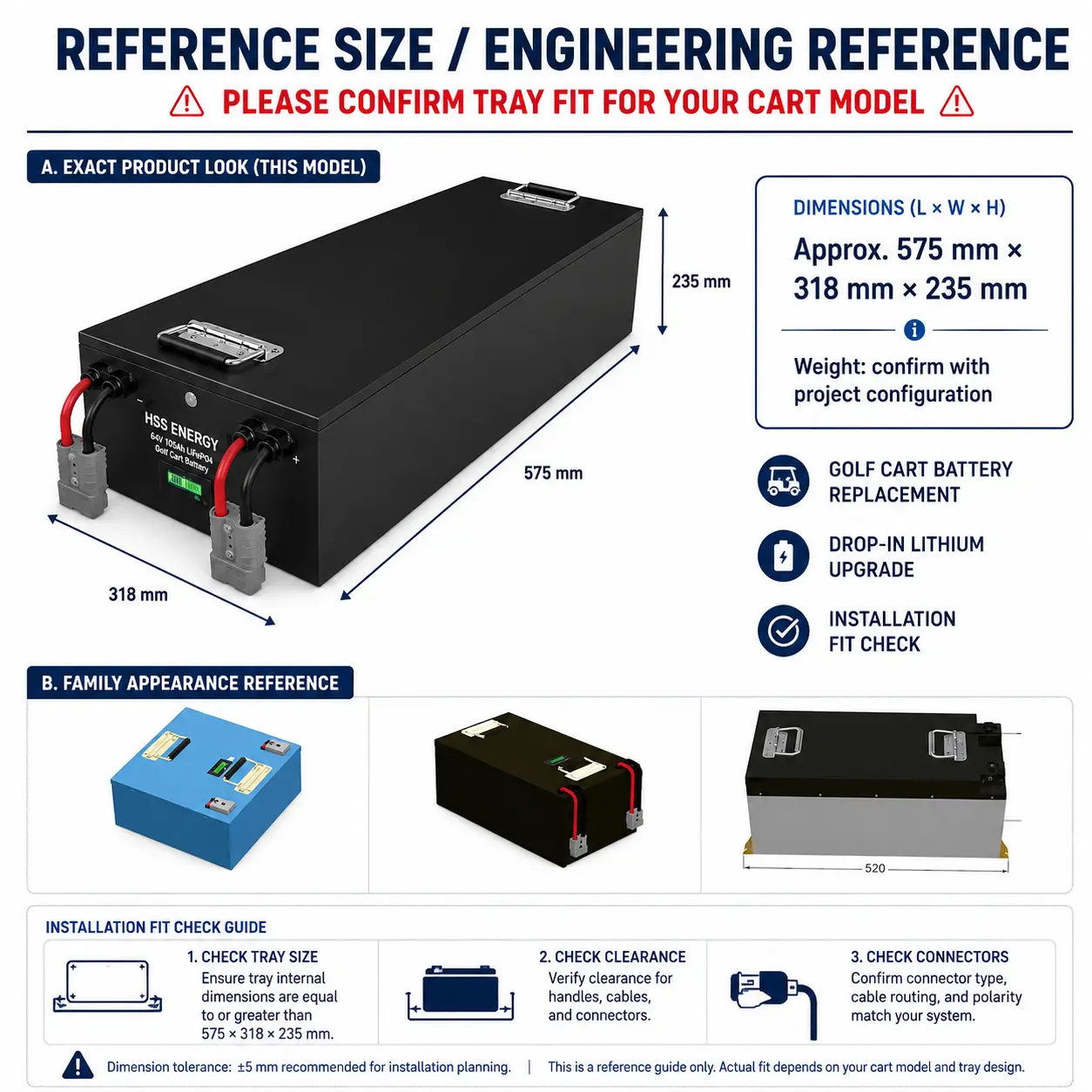
A 64V lithium golf cart battery project can use the approximate 575 × 318 × 235 mm package as an engineering reference while rebalancing length, width and height for the customer battery tray. Final dimensions and weight are confirmed only after cell arrangement, BMS, structure and interface design are approved.
|
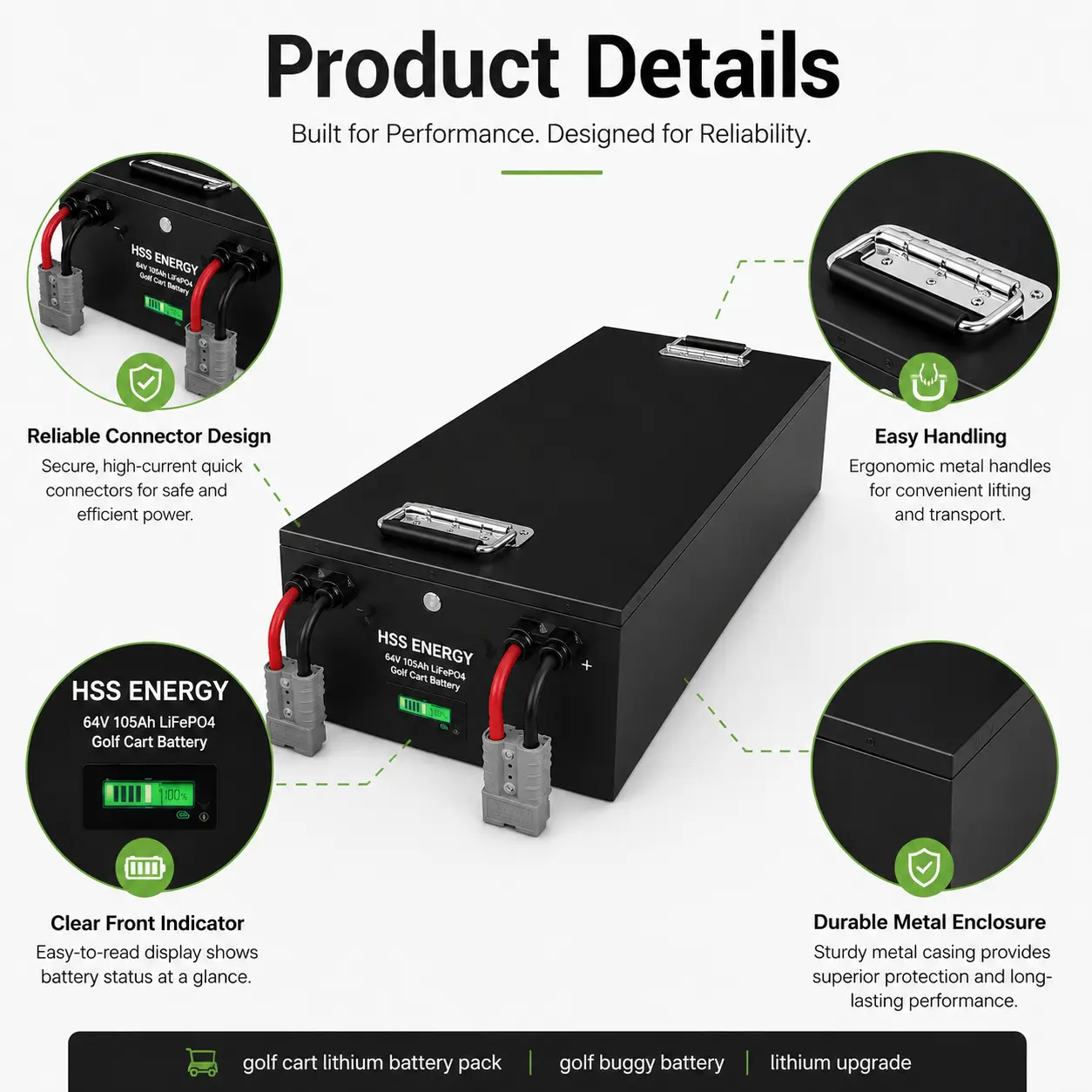
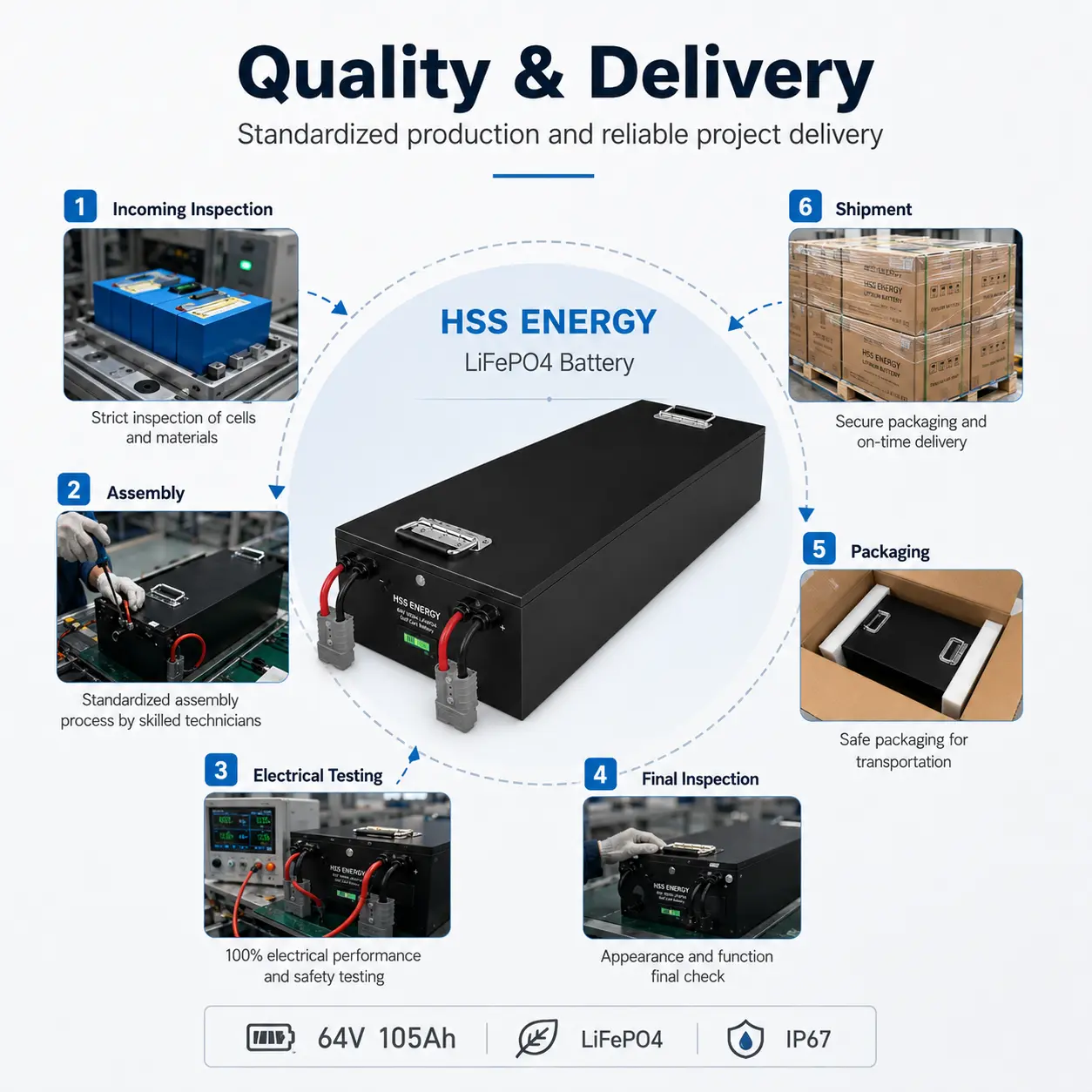
Engineering Reference Package • Approximate reference size: 575 × 318 × 235 mm. • Reference dimensions are for project planning, not a fixed universal cart fit. • Finished-pack weight depends on the final enclosure, cell layout, BMS, harness and interface configuration. • Top carry handles and front-facing high-current connector / display zone support service access and installation planning. |
Custom Size as a Sales Advantage • Length, width and height can be rebalanced around the customer tray rather than extending the pack in only one direction as voltage increases. • Connector position, cable exit direction and display location can be coordinated with the cart layout. • Mounting / retention features can be adapted to the chassis or battery compartment. • Final geometry remains subject to electrical clearance, structural strength, thermal behavior, sealing and serviceability review. |
|
Specification |
Details |
|
|
Power Interface |
Front high-current quick-connector layout; connector family and cable length can be project-selected |
|
|
Status / SOC |
External SOC display available; front battery-status indicator shown in the reference configuration |
|
|
Communication |
CAN / RS485 / Bluetooth optional after vehicle-controller protocol review |
|
|
BMS |
200A-class Smart BMS with project-specific current, voltage and temperature protection settings |
|
|
Charging Interface |
Approx. 73.0V LiFePO4 profile; charger current and regenerative-charge limits confirmed by project |
|
|
Vehicle Integration |
Controller, motor, DC-DC, regen, harness, fuse, connector, display and communication reviewed as one system |
|
The 64V platform should be approved as a complete vehicle electrical system: controller voltage range, motor demand, charger profile, regenerative braking, BMS current limits, connectors, fuse / cable design, display and communication all interact with final pack configuration.
|
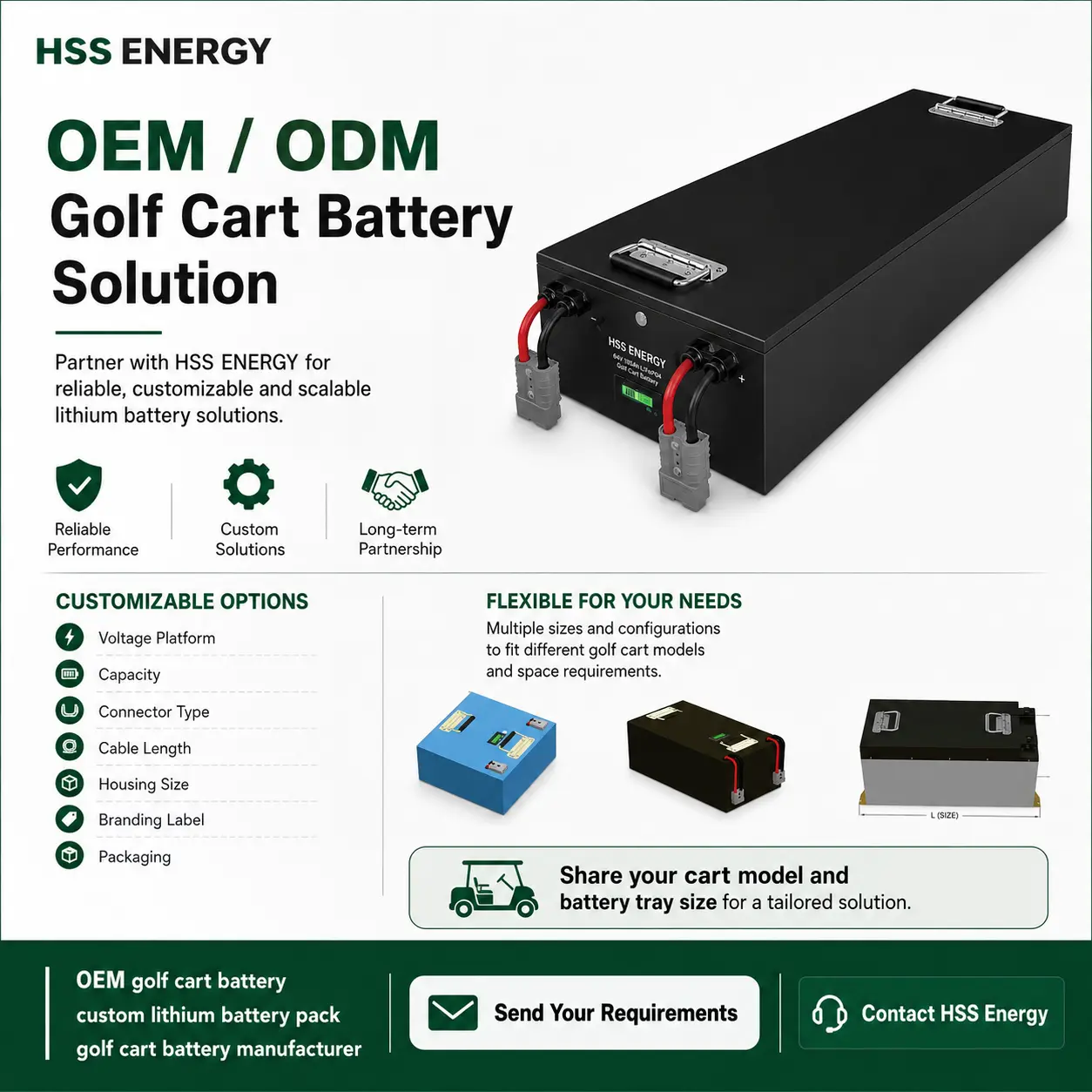
Configurable Product Elements • Case dimensions and battery-tray fit geometry. • High-current connector family, cable length and cable-exit direction. • BMS protection limits matched to the approved controller / motor duty. • CAN / RS485 / Bluetooth communication and external display options. • Charging solution, accessory DC-DC integration and front-interface layout. • Private label, logo, packaging, documentation and project-specific validation requirements. |
What the customers Should Send • Golf cart brand / model / year or vehicle platform drawing. • Battery tray internal dimensions and available installation clearance. • Controller and motor ratings, including continuous / peak demand and regenerative braking behavior. • Existing charger data or required charge-time target. • Connector, cable, fuse, display, communication and accessory-power requirements. • Target quantity, branding, certification, packaging and delivery requirements. |
||
|
Inquiry CTA |
|||
|
For a 60V 105ah lithium battery project, send HSS Energy your vehicle model, tray dimensions, controller / motor data, charger requirements and preferred interface. We can review the project and define the pack geometry and electrical configuration before production. |
|||
No. This 20S platform is intended for vehicles whose controller, motor and accessory architecture are approved for the 64V nominal / approximately 73V full-charge range.
A 20S LiFePO4 engineering target is approximately 73.0V. The final charger profile must be confirmed against the selected cells, BMS limits and vehicle charging strategy.
Yes. The package is an engineering reference. HSS Energy can rebalance enclosure proportions, mounting, cable exits and interface positions to fit the approved battery tray.
They are the current series-reference values for this 64V SKU. Final continuous, peak and duration limits must be validated with the selected BMS, thermal design and vehicle duty cycle.
Vehicle voltage architecture, controller / motor demand, regenerative braking, charger, battery tray, connector, fuse / cable design, communication, display, branding, certification and packaging.
Best fit: compatible higher-voltage golf carts, lifted / multi-passenger builds, resort and utility vehicles, performance-oriented vehicle projects and OEM programs that need 6.72kWh at 105Ah with configurable case geometry and high-current integration.
Address
A3, 1204-1, 1142 Jimei North Avenue, Software Park Phase III, Xiamen Torch High-tech Zone, Xiamen, China
Tel