HSS Energy 25.6V 100Ah AGV Battery is for AGV projects needing more onboard energy than a compact 60Ah platform. Selection confirms the 8S voltage route, runtime target, bay space, mass allowance, charger and communication before sampling. This makes it a different purchasing decision from the compact 60Ah platform. customers are effectively trading more battery volume and mass for a larger runtime budget and fewer charging interruptions. The final choice should consider route length, average power, payload, shift structure, charging windows and available battery space so that the 100Ah capacity solves a real operational problem rather than simply increasing the specification.
|
Parameter |
HSS Reference Configuration / Project Confirmation |
|
Market Voltage Class |
24V-class |
|
Nominal Voltage |
25.6V |
|
Chemistry / Architecture |
LiFePO4 / 8S |
|
Capacity |
100Ah |
|
Nominal Energy |
2.56kWh |
|
Upper Charge Reference |
29.2V = 8 × 3.65V; final charger profile project-confirmed |
|
Steady / Peak Current |
Confirmed from measured AGV load and peak duration |
|
Charging |
Manual, dock or opportunity charging by approved project |
|
Communication |
CAN / RS485 project-selectable; protocol mapping confirmed |
|
Enclosure / Weight |
Released after battery-bay and allowable-mass review |
A 24V 100Ah AGV battery can use a 25.6V nominal 8S LiFePO4 route. Confirm controller and charger limits against 29.2V. As with other 24V-class lithium systems, the market label does not fully describe the electrical architecture. The charger and controller must support the 8S voltage range and the 29.2V upper-charge reference. Recording the approved 8S route in the project documentation helps prevent later replacement confusion, especially in facilities where different AGV models or battery generations operate side by side.
A 25.6V 100Ah LiFePO4 AGV battery provides 2.56kWh nominal energy; size it from duty cycle and charging windows. That energy figure should be translated into a duty-cycle budget using average power, usable SOC and planned charging opportunities. A larger capacity can extend the interval between charges, but it does not by itself guarantee a full shift because payload, auxiliary loads, temperature and peak current all affect energy use. For fleet customers, the better question is whether 2.56kWh reduces charging interruptions enough to justify the extra size and mass.
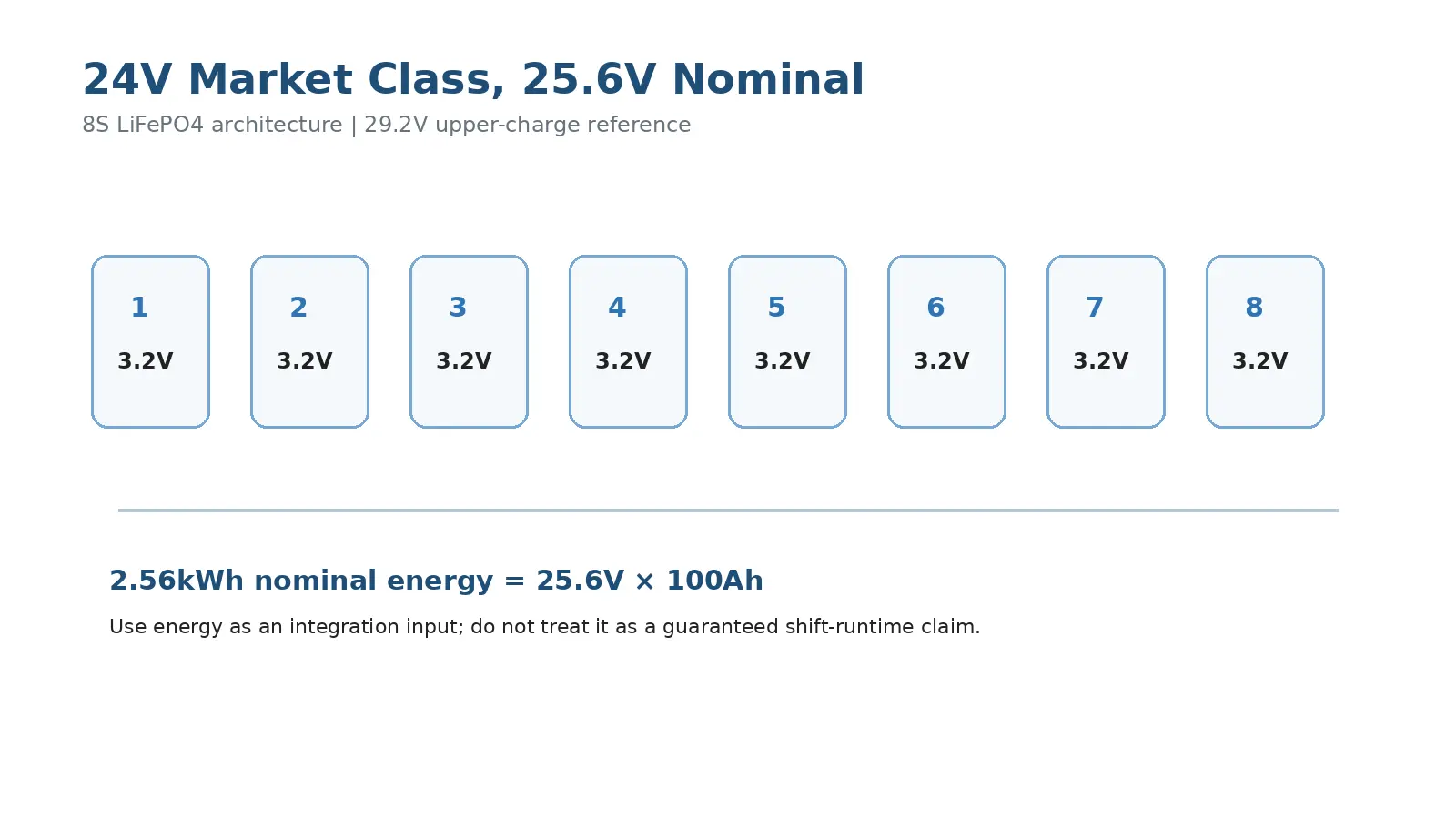
8S architecture visual. The 29.2V value is an upper-charge reference, not a substitute for charger approval.
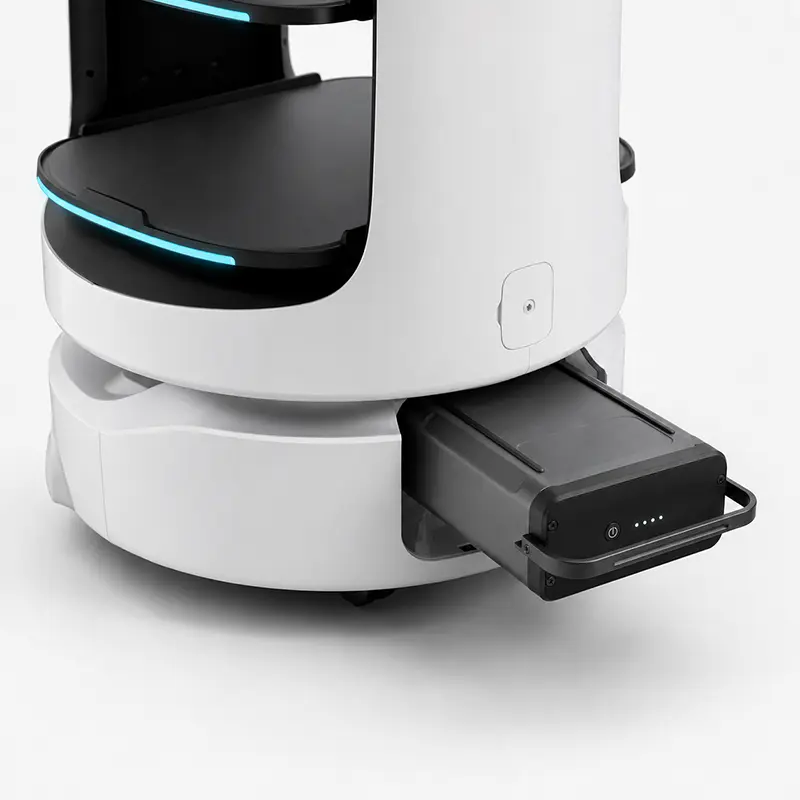
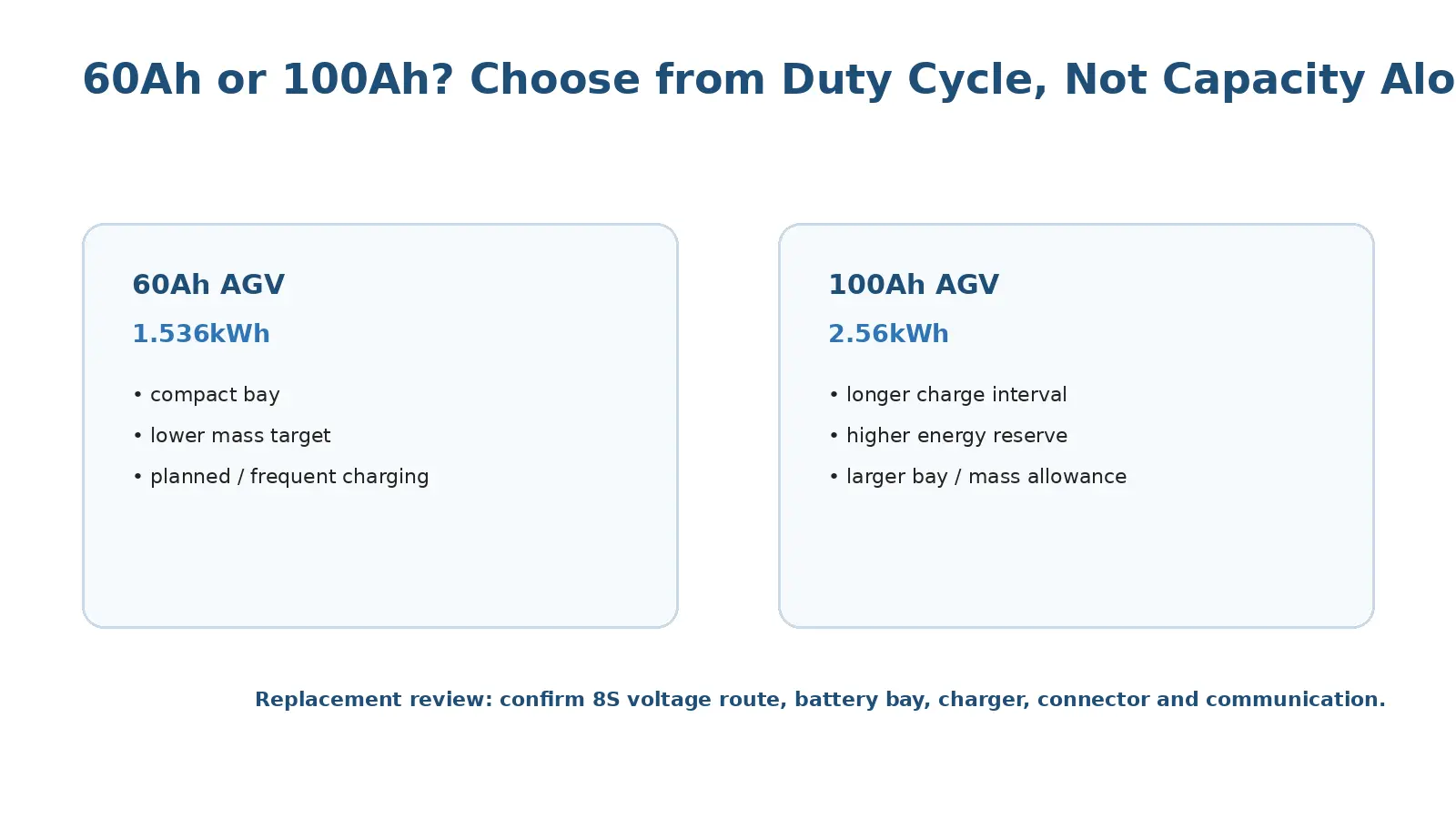
A 100Ah AGV lithium battery fits projects needing longer charge intervals when the battery bay and allowable mass can support the extra energy. This is most useful when the AGV has sufficient enclosure space and the added battery mass does not compromise payload or vehicle balance. customers should therefore validate the battery bay and mass allowance together with the runtime target rather than treating capacity as an isolated upgrade. Where opportunity charging is frequent and space is tight, the smaller 60Ah platform may produce a better overall system result.
|
customers Input |
Why It Matters |
|
Average power + runtime |
Sets usable-energy requirement |
|
Steady + peak load |
Sets BMS, cable and connector requirements |
|
Battery-bay L×W×H |
Defines feasible enclosure and service clearance |
|
Allowable battery mass |
Protects vehicle balance and payload planning |
|
Charging window |
Determines whether 60Ah or 100Ah better fits the fleet |
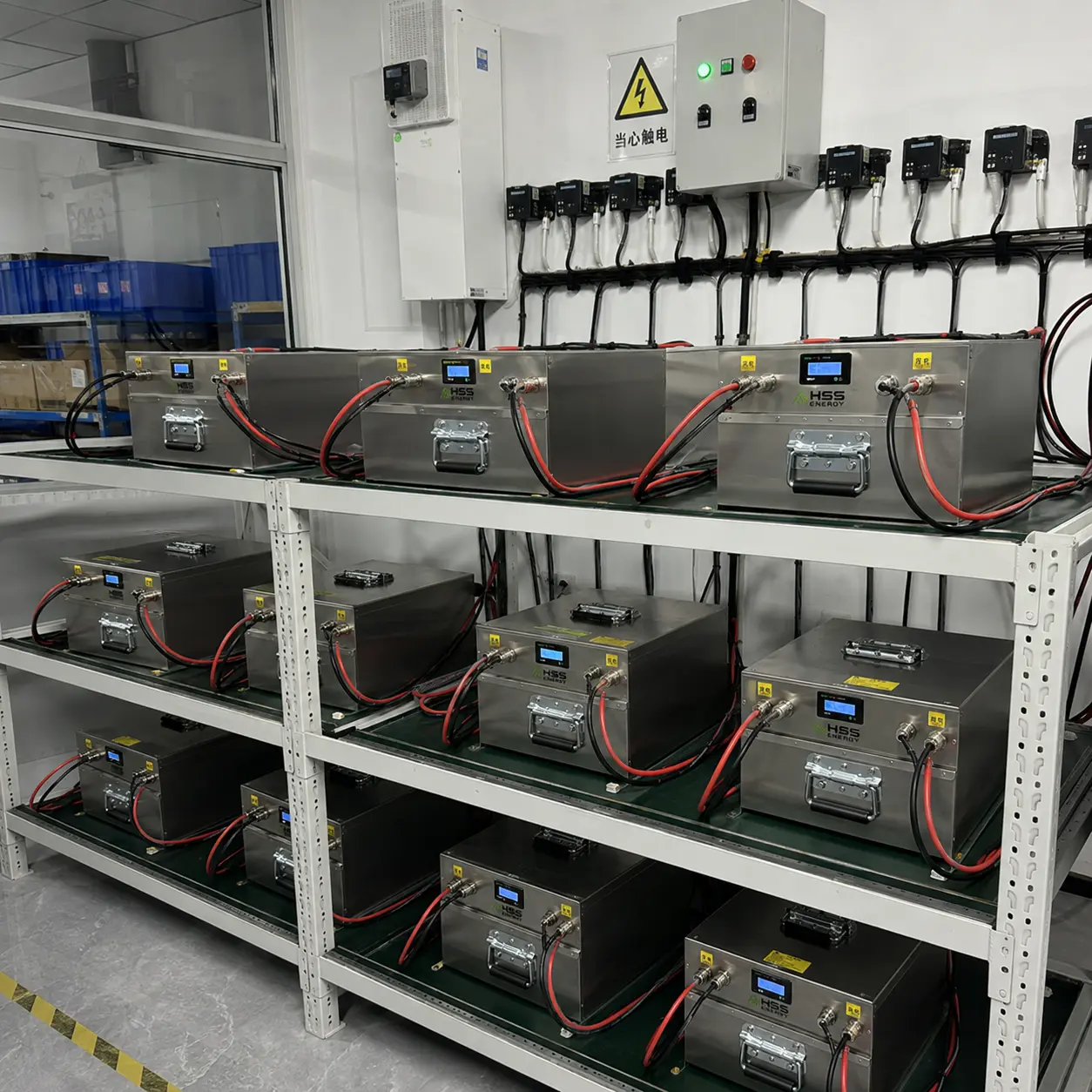
A 25.6V 100Ah robot battery still needs charger, dock, load and CAN/RS485 approval before it is treated as compatible. Communication and charging integration remain just as important on a high-capacity pack as they are on a smaller battery. The dock must match voltage, current, polarity, contacts and interlock logic, while CAN or RS485 behavior must match the robot's protocol expectations. For OEM customers, validating these interfaces before sampling reduces the risk of a battery that has sufficient energy but cannot be charged or recognized correctly by the fleet.
|
Integration Point |
Confirm Before Sample Approval |
|
Dock / charger |
voltage, current, polarity, contacts, interlock |
|
Main power |
steady/peak current, connector rating, cable route |
|
CAN |
bitrate, IDs, scaling, heartbeat and fault response |
|
RS485 |
baud rate, address, register map and polling logic |
HSS Energy | AGV Battery Engineering | Product Detail V2.0
A 24V 100Ah AGV replacement battery needs more than matching labels. For this 25.6V 100Ah AGV Battery, confirm the 8S route, bay, mass, charger, connector and communication. The replacement review should confirm the original voltage route, battery-bay geometry, allowable mass, charger, connector and communication behavior. This is especially important for 100Ah batteries because a dimensional or mass mismatch can have a larger effect on service access and vehicle balance than it would with a compact pack. HSS uses the existing system as the reference so the replacement can be evaluated as a complete integration project.
|
1 Collect |
2 Match |
3 Configure |
4 Validate |
|
label + bay + mass |
8S voltage + duty cycle |
enclosure + interfaces |
fit + charging + comms |
Choose 100Ah for longer charge intervals when bay and mass allowance permit. Choose 60Ah when compact packaging and planned charging matter more. Choose 60Ah when compact packaging, lower battery mass and planned charging opportunities are more valuable than maximum onboard energy. Presenting both options helps fleet customers make a practical selection based on duty cycle rather than assuming the larger battery is automatically better. The right capacity is the one that fits the operating schedule with acceptable size, mass and charging behavior.
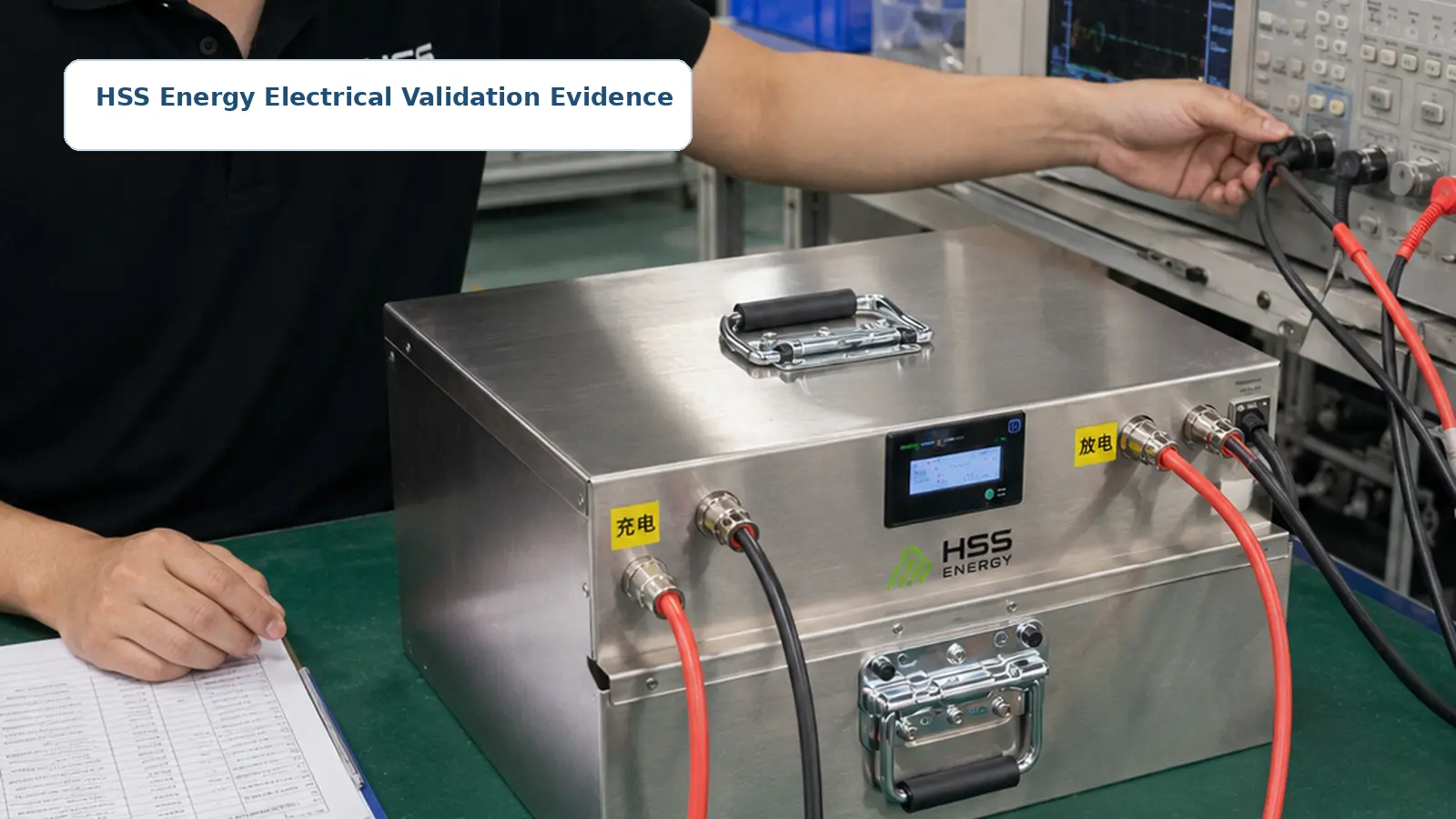
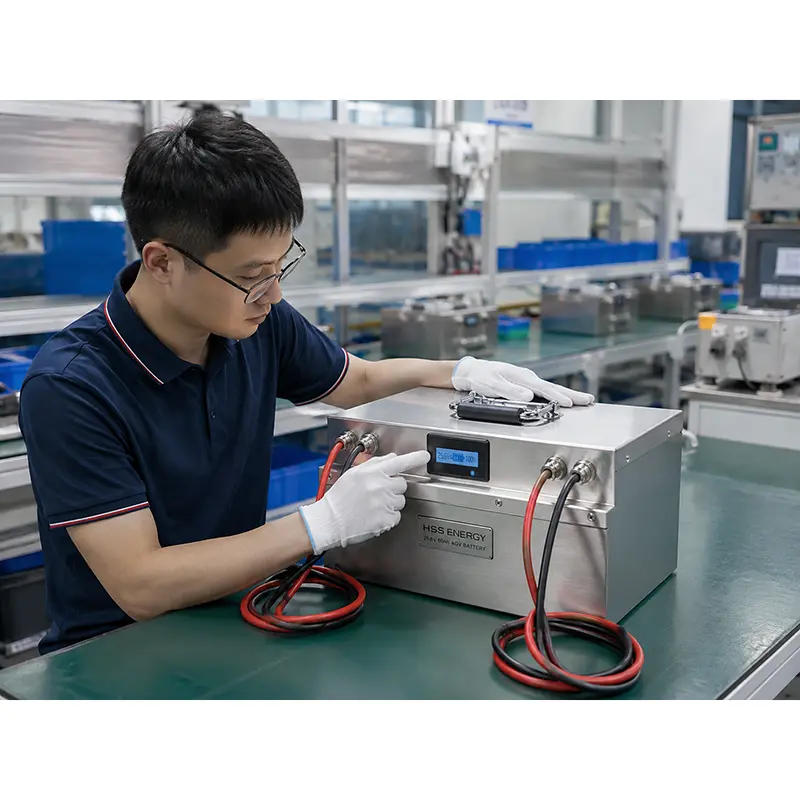
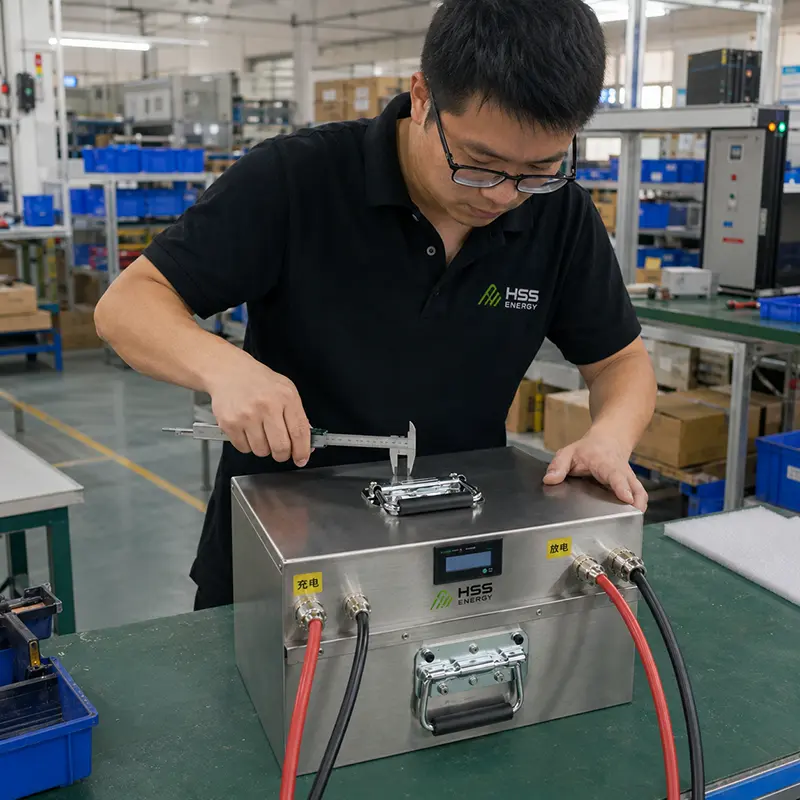
HSS Energy battery-pack electrical validation environment. The photo supports test/process capability; displayed instrument values are not specifications for this exact 25.6V 100Ah configuration.
|
Cell Matching |
BMS Function |
Aging / Validation |
Final Inspection |
|
consistency checks |
protection + communication |
project-defined checks |
configuration + packing |
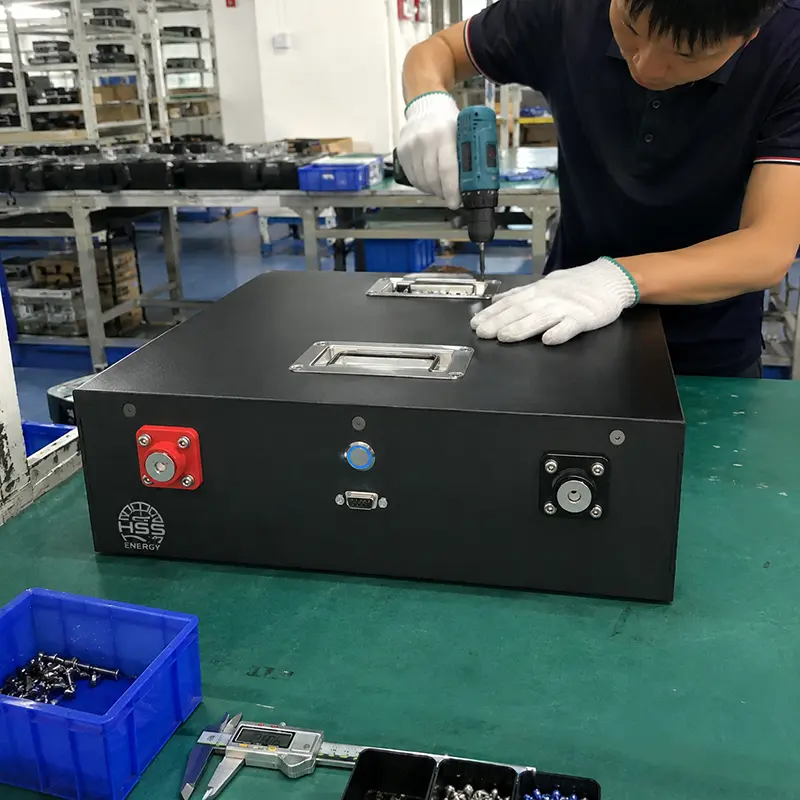
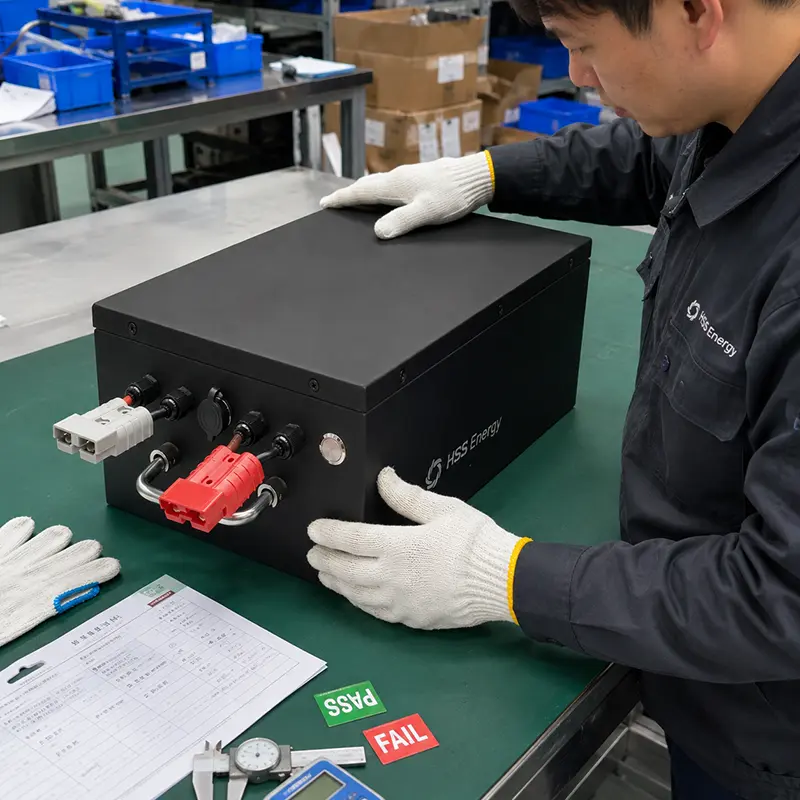
HSS Energy can configure enclosure, connectors, BMS mapping and charger strategy after the AGV platform is approved. For foreign-trade and OEM projects, those configuration items can be frozen in the approved drawing and technical agreement before bulk production. This creates a clearer handover from sample validation to repeat supply and helps distributors or integrators support the same AGV model with consistent mechanical, electrical and communication details over multiple orders.
|
Question |
HSS Engineering Answer |
|
Why do customers search 24V if this pack is 25.6V? |
24V is the market class; 8S LiFePO4 is 25.6V nominal with a 29.2V upper charge reference. |
|
Does 100Ah guarantee a full shift? |
No. Runtime depends on average power, usable SOC, payload, auxiliaries and charging windows. |
|
Can this replace another 24V / 100Ah AGV battery? |
Only after voltage architecture, bay, mass, charger, connector and communication are checked. |
|
Can CAN / RS485 be matched? |
Yes, after protocol details and fault behavior are confirmed for the target AGV. |
SEND YOUR AGV BATTERY REQUIREMENTS
For a 25.6V 100Ah AGV Battery fit review, send HSS Energy the AGV model, load, runtime, bay, mass allowance, charger/dock and communication data Include sample quantity and expected annual demand when available. That allows the engineering review and commercial planning to happen together, so HSS can evaluate battery fit, interface requirements, component sourcing and repeat-production needs before the project moves to a formal quotation.
Address
A3, 1204-1, 1142 Jimei North Avenue, Software Park Phase III, Xiamen Torch High-tech Zone, Xiamen, China
Tel