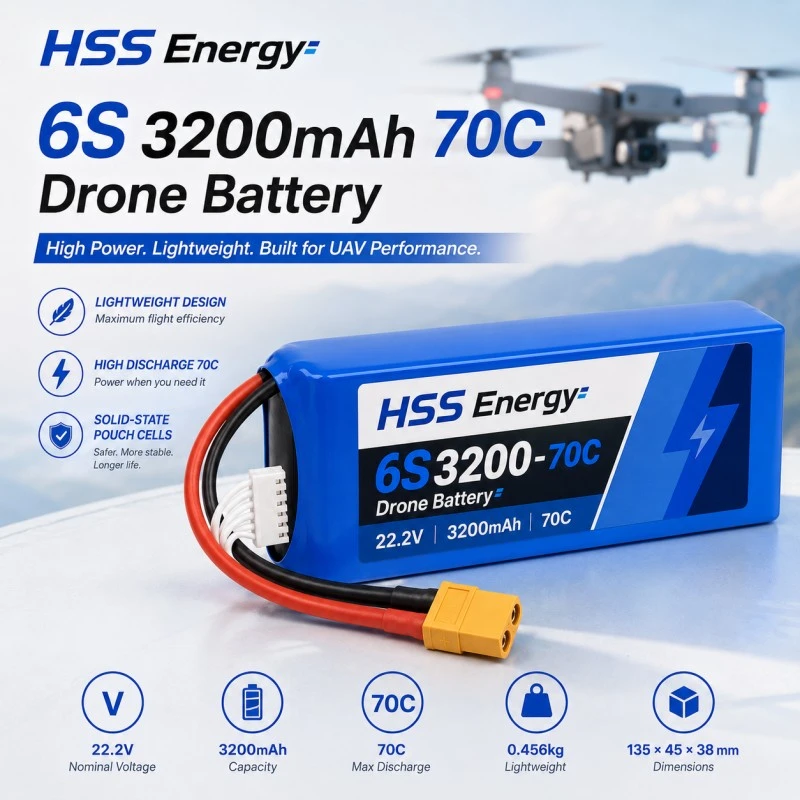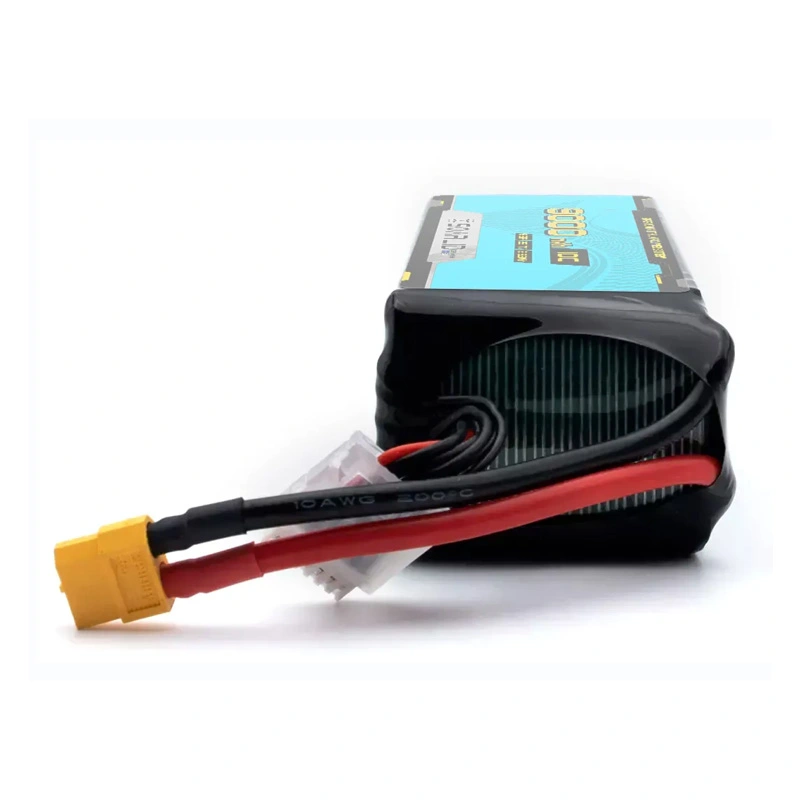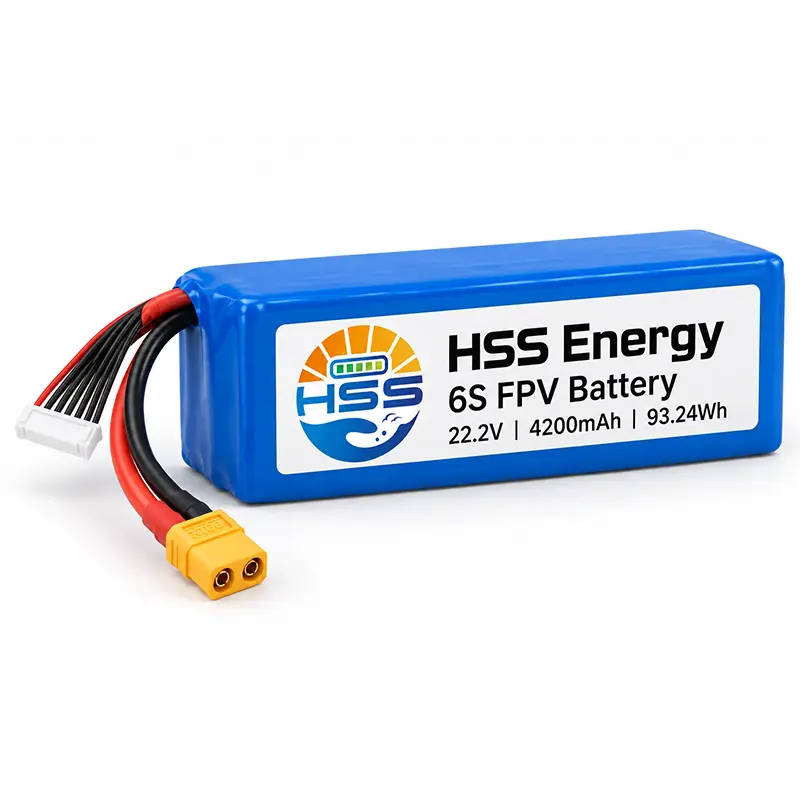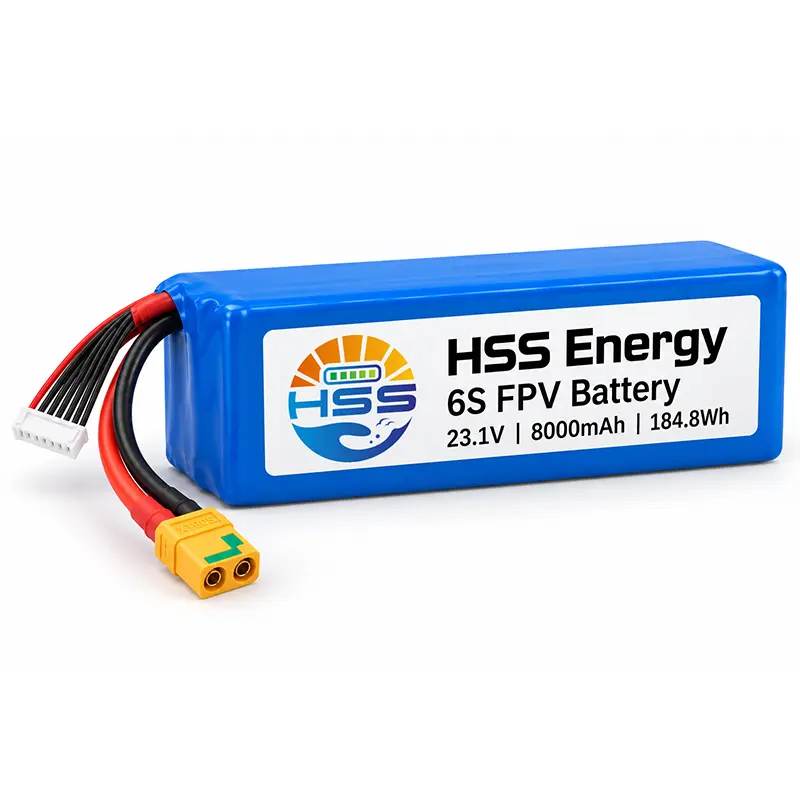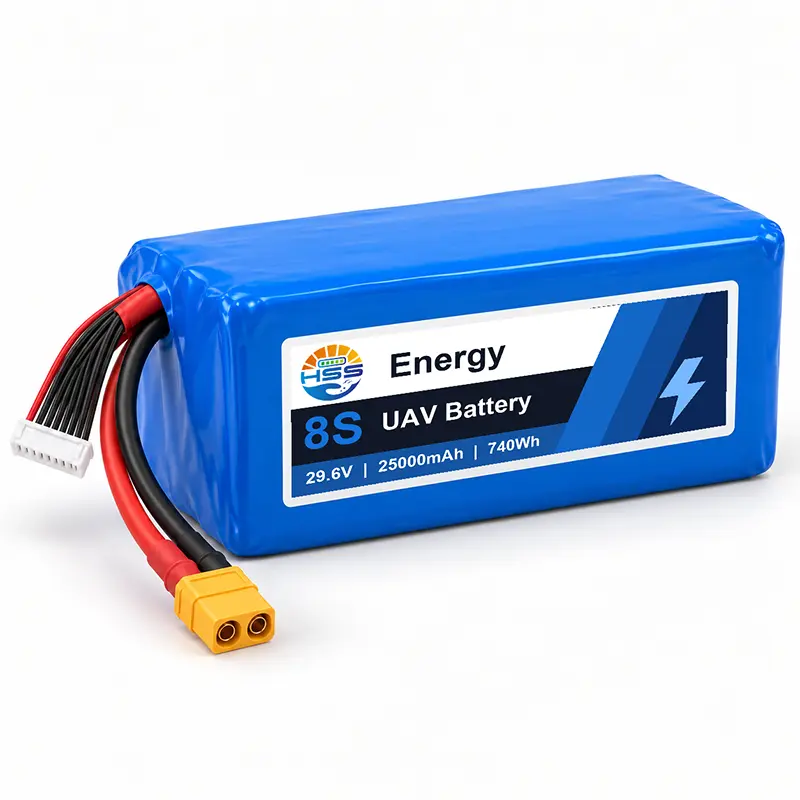
HSS Energy order review for each 8S 25000mAh UAV Battery starts with the aircraft voltage range, load profile and mounting envelope. The pack combines eight series groups with 25Ah capacity. Before integration, confirm the 33.6V charging endpoint, 22.0V discharge limit and external connections against the complete UAV power system.
|
Parameter |
Specified value |
|
Cell designation |
10474172-25000mAh (solid state) |
|
Series configuration |
8S |
|
Nominal capacity |
25000mAh / 25Ah |
|
Nominal voltage |
29.6V |
|
Nominal energy |
740Wh, calculated from 29.6V × 25Ah |
|
Maximum charge current |
25A (1C) |
|
Charge cut-off voltage |
33.6V |
|
Discharge cut-off voltage |
22.0V |
|
Continuous discharge rating |
75A (3C) |
|
Peak discharge rating |
250A (10C) |
|
Cycle-life reference |
1000 cycles |
Check five limits before sample evaluation: 33.6V maximum charging voltage, 75A continuous load, 250A peak rating, a 195 × 90 × 78mm body, and approximately 2650g installed mass. These values define the first compatibility screen; they do not replace aircraft-level review.
Provide the aircraft voltage range, continuous and peak current profile, available battery compartment, cable exit direction, connector and polarity, and charger configuration. These inputs are used to review the proposed sample against the intended aircraft.
Use the 740Wh nominal energy of this 25Ah UAV battery pack as an input to mission planning, not as a direct flight-time promise. Aircraft mass, payload, propulsion efficiency, weather, route and landing reserve determine usable endurance. The approximately 2650g pack mass must also be included in payload and centre-of-gravity calculations.
A 29.6V 25Ah UAV battery reaches 33.6V at charge cut-off. Confirm that motor controllers, power distribution, avionics and auxiliary loads accept the full charged voltage. Set aircraft warnings above the 22.0V pack limit so normal operation does not consume the landing reserve.
The supplied 310Wh/kg value applies to the individual cell, not to the complete battery. Using the supplied 740Wh nominal energy and approximately 2.65kg finished-pack weight gives a calculated pack-level value of about 279Wh/kg. This distinction accounts for insulation, conductors, connectors, wrap and other assembly mass.
The 25Ah solid state UAV battery uses eight series groups. Cell matching should compare capacity, open-circuit voltage and internal resistance before the groups are assembled. Insulation between conductive surfaces, controlled tab joining and strain relief at the cable exit are separate checks; a visual match alone does not establish electrical consistency.
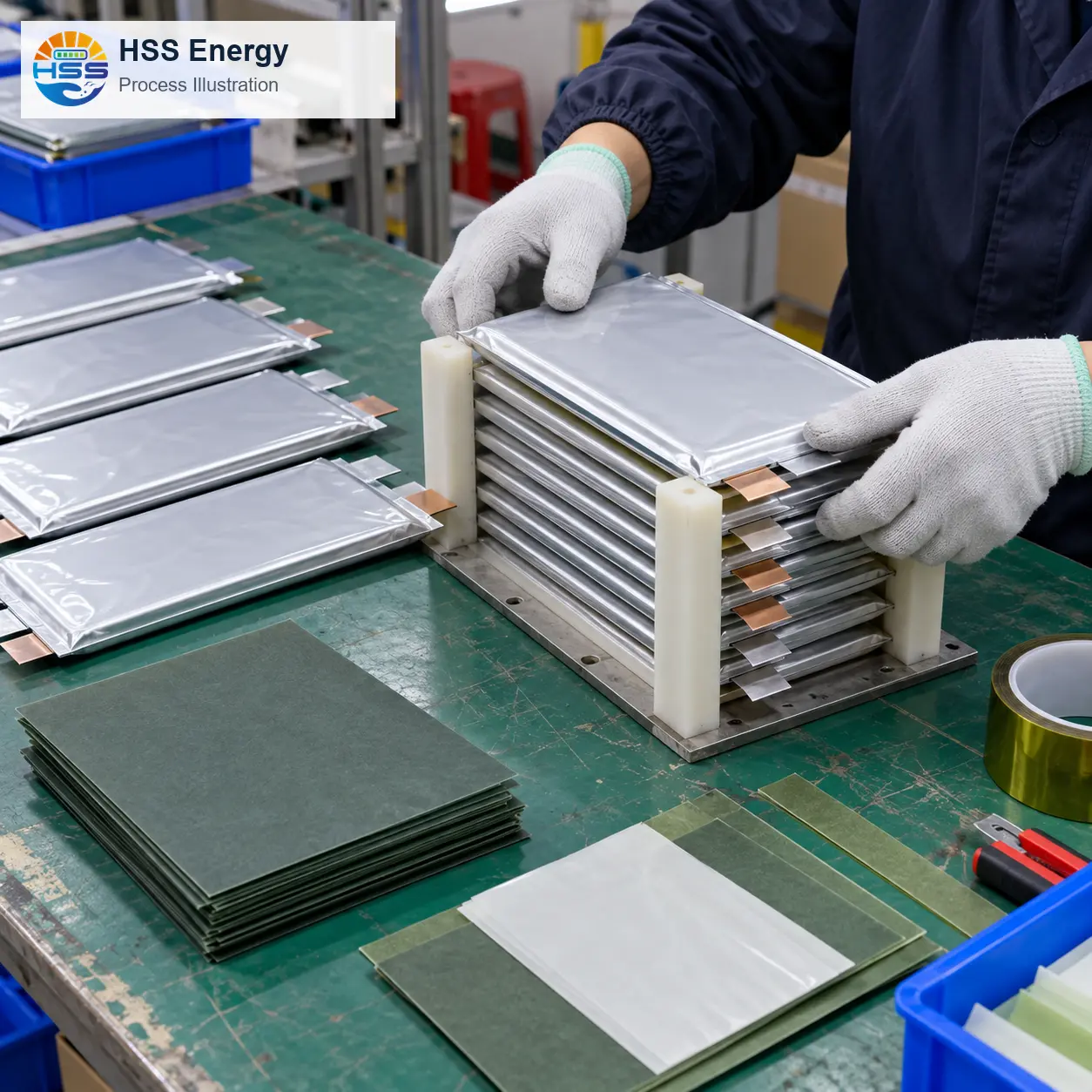
Process illustration • Cell arrangement and insulation preparation
|
Condition |
Specified limit |
|
Working temperature |
-20 to 55°C |
|
Storage temperature |
-20 to 40°C |
|
Storage humidity |
Below 85% RH |
These ranges define supplied product limits; they do not replace an aircraft-level thermal review. Charging equipment, enclosure airflow and the planned duty cycle should be selected for the actual installation and ambient conditions.
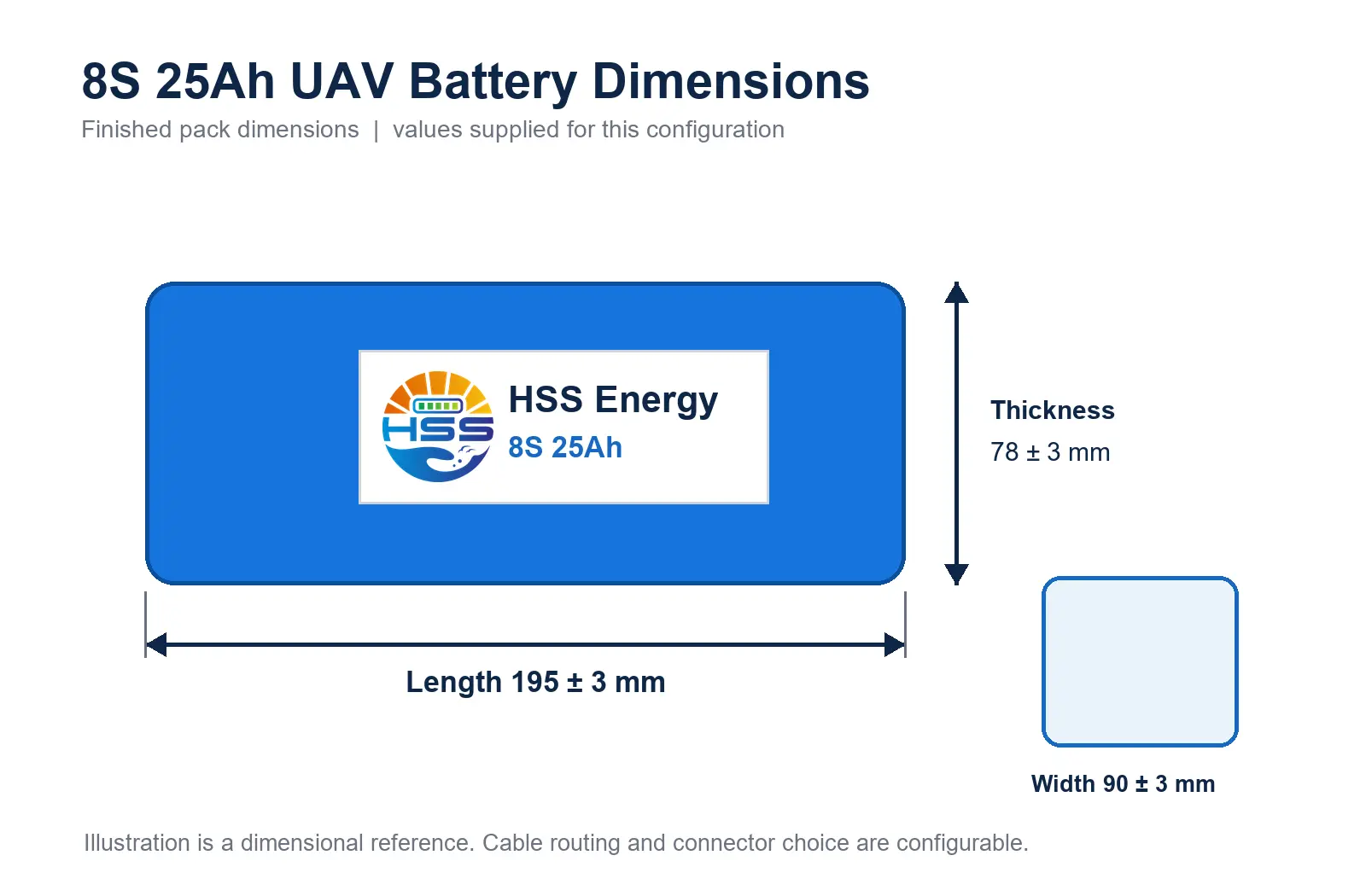
Dimensional illustration • Finished pack body and supplied tolerances
|
Mechanical item |
Specified value |
|
Finished body |
90 ± 3mm × 78 ± 3mm × 195 ± 3mm |
|
Approximate weight |
2650g |
The 8S 25Ah drone battery has a thick rectangular body rather than the flatter profile used by smaller FPV packs. Reserve clearance for manufacturing tolerance, protective cushioning, cable bend radius and connector access. The aircraft tray should support the body directly; the power or balance leads must not carry the pack weight.
|
Optional item |
Reference configuration |
|
Main power lead |
10AWG, 150mm |
|
Power connector |
XT60 |
|
Balance harness |
22AWG, 150mm |
|
Balance connector |
XH-9P (B0-B8) |
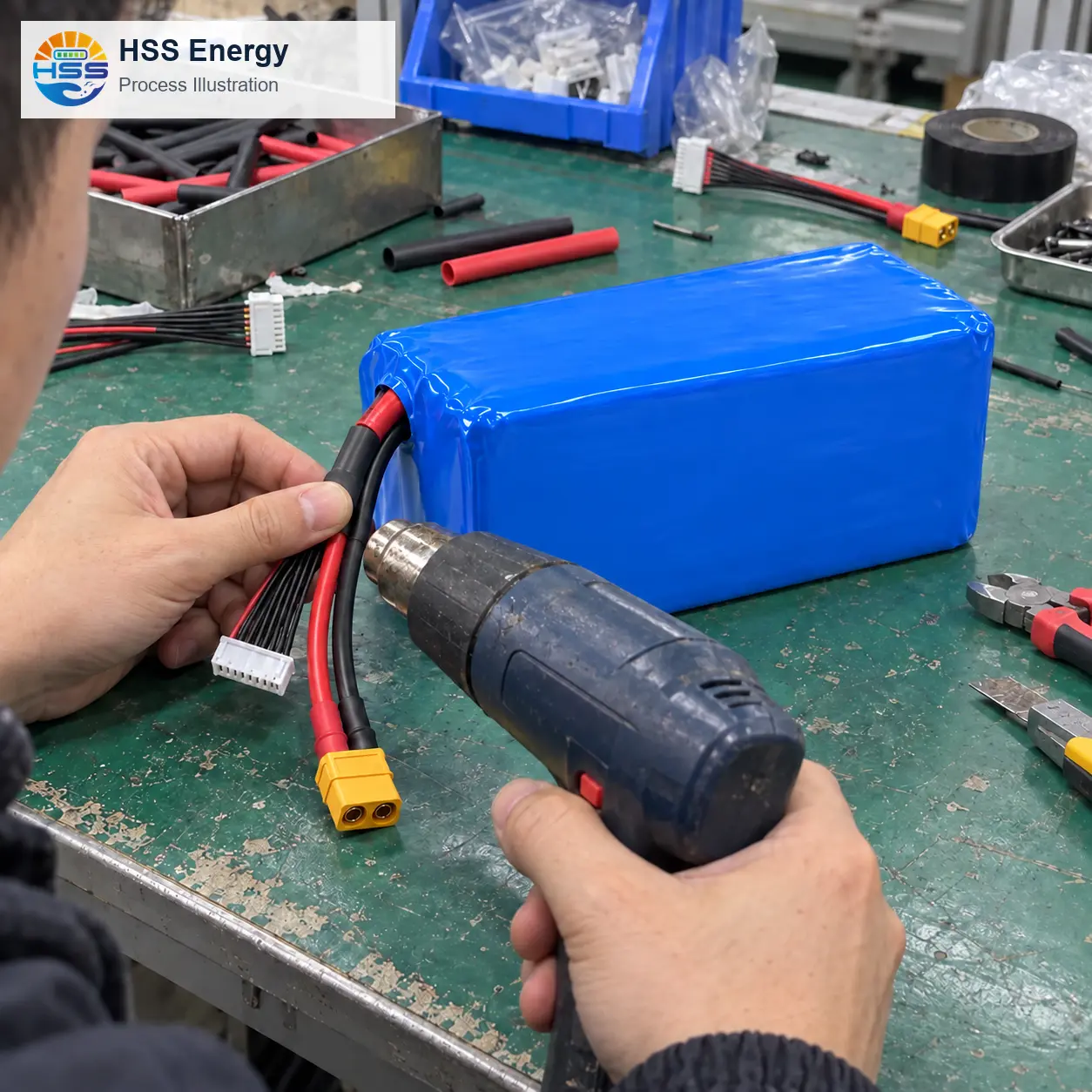
Process illustration • Cable insulation and connector integration
Lead length, wire gauge and connector type may be configured for the approved aircraft interface. Optional reference components do not verify a 75A continuous or 250A peak current path on their own. Review temperature rise, contact resistance, polarity and retention for the complete assembly.
Treat 75A continuous and 250A peak as separate design inputs. Propulsion load, cable routing, cooling and connector arrangement determine installed electrical and thermal limits. Cell C-rate alone does not confirm acceptable whole-aircraft current.
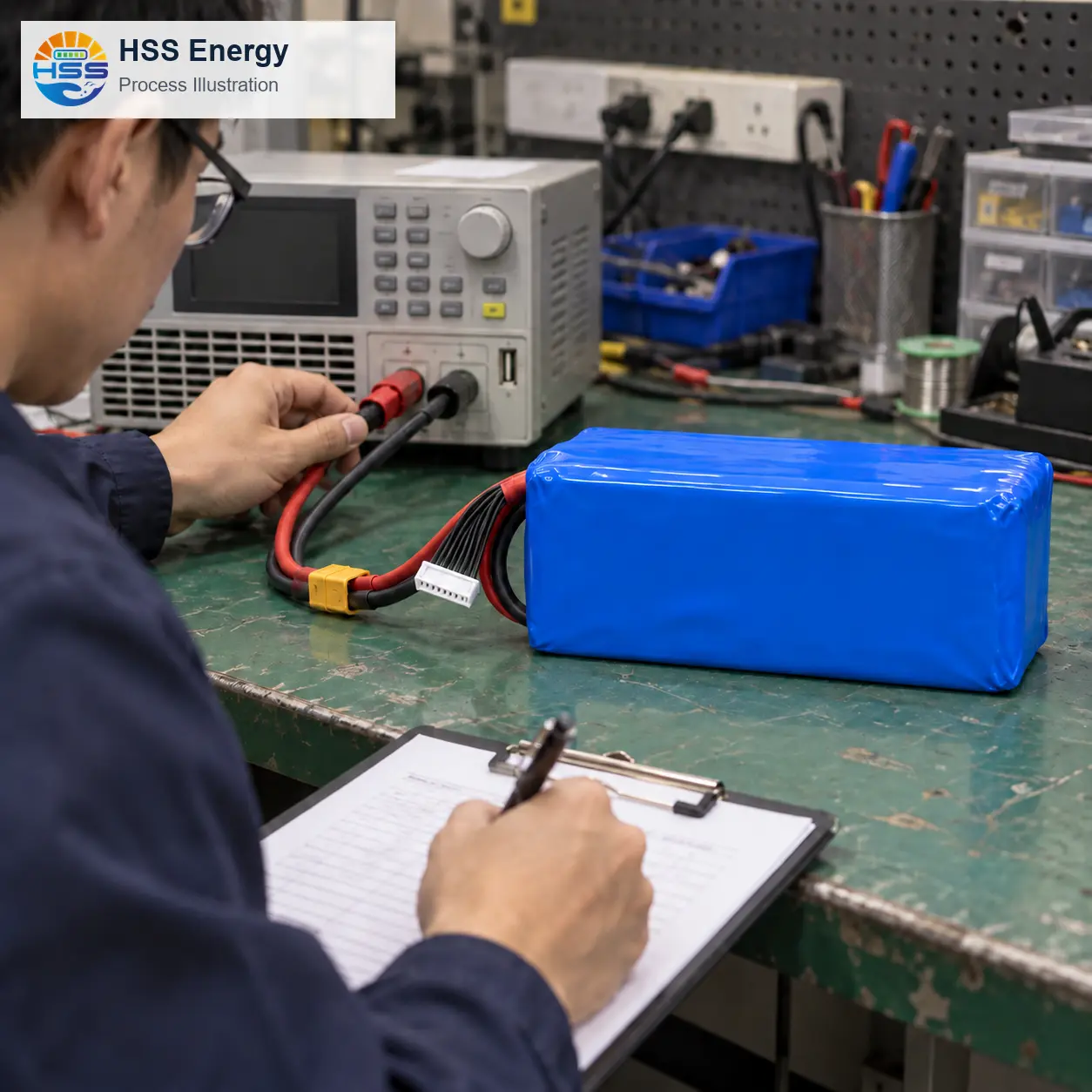
Process illustration • Connected electrical inspection
A cycle review for the 8S 25000mAh UAV Battery should define charge and discharge currents, temperature, rest periods and the retained-capacity endpoint. The supplied 1000-cycle figure is a specification reference; an acceptance record should identify the pack configuration and the procedure used for the measured result.
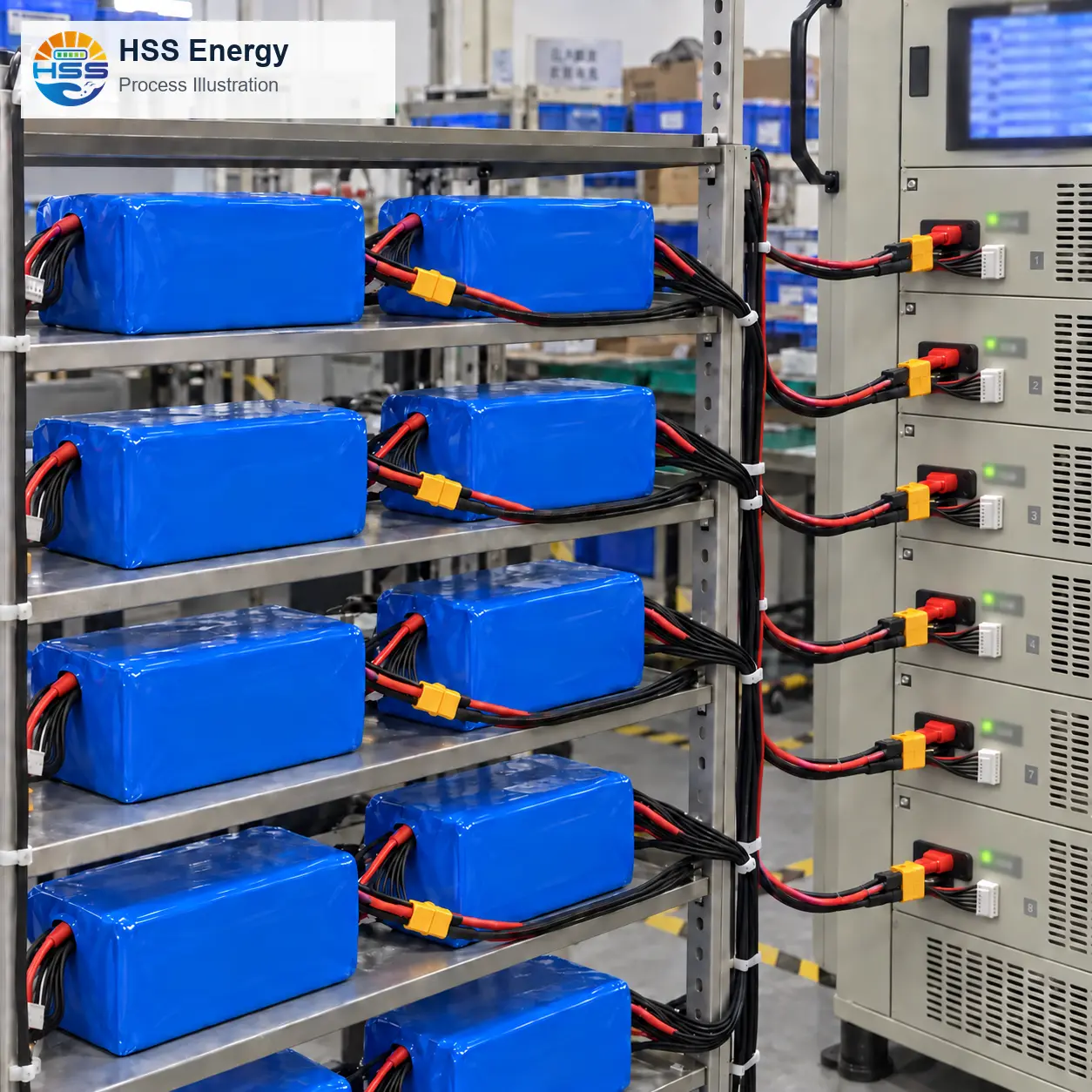
Process illustration • Multi-channel aging connections
In an aging setup, identify each pack's main and balance connections to the same channel. Support cables, separate channels and observe temperature so the setup represents an active test rather than storage.
Packaging for the 25000mAh drone battery is selected after the cable and connector arrangement is approved. The illustration shows an unlabeled pack during foam-fit verification; the HSS label may be applied before final inspection and shipment. Cushion the body directly and keep the protected leads in a separate recess away from the carton closure.
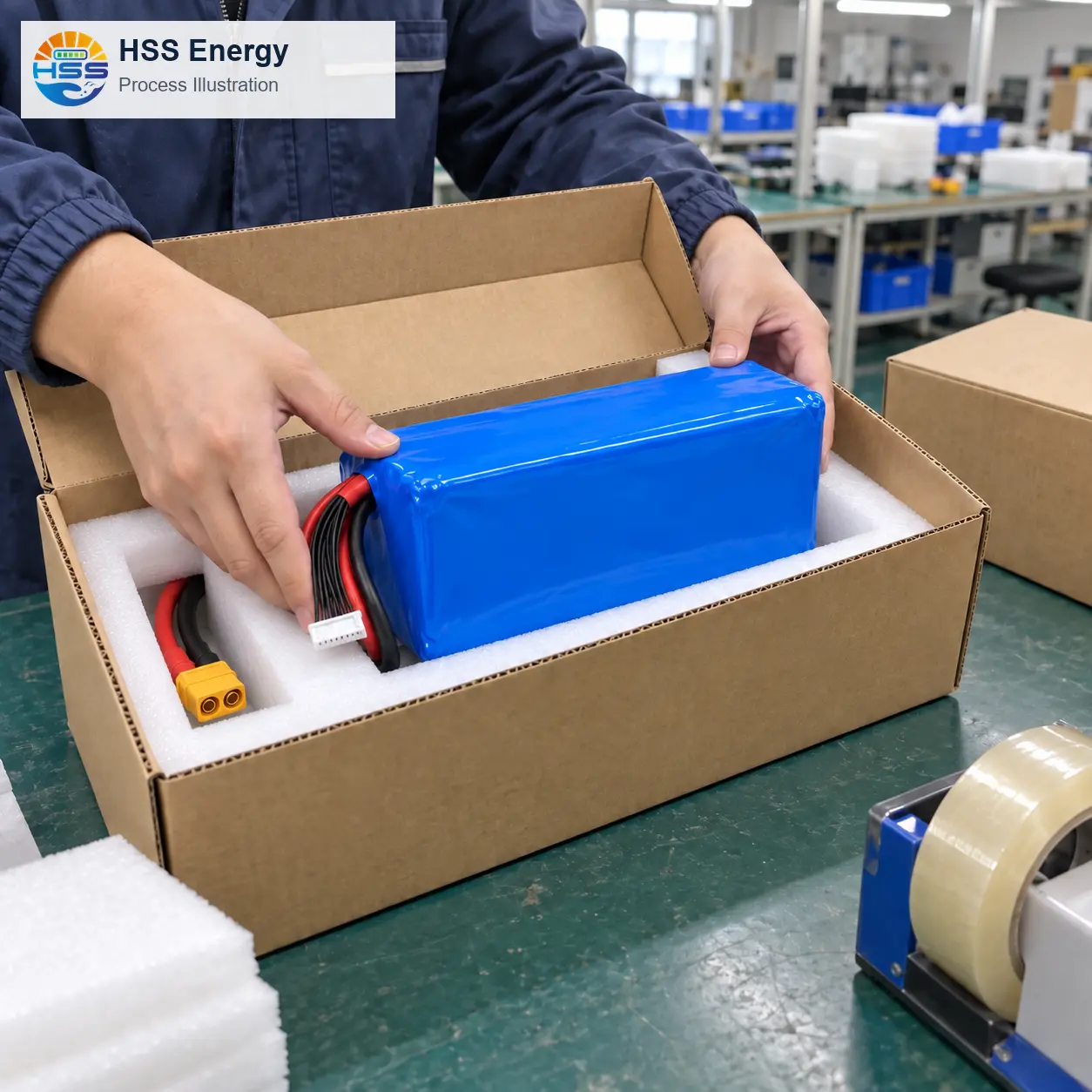
Packaging-fit illustration • Custom foam support and protected cable recess
No. The supplied 310Wh/kg value is identified as the individual-cell energy density. Based on 740Wh and approximately 2650g, the calculated complete-pack value is about 279Wh/kg.
No. Review the cable, connector, contacts, installation and thermal conditions together for the aircraft load profile.
Confirm the charger, voltage range, mounting envelope, cable exit, connector polarity, load profile and acceptance checks. Record the accepted sample configuration before repeat production.
Not as a direct replacement. The aircraft power system, charger and voltage warnings must support 29.6V nominal voltage, 33.6V charge cut-off and 22.0V discharge cut-off before conversion.
Use an 8S charging profile that stops at 33.6V and does not exceed the specified 25A maximum charge current. Confirm the approved balance-harness pinout before connection.
They are defined in the quotation for the approved configuration and destination. Transport documentation and carrier acceptance must correspond to the actual battery and shipping route. Before release of the 8S 25000mAh UAV Battery, record the approved voltage limits, cable and connector arrangement, mounting clearance, charger profile, acceptance checks and packaging method on one configuration sheet.
Address
A3, 1204-1, 1142 Jimei North Avenue, Software Park Phase III, Xiamen Torch High-tech Zone, Xiamen, China
Tel