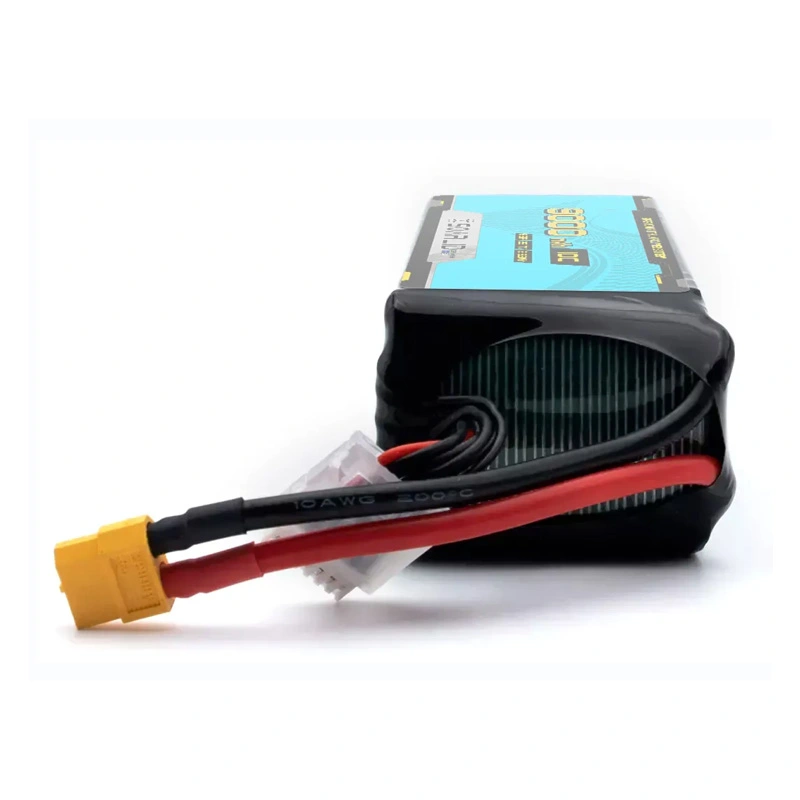
| 213.3Wh Nominal Energy |
Approx. 824g Pack Weight |
300Wh/kg Cell Energy Density |
165 x 71 x 33mm Pack Size |
6S 9000mAh FPV Battery occupies the high energy position in the HSS RC/FPV range. At 9Ah and approximately 824g, it should not be treated as a conventional 5-inch racing pack. Its purpose is to give larger FPV aircraft, custom RC fixed wing platforms, and larger custom multirotors a defined 6S HV energy option when the airframe can accommodate the pack mass, dimensions, connector layout, and approved current limits. Procurement should start with battery-mass allowance, CG, battery-bay dimensions, average and peak current, and charge strategy rather than capacity alone.
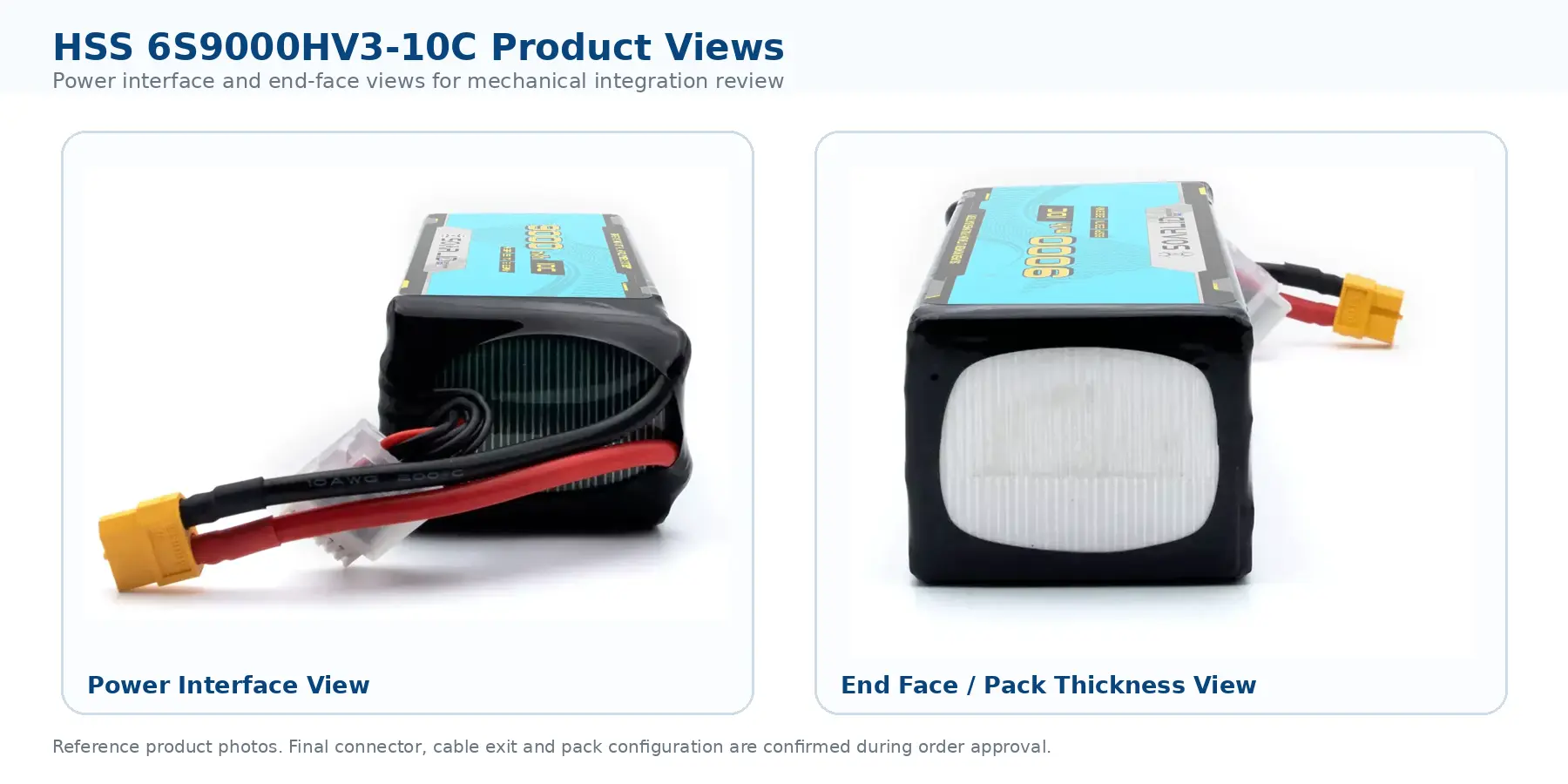
HSS Energy 6S9000HV3-10C power-interface and end-face reference views.
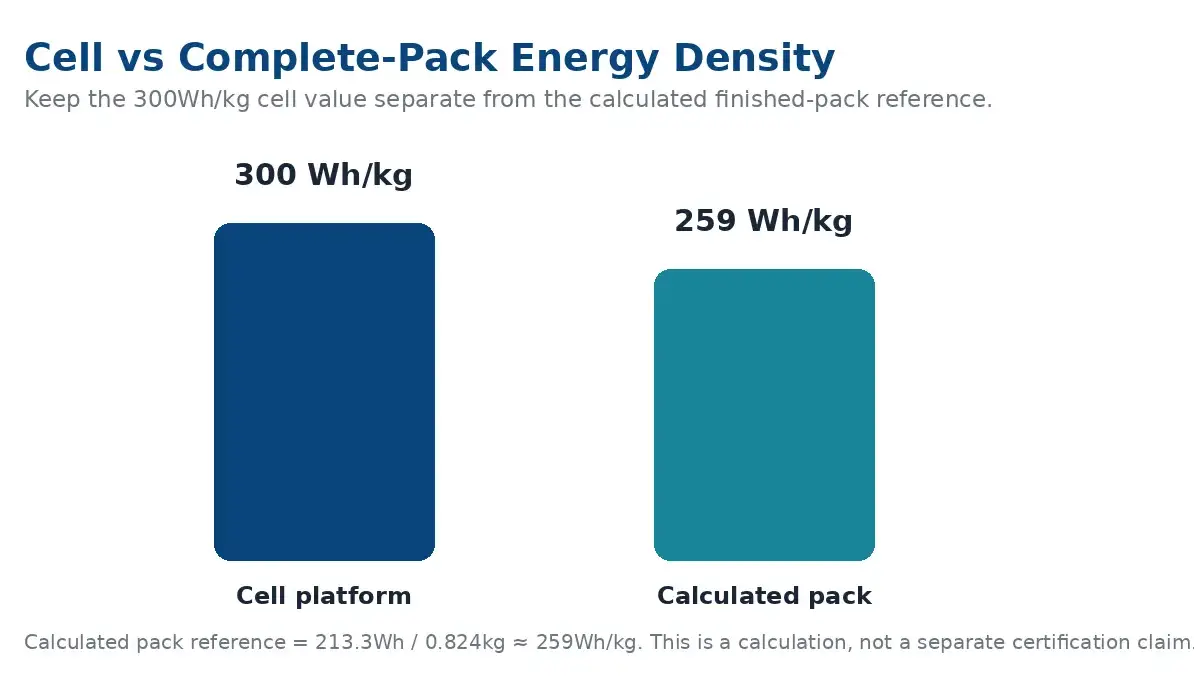
For HSS RC/FPV selection, this 9Ah model is not grouped with compact 5-inch competition packs. For customers comparing a 6S LiPo battery, its verified role is defined by 213.3Wh installed energy, approximately 824g pack weight, a 165 x 71 x 33 mm mechanical envelope, and a 300Wh/kg cell-level energy-density value. The resulting calculated complete pack reference is about 259Wh/kg, so energy-to-weight, battery-bay fit, center of gravity, and the aircraft current profile are more useful selection factors than a racing headline alone.
|
300Wh/kg Cell Energy Density Cell-level value used to define the high-energy platform. |
About 259Wh/kg Complete Pack Reference Calculated from 213.3Wh and approximately 0.824kg finished pack weight. |
213.3Wh Nominal Energy A verified electrical quantity for aircraft-level energy budgeting. |
|
Parameter |
Specification |
|
Product model |
HSS 6S9000HV3-10C |
|
Battery type |
High energy HV lithium polymer battery pack |
|
Configuration |
6S1P |
|
Nominal voltage |
23.7V |
|
Nominal capacity |
9000mAh |
|
Nominal energy |
213.3Wh |
|
Cell energy density |
300Wh/kg (cell-level value) |
|
Calculated pack reference |
About 259Wh/kg (213.3Wh / 0.824kg) |
|
Discharge rate shown on product |
10C |
|
Arithmetic current reference |
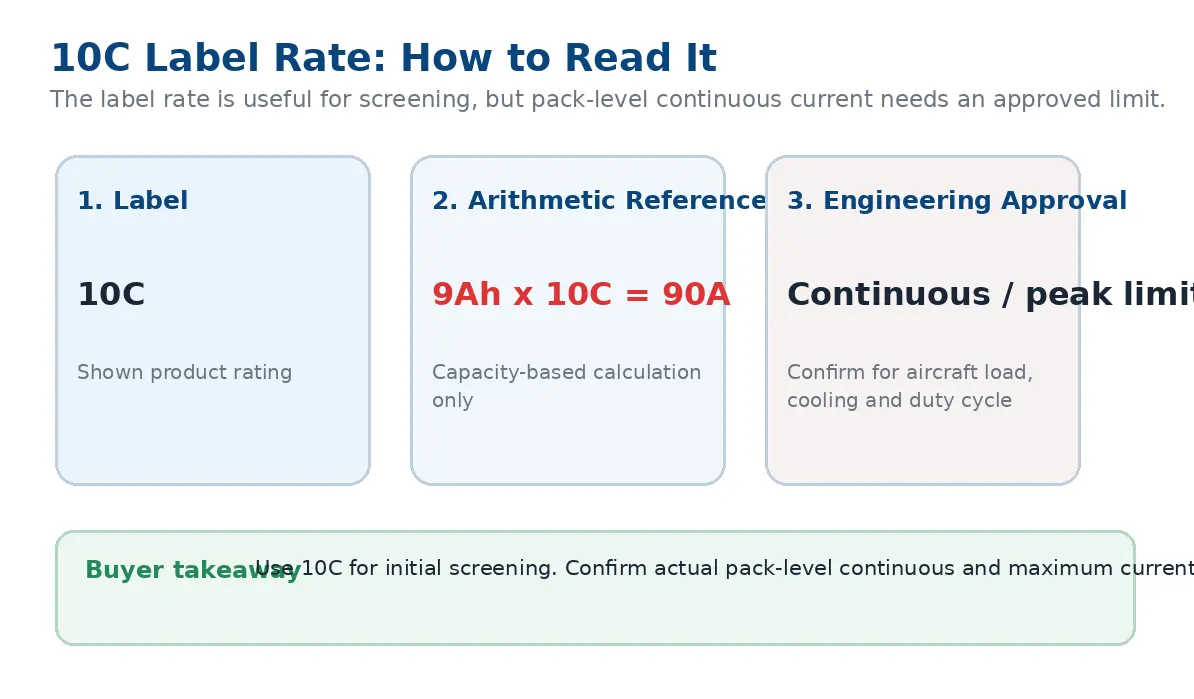
90A (9Ah x 10C); not a verified continuous-current limit |
|
Pack weight |
Approx. 824g |
|
Pack size (L x W x H) |
165 x 71 x 33 mm |
|
Power connector |
XT90 shown on product; final order configuration confirmed before production |
|
Balance connector |
Multi-pin balance connector shown; mating interface confirmed before order approval |
|
Charge method |
Matched 6S HV balance charging; exact charge voltage to be confirmed |
|
Charge profile confirmation |
Use the approved charger profile for the final battery configuration |
|
Cycle-life reference |
Approx. 200-400 cycles; near the end of this range, available capacity typically declines to about 80% of initial rated capacity under specified conditions |
* Cycle-life results vary with charge/discharge rate, depth of discharge, temperature, storage practice, and end-of-life criteria. Use the applicable pack-level test method when available.
This 6S LiHV battery uses 23.7V nominal voltage and 9Ah capacity for 213.3Wh nominal energy. The product label shows 10C. Multiplying 9Ah x 10C gives 90A as an arithmetic reference only; it should not be presented as a verified continuous pack current without applicable finished pack test data. Before sample approval, HSS reviews average current, peak current, cooling, wiring, connector temperature, mission duty cycle, and the approved charge profile.
10C Label Rate
The 90A figure is a capacity-based arithmetic reference. Finished pack continuous and peak limits require applicable approval.
23.7V 6S HV Architecture
Use a matched HV balance-charge workflow and confirm the approved charge profile for the final configuration.
For a high voltage LiPo battery in this mass class, the engineering question is not simply the C-rate on the label. customers should confirm whether the aircraft current profile stays within the approved pack limits and whether the lead, connector, cable routing, mounting method, and cooling remain appropriate under the intended duty cycle.
This 6S FPV battery is intended for evaluation on airframes that can accommodate an approximately 824g battery and a 165 x 71 x 33 mm package. For an FPV drone battery project, fixed wing or custom multirotor developers should review battery-bay geometry, center of gravity, takeoff weight limit, average and peak current, connector location, and charger strategy before selecting the pack. It is not positioned as a drop-in standard 5-inch racing battery, and it should not be assumed to fit every 7-inch or 10-inch long-range platform without airframe-level confirmation.
HSS Energy supports requirement review, connector and cable confirmation, sample evaluation, drawing approval, and production release. The workshop images below show an organized production environment and aging / quality-control workflow. Final electrical limits, charger profile, connector configuration, and acceptance criteria are confirmed for the approved order.
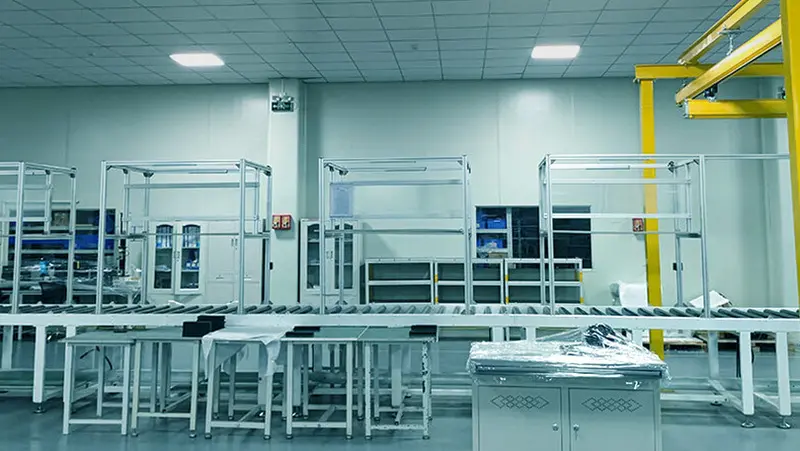
Standardized Workshop
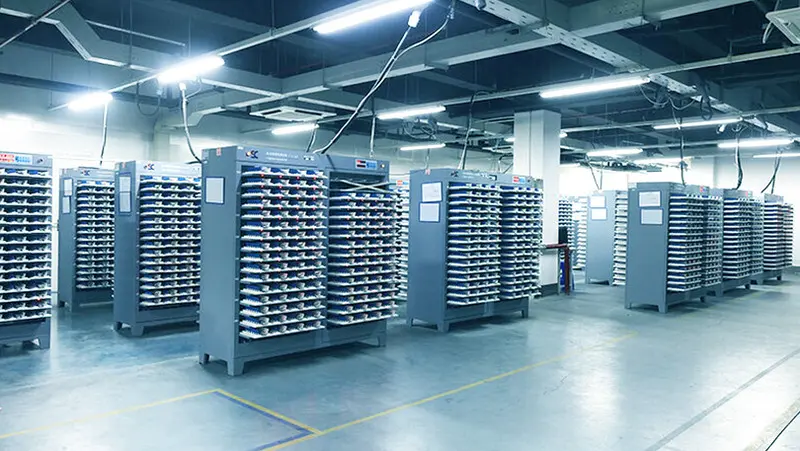
Aging / Quality Control
|
Is this battery intended for standard 5-inch FPV racing drones? No. At approximately 824g and 165 x 71 x 33 mm, it is positioned for larger-format or custom 6S aircraft rather than compact 5-inch racing quadcopters. |
|
What does the 10C rating mean? 10C is the rate shown on the product. For 9Ah, 9Ah x 10C equals 90A as an arithmetic reference. Confirm approved continuous and peak pack-current limits for the aircraft load and duty cycle. |
|
Does 300Wh/kg describe the complete battery pack? No. 300Wh/kg is the cell-level energy-density value. Using 213.3Wh and approximately 824g, the calculated complete pack reference is about 259Wh/kg. |
|
What should be checked before fitting this battery to an aircraft? Confirm battery-bay clearance, battery-mass limit, center of gravity, mounting direction, cable exit, connector access, average and peak current, and charger strategy. |
|
What charger should be used? Use a matched 6S HV balance charger with the approved charge profile for the final battery configuration. Do not assume a standard 6S charge cutoff without confirmation. |
Send your aircraft model, current profile, battery-mass limit, bay dimensions, CG / mounting constraints, connector, charger strategy, and sample quantity for review.
Address
A3, 1204-1, 1142 Jimei North Avenue, Software Park Phase III, Xiamen Torch High-tech Zone, Xiamen, China
Tel