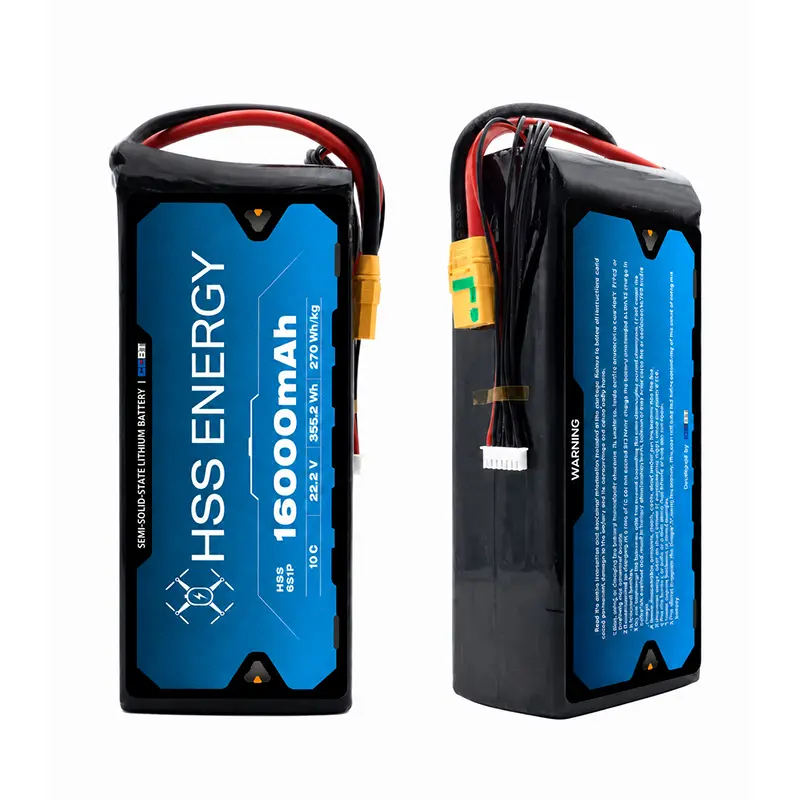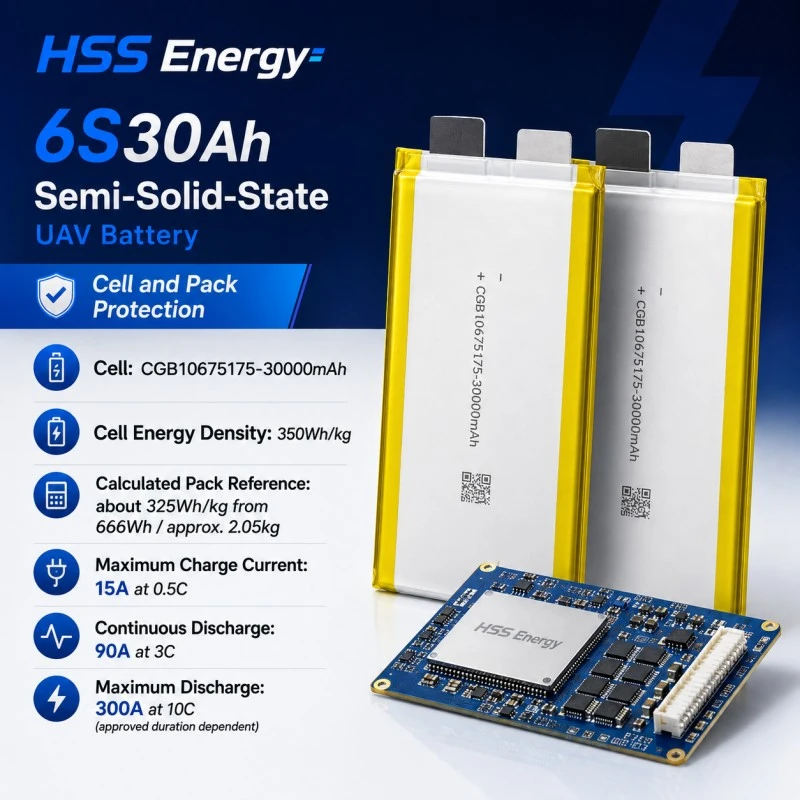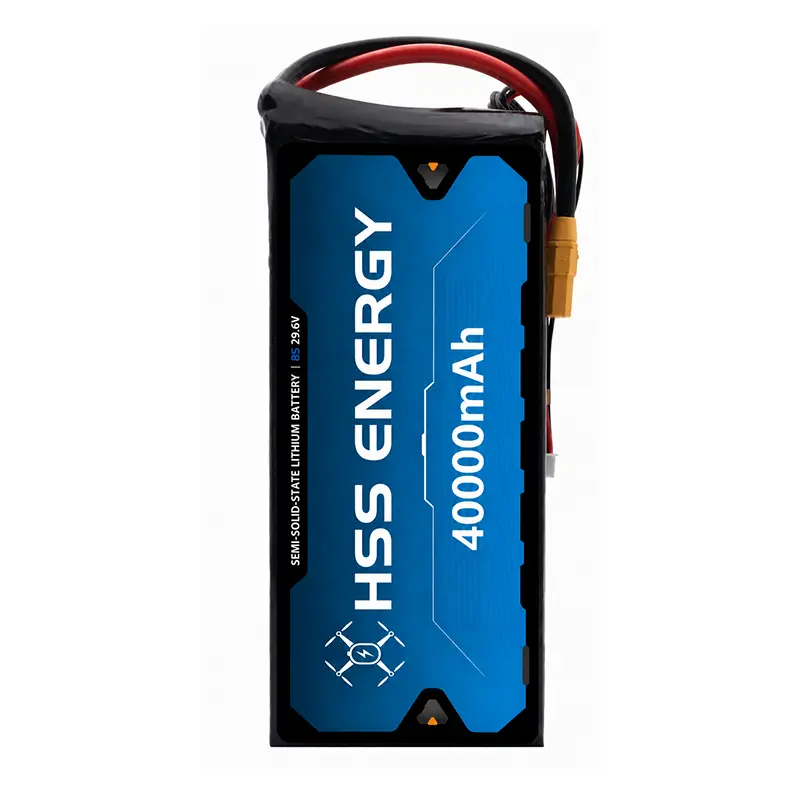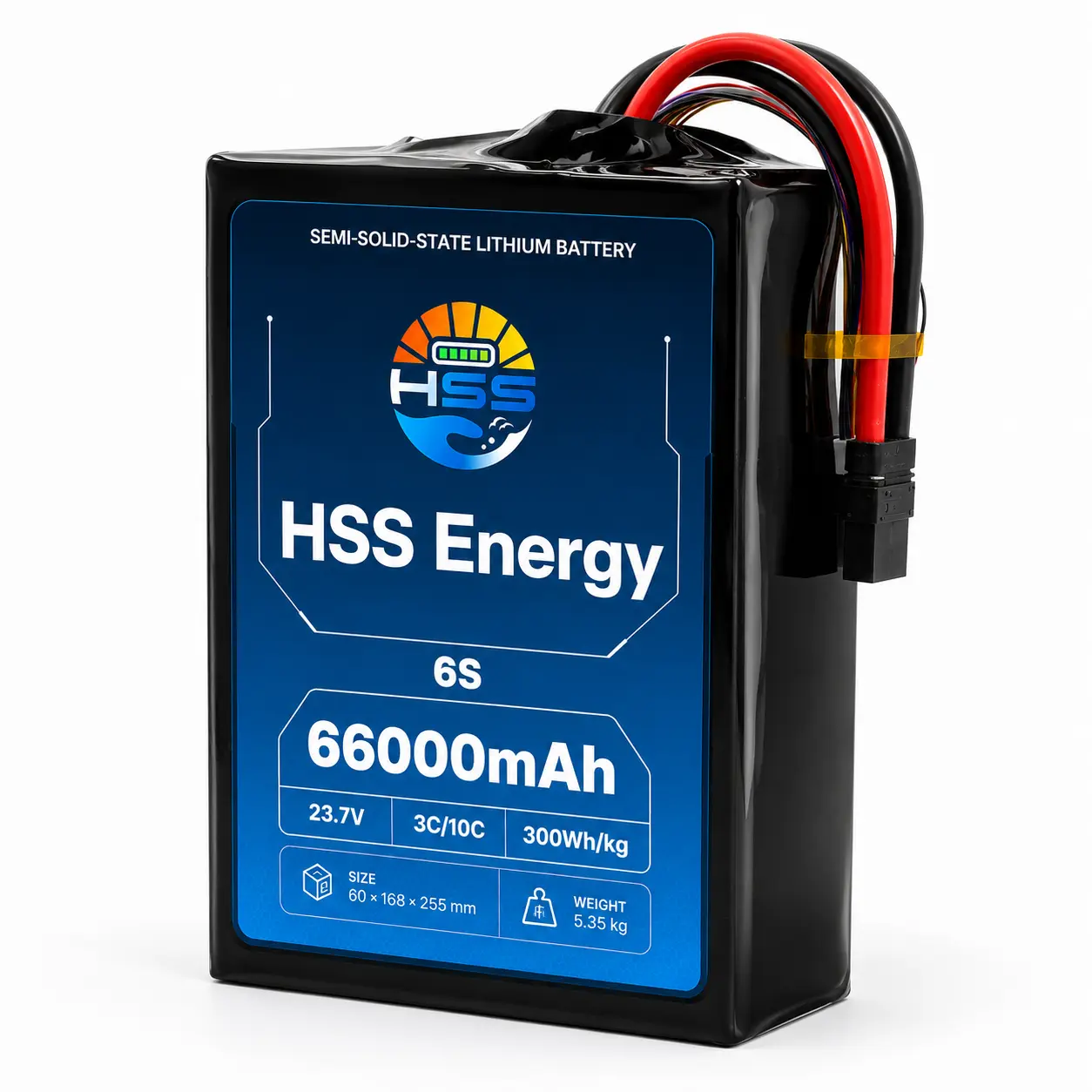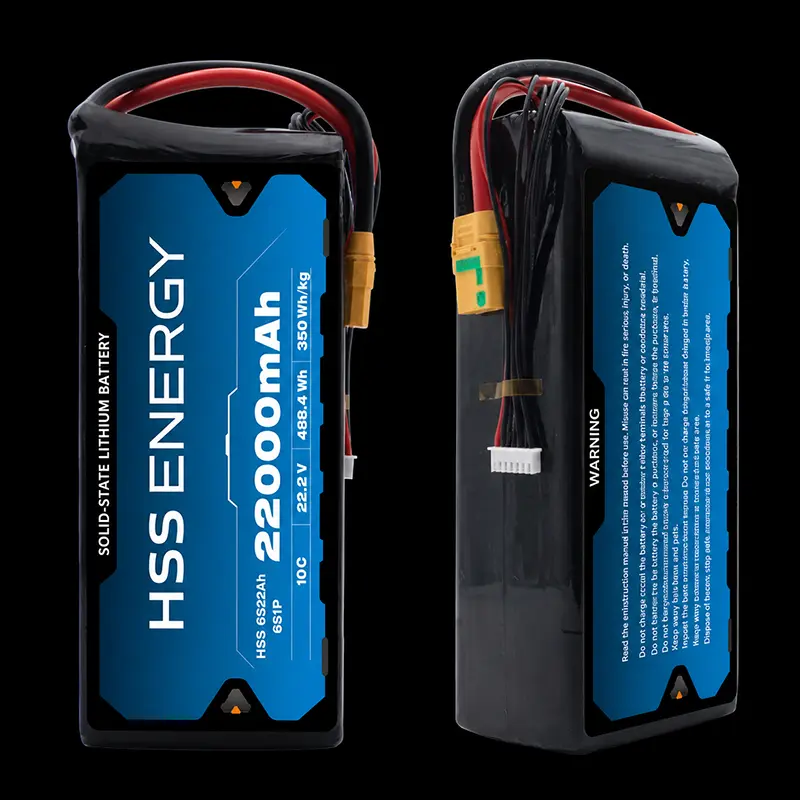
The 6S 22000mAh UAV Battery by HSS Energy is positioned as the narrow-envelope, high-energy bridge SKU within the current HSS 6S family. Its 488.4Wh nominal energy is 133.2Wh above the 16Ah platform while finished mass increases by approximately 140g and pack width increases from 50mm to 55mm; thickness and height remain in the same 78 x 195mm class.
The 350Wh/kg figure applies to the individual cell platform. Using 488.4Wh nominal pack energy and approximately 1.62kg finished-pack mass gives about 301Wh/kg as a calculated complete-pack reference. This distinction is kept explicit so aircraft designers can evaluate energy, mass, sustained current and installation space without confusing cell-level and pack-level values.
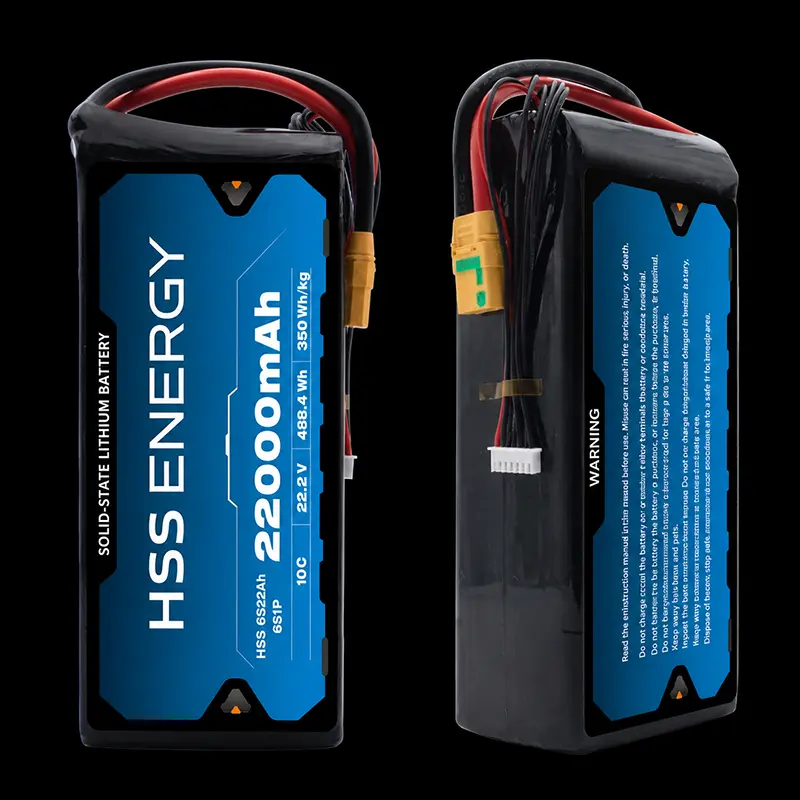
HSS Energy HSS 6S22Ah front and side product views.
|
Parameter |
Specification |
|
Product model |
HSS 6S22Ah |
|
Battery type |
Solid-state lithium battery |
|
Configuration |
6S1P; cell reference CGB8575175-22000mAh |
|
Nominal voltage |
22.2V |
|
Nominal capacity |
22000mAh / 22Ah |
|
Nominal energy |
488.4Wh |
|
Cell energy density |
350Wh/kg individual-cell value |
|
Maximum charge current |
11A at 0.5C |
|
Charge cutoff voltage |
25.5V |
|
Discharge cutoff voltage |
15.0V |
|
Continuous discharge |
66A at 3C |
|
Maximum discharge |
220A at 10C; applicable duration follows the approved configuration |
|
Cycle life reference |
Approx. 200-400 cycles; around the end of this range, available capacity typically declines to about 80% of initial rated capacity under specified conditions |
|
Working temperature |
-20°C to 55°C |
|
Storage conditions |
-20°C to 40°C; below 85% RH |
|
Dimensions (W x T x H) |
55 x 78 x 195mm; tolerance +/-5mm |
|
Weight |
approximately 1620g |
Actual cycle-life results vary with charge and discharge rate, depth of discharge, temperature, storage practice and the selected end-of-life criterion. Use the acceptance conditions defined for the approved HSS 6S22Ah configuration.
|
Interface |
Reference Configuration |
||
|
Power lead |
10AWG, 150mm, optional |
||
|
Power connector |
XT90, optional |
||
|
Balance harness |
22AWG, 150mm, optional |
||
|
Balance connector |
XH-7P for B0-B6, optional |
The 6s 22000mAh drone battery is not positioned as a smaller copy of the 30Ah model or a larger copy of the 16Ah model. Its role is to give customers a mid-capacity 6S option that raises installed energy while keeping the pack within a narrow 55mm width. The table below is HSS selection guidance for product-family screening, not an automatic aircraft-compatibility statement.
|
Selection Point |
6S16Ah |
6S22Ah |
6S30Ah |
6S40Ah High Energy |
|
Nominal energy |
355.2Wh |
488.4Wh |
666Wh |
888Wh |
|
Approx. pack mass |
1.48kg |
1.62kg |
2.05kg |
2.35kg |
|
Continuous current |
48A |
66A |
90A |
80A |
|
Cell energy density |
270Wh/kg |
350Wh/kg |
350Wh/kg |
400Wh/kg |
|
Calculated pack ref. |
~240Wh/kg |
~301Wh/kg |
~325Wh/kg |
~378Wh/kg |
|
Pack envelope |
50 x 78 x 195 |
55 x 78 x 195 |
68 x 78 x 195 |
70 x 90 x 205 |
|
Matrix role |
Compact 6S |
Mid-capacity high energy |
Higher-current 6S |
High installed energy |
Why the 22Ah slot matters: compared with HSS 6S16Ah, nominal energy increases by 37.5% while approximate pack mass increases by about 9.5% and width by 5mm. Compared with HSS 6S30Ah, the 22Ah pack is approximately 430g lighter and 13mm narrower, while the 30Ah platform offers more installed energy and higher continuous current. This creates a clear selection step before moving into larger 30Ah / 40Ah architectures. That positioning makes HSS 6S22Ah a high energy density UAV battery option for teams that need a clear step above 16Ah without moving directly to the wider 30Ah class.
|
Choose 16Ah when Compact mass and the narrowest HSS 6S envelope are the first screening priorities. |
Choose 22Ah when You need a mid-capacity high-energy step without moving directly to the wider 30Ah class. |
|
Choose 30Ah when Higher installed energy and 90A continuous current justify the added mass and width. |
Choose 40Ah High Energy when Maximum installed energy and complete-pack specific-energy positioning are the main product-family priorities. |
For a 22.2V 22Ah drone battery, aircraft fit should be screened from the complete pack outward: 55 x 78 x 195mm envelope, approximately 1620g mass, cable exit, connector access, restraint and center-of-gravity location. The 22Ah platform keeps the same 78mm thickness and 195mm height class as HSS 6S16Ah while adding only 5mm of nominal width.
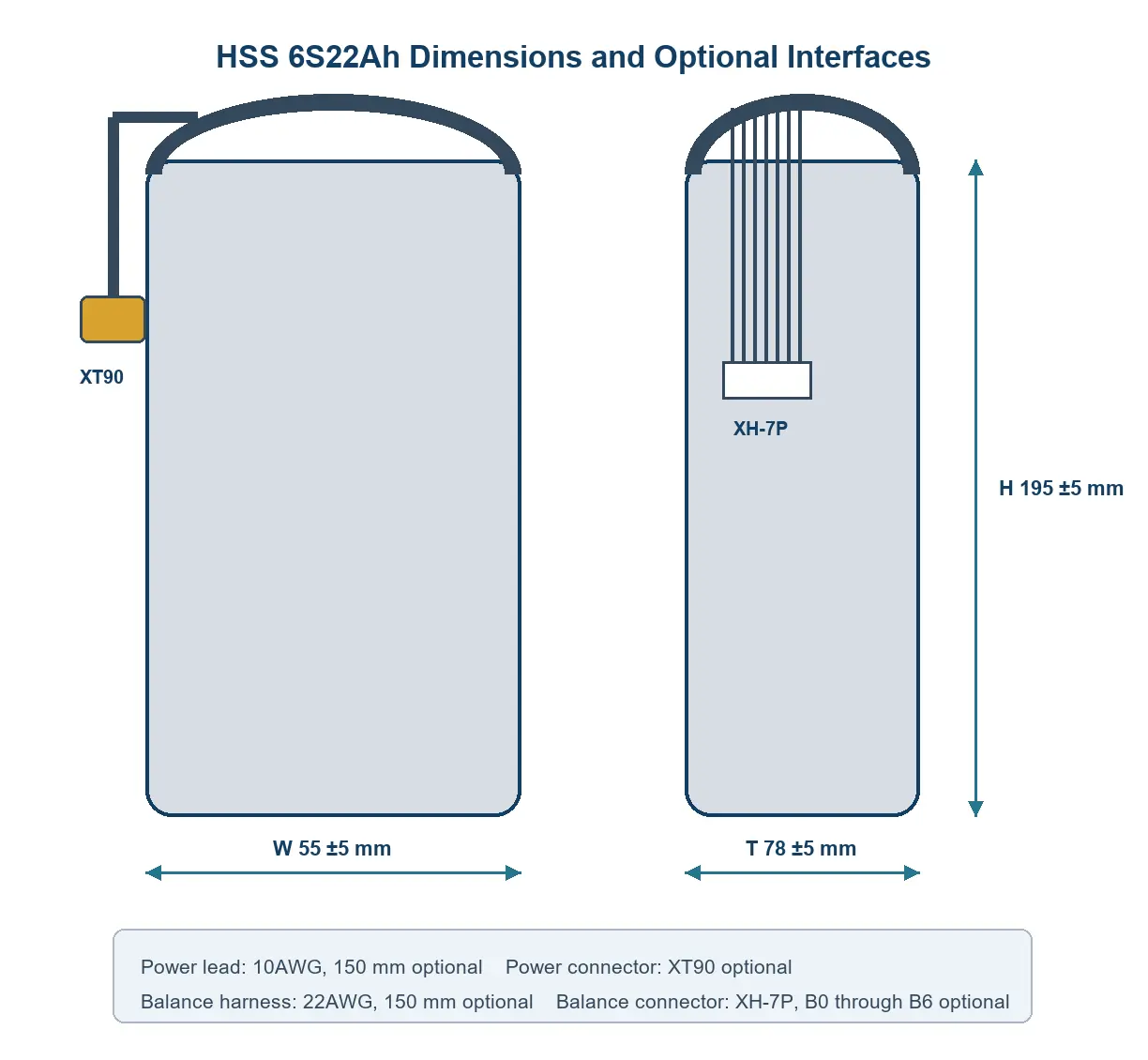
HSS 6S22Ah dimensional and optional-interface reference.
|
66A continuous at 3C Use measured steady aircraft current for sustained-load screening. |
220A maximum at 10C This is not the continuous rating. Applicable duration follows the approved configuration and operating conditions. |
|
11A maximum charge Specified at 0.5C with a 25.5V charge cutoff. |
15.0V discharge cutoff Coordinate aircraft alarms, reserve policy and landing strategy with the approved configuration. |
For customers comparing a 6S solid state battery within the HSS 6S family, this SKU is strongest when the design question is not simply maximum capacity. It is intended for project-level evaluation where a medium custom multirotor or professional observation / camera platform needs more nominal energy than the compact 16Ah class but still benefits from a narrower and lighter pack than the 30Ah / 40Ah alternatives.
|
Primary: Medium Custom 6S Multirotor Suitable for engineering evaluation where the aircraft supports the 22.2V platform and the 55 x 78 x 195mm battery envelope. |
Secondary: Professional Observation / Camera UAV Useful when battery mass, bay width and sustained current must be balanced with sensor or camera integration. |
|
Secondary: OEM Prototype Aircraft A practical selection point for prototype programs that need a defined 6S energy/current envelope before committing to a larger battery class. |
Not a universal drop-in replacement Proprietary smart-battery aircraft may require communication, enclosure, locking and charger functions not provided by this reference configuration. |
Provide nominal and maximum aircraft voltage, measured average current, peak current and duration, battery-bay drawing, maximum battery mass, center-of-gravity constraint, connector, cable direction, charger profile, operating temperature and sample quantity. HSS Energy uses these inputs to determine whether the 22Ah configuration should proceed to sample evaluation or whether another 6S matrix position is more appropriate.
|
Move down to 16Ah Use the compact 16Ah slot when battery mass or 50mm pack width is the dominant design constraint. |
Move up to 30Ah Use the 30Ah slot when 666Wh nominal energy or 90A continuous current better matches the aircraft requirement. |
||
|
Move to 40Ah High Energy Use the larger 40Ah high-energy slot when installed energy and pack specific-energy positioning take priority over the smaller 22Ah envelope. |
Move to an 8S platform If propulsion and charger architecture are designed for 8S, select an HSS 8S matrix position rather than forcing a 6S battery into the project. |
Repeat production for a 22.2V 22000mAh UAV battery is not only a specification decision; OEM customers also need confidence in manufacturing organization and process visibility. HSS Energy uses organized production areas and dedicated battery-processing equipment to support cell / pack manufacturing workflow, in-process control and sample-to-production handoff. Exact process settings and model-specific acceptance criteria are defined for the approved configuration.
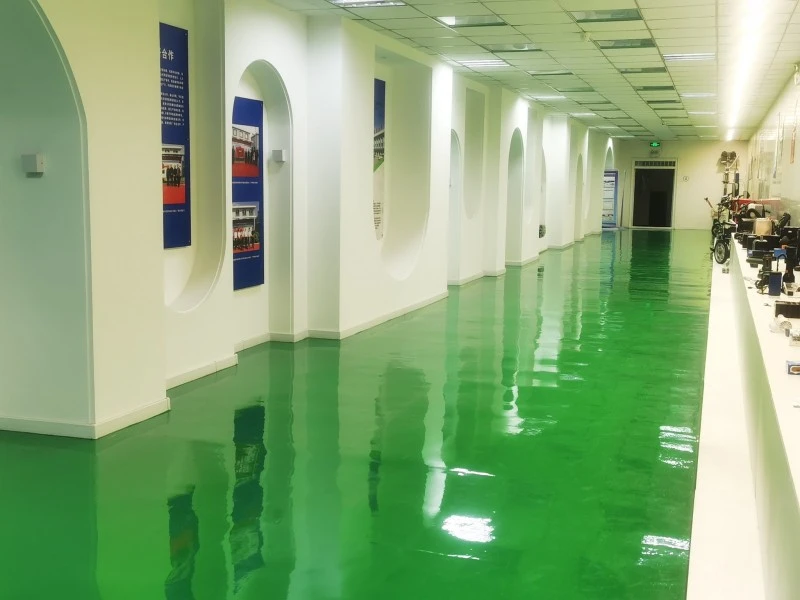
Organized production area used as workshop-environment evidence.
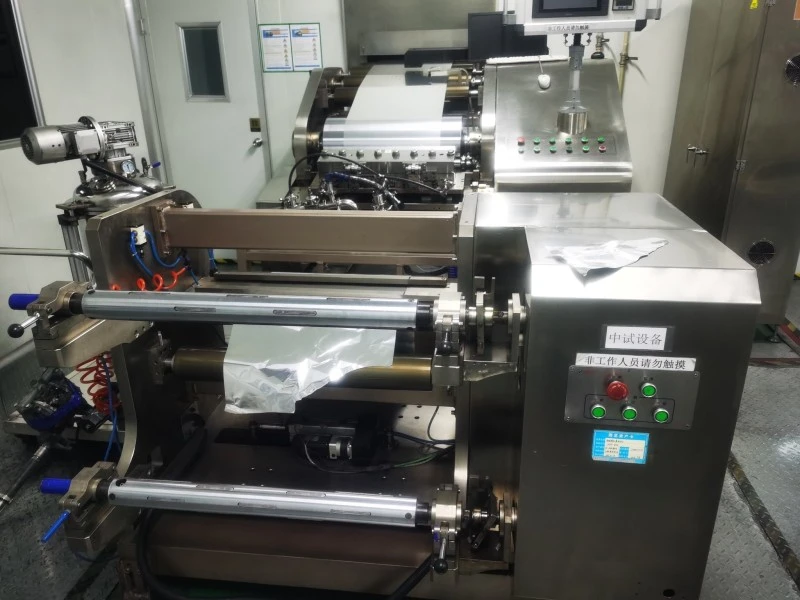
Sheet-processing equipment within the battery production workflow.
The HSS 6S22Ah is released through an engineering review rather than by capacity label alone. The selection process keeps electrical limits, mechanical interfaces and sample acceptance aligned before volume production.
|
1 Select Matrix Slot |
2 Freeze Interfaces |
3 Evaluate Sample |
4 Approve Order Drawing |
This process helps customers compare the 16Ah / 22Ah / 30Ah / 40Ah family on a common engineering basis while keeping each ordered pack tied to its own approved drawing, cable arrangement and operating limits.
It is the mid-capacity high-energy 6S option between the compact 16Ah platform and the larger 30Ah / 40Ah classes. The selection role is based on verified energy, mass, current and mechanical-envelope differences; final aircraft compatibility still requires engineering review.
No. 350Wh/kg is the individual-cell energy-density value. Based on 488.4Wh nominal energy and approximately 1.62kg finished-pack mass, the calculated complete-pack reference is about 301Wh/kg.
No. Continuous discharge is 66A at 3C. The 220A value is the 10C maximum-discharge rating, and its applicable duration depends on the approved configuration and operating conditions.
Maximum charge current is 11A at 0.5C with a 25.5V charge cutoff. Use the charger profile and balance connection approved for the ordered 6S configuration.
The reference configuration includes an optional XT90 power connector and 10AWG 150mm power lead. Connector, cable length, polarity and exit direction can be reviewed and frozen on the approved order drawing.
Not automatically. A proprietary aircraft may require communication, locking, monitoring, enclosure or charging functions beyond voltage and capacity. Provide the aircraft battery interface and charger details for compatibility review.
Send the aircraft model or project type, voltage range, average and peak current, peak duration, battery-bay drawing, maximum battery mass, connector, charger, operating temperature, sample quantity and destination.
Send HSS Energy your aircraft requirements and battery-bay drawing. We will review whether HSS 6S22Ah is the appropriate matrix position and prepare the configuration details needed for sampling and quotation.
Address
A3, 1204-1, 1142 Jimei North Avenue, Software Park Phase III, Xiamen Torch High-tech Zone, Xiamen, China
Tel