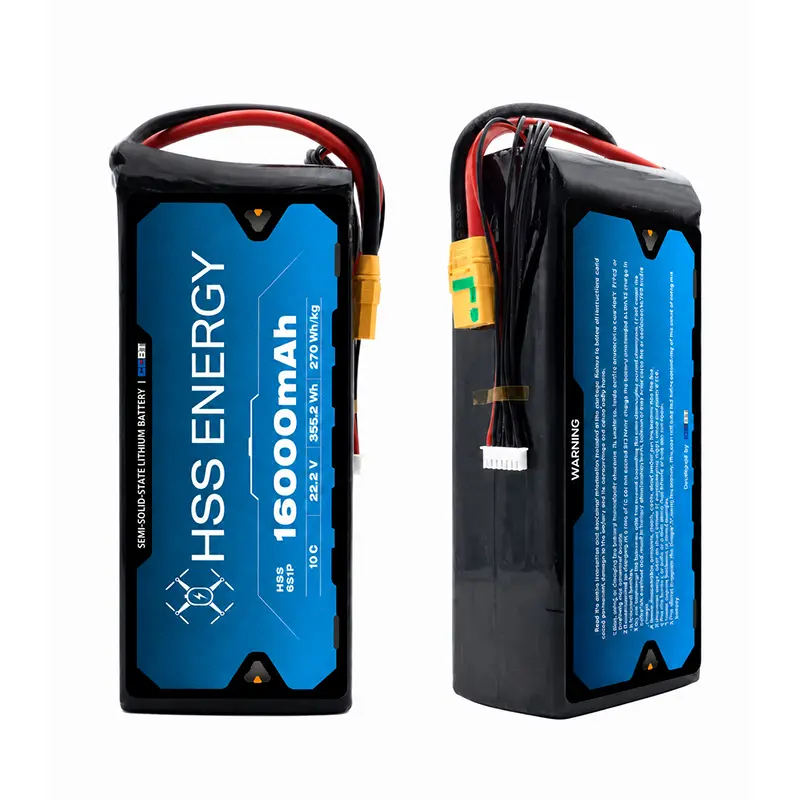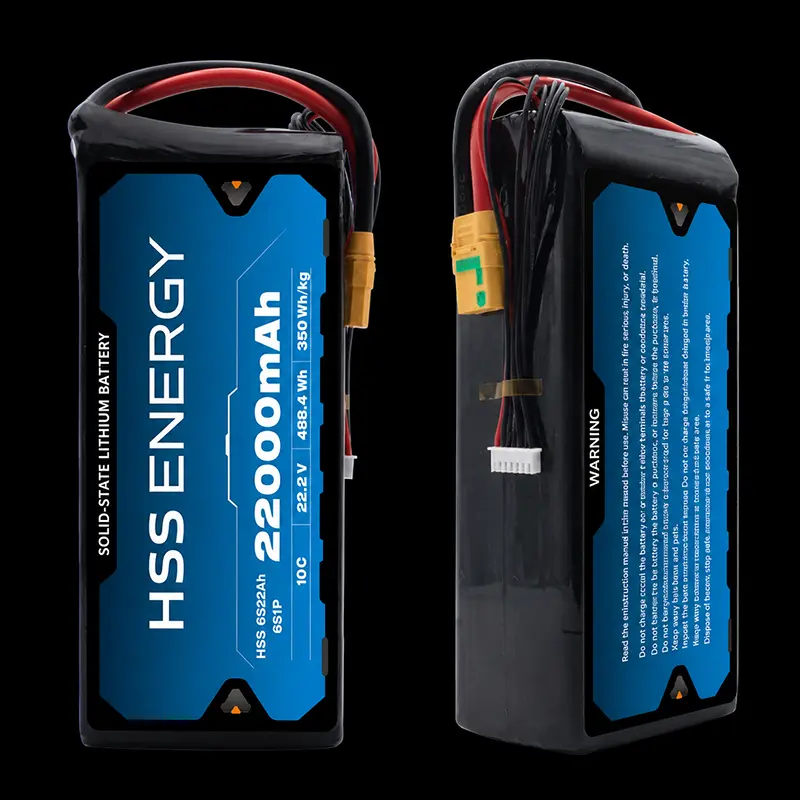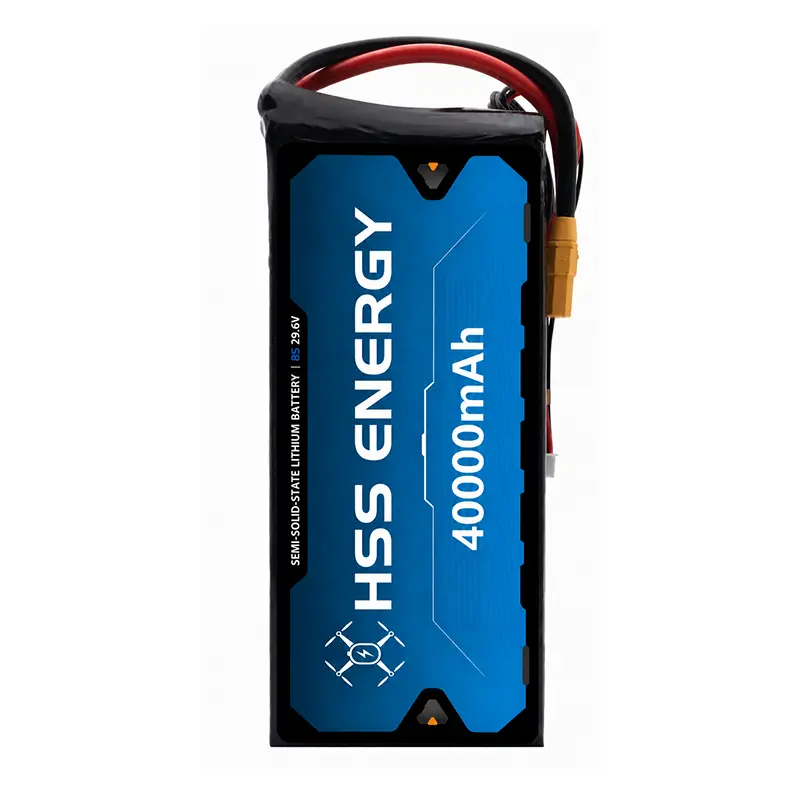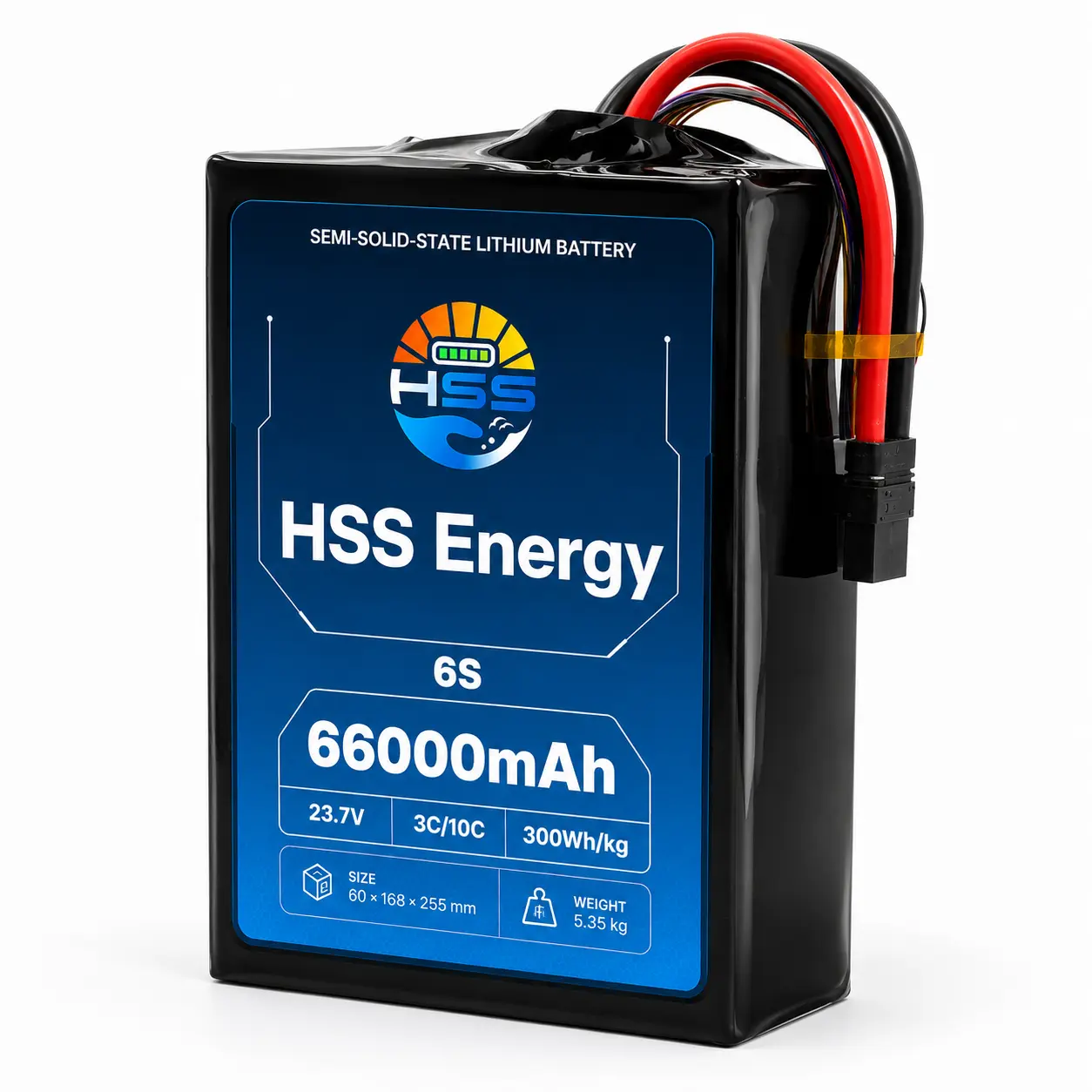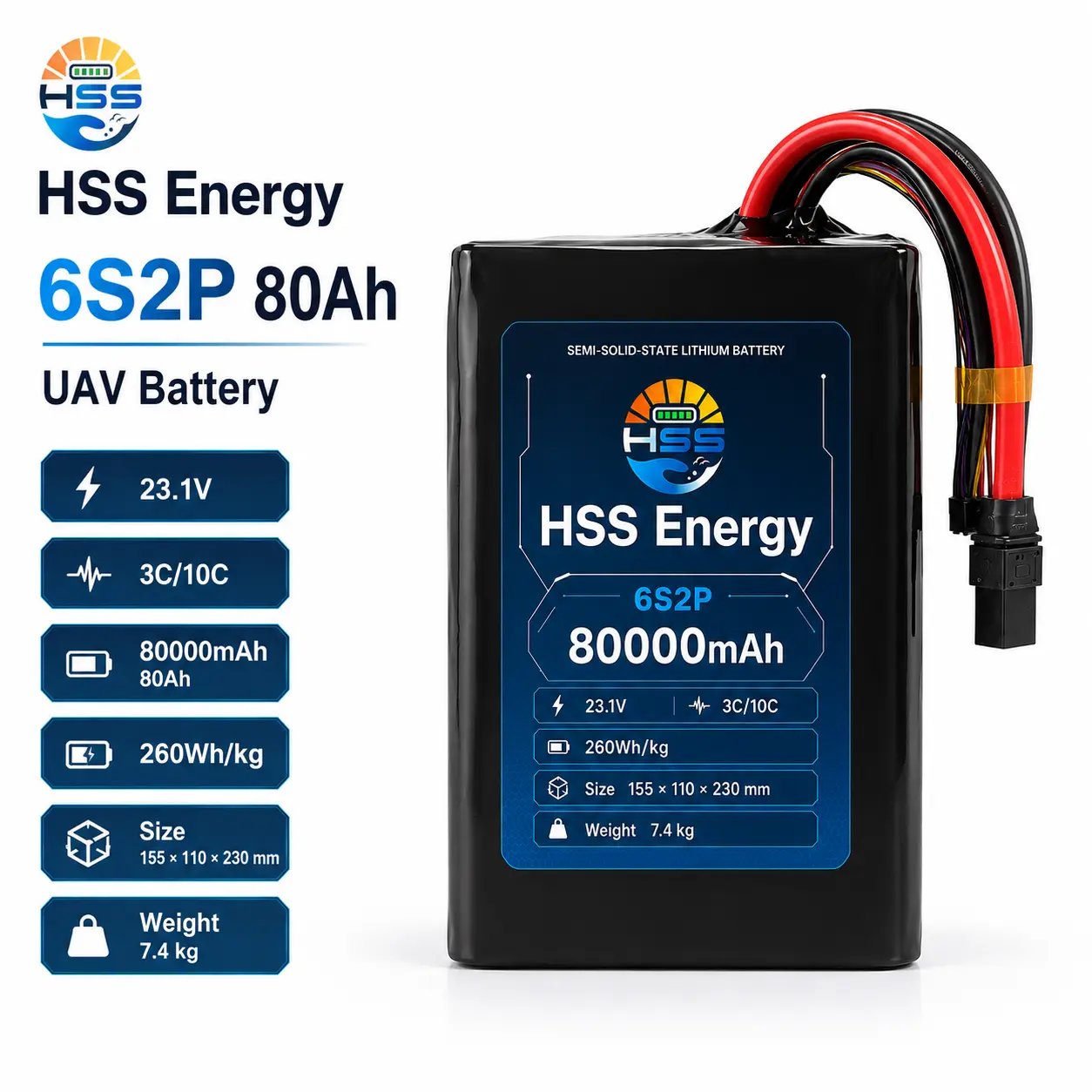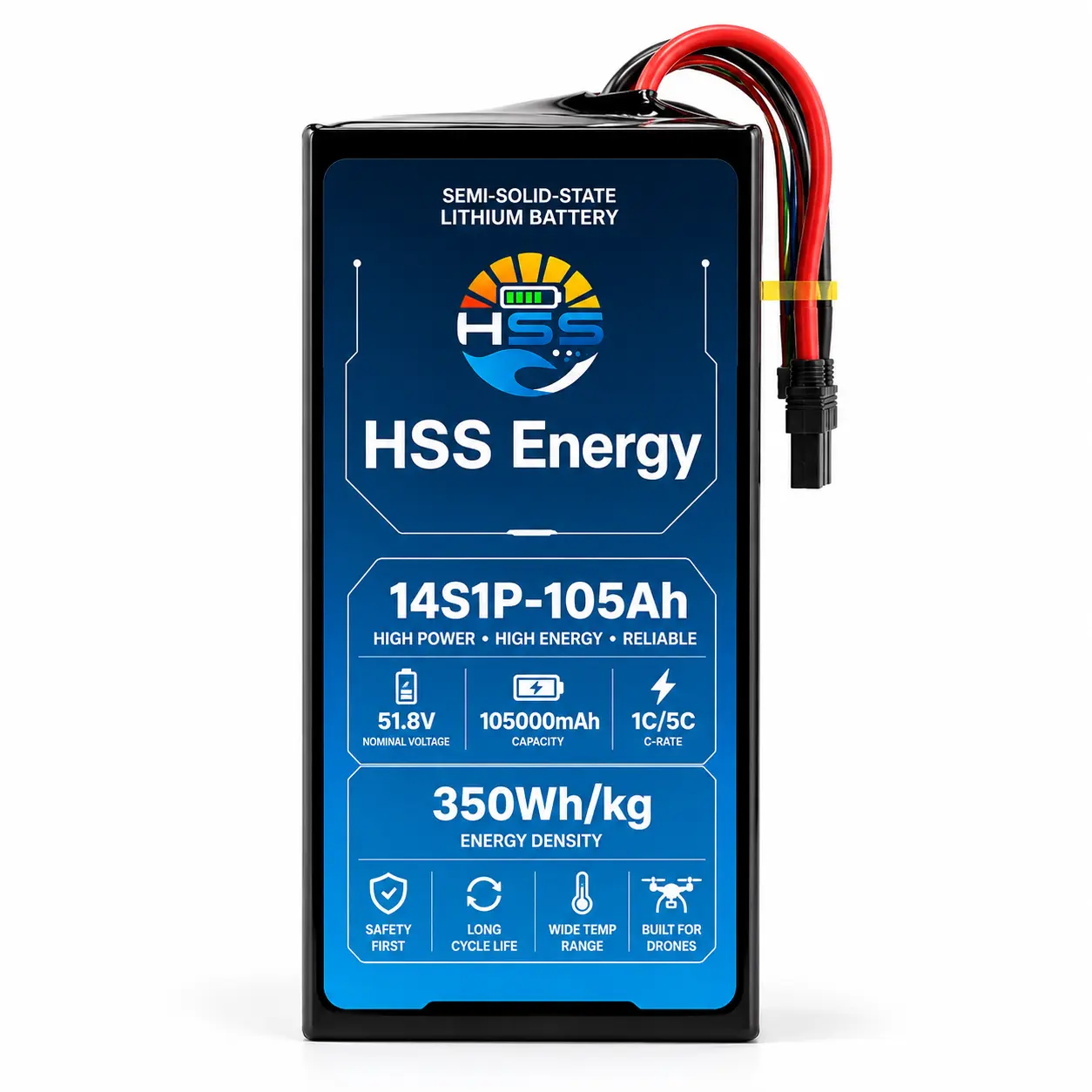
The China 14S 105Ah UAV battery is the maximum installed-energy position in the current HSS Energy 14S family. With 51.8V nominal voltage and 105Ah capacity, calculated nominal energy is 5439Wh. This SKU is not a general-purpose upgrade from the 72Ah model; it is an OEM integration platform for aircraft that can structurally and electrically accommodate a 15.6kg, 420mm-tall battery.
|
Parameter |
Specification |
|
Product model |
HSS 14S1P-105Ah |
|
Product category |
Semi-solid-state lithium UAV battery |
|
Configuration |
14S1P |
|
Nominal voltage |
51.8V |
|
Nominal capacity |
105000mAh / 105Ah |
|
Nominal energy |
5439Wh |
|
Published energy density |
350Wh/kg value shown on supplied product reference |
|
Calculated pack reference |
About 349Wh/kg (5439Wh / 15.6kg) |
|
Pack weight |
Approx. 15.6kg |
|
Pack size (L x W x H) |
175 x 123 x 420mm |
|
Discharge rate shown |
1C / 5C shown on product reference |
|
Arithmetic current reference |
105A at 1C; 525A at 5C (arithmetic references only, not verified pack limits) |
|
Power / balance interface |
High-current power lead and balance interface shown; final mating connector and cable configuration confirmed for the approved order |
|
Charging profile |
Matched series-count charging; charge voltage/current and charger workflow confirmed for the final configuration |
The 14S 105Ah drone battery is for projects where 5439Wh of installed energy matters more than keeping the battery light or compact. At 15.6kg and 420mm tall, it should be selected only after the aircraft team has confirmed mounting, CG, handling and service access.
|
Selection Point |
14S1P 72Ah |
14S1P 105Ah |
|
Nominal energy |
3686.4Wh |
5439Wh |
|
Pack mass |
9.5kg |
15.6kg |
|
Envelope |
128 x 153 x 290mm |
175 x 123 x 420mm |
|
Published density value |
400Wh/kg |
350Wh/kg |
|
Product position |
Endurance / mass balance |
Maximum installed energy |
A 14S1P 105Ah UAV battery at 15.6kg and 175 x 123 x 420mm must be treated as a structural aircraft component. HSS Energy should review the bay drawing, mounting points, restraint method, removal path, cable bend radius, connector access and CG target before a sample is built. A simple available-volume check is not enough for this capacity class.
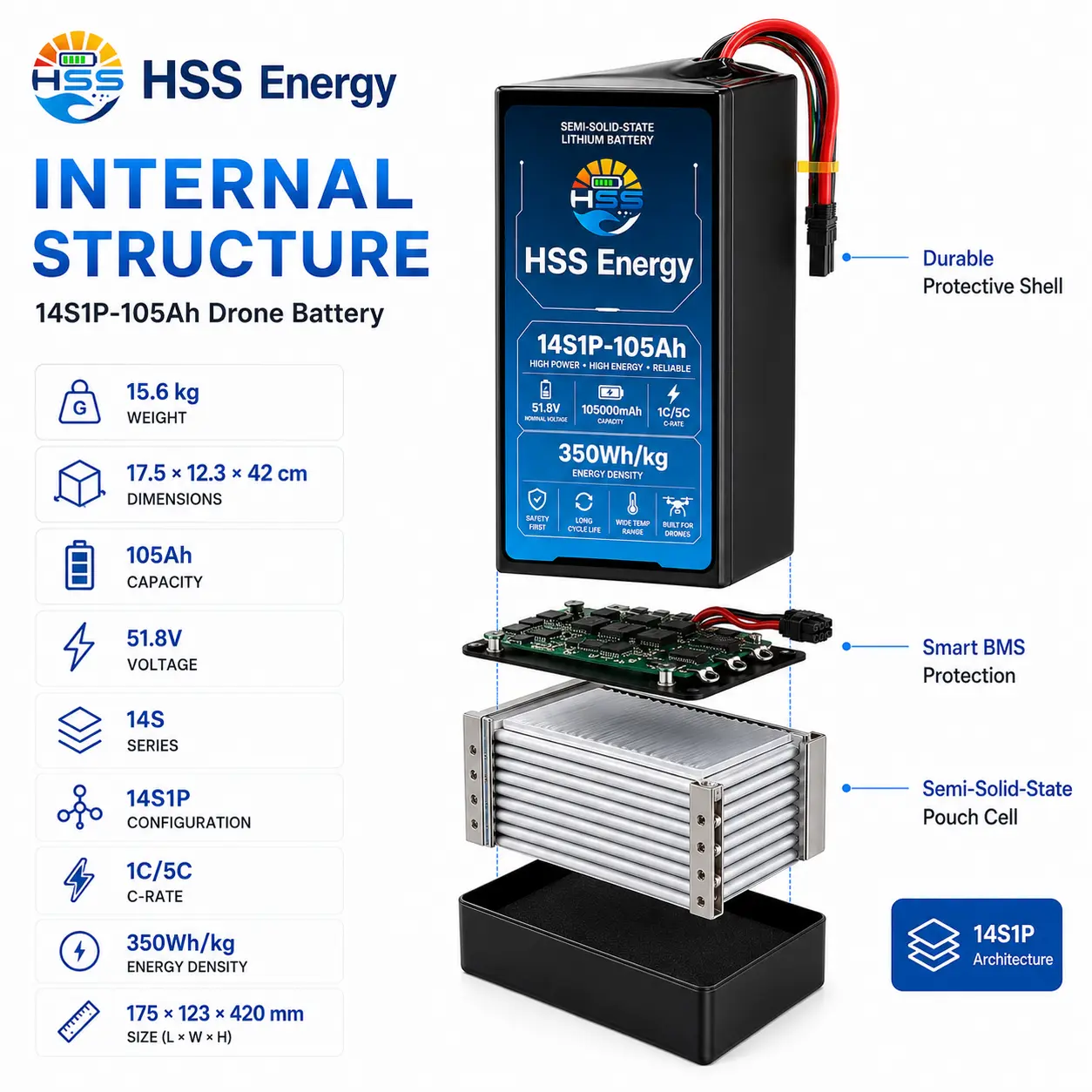
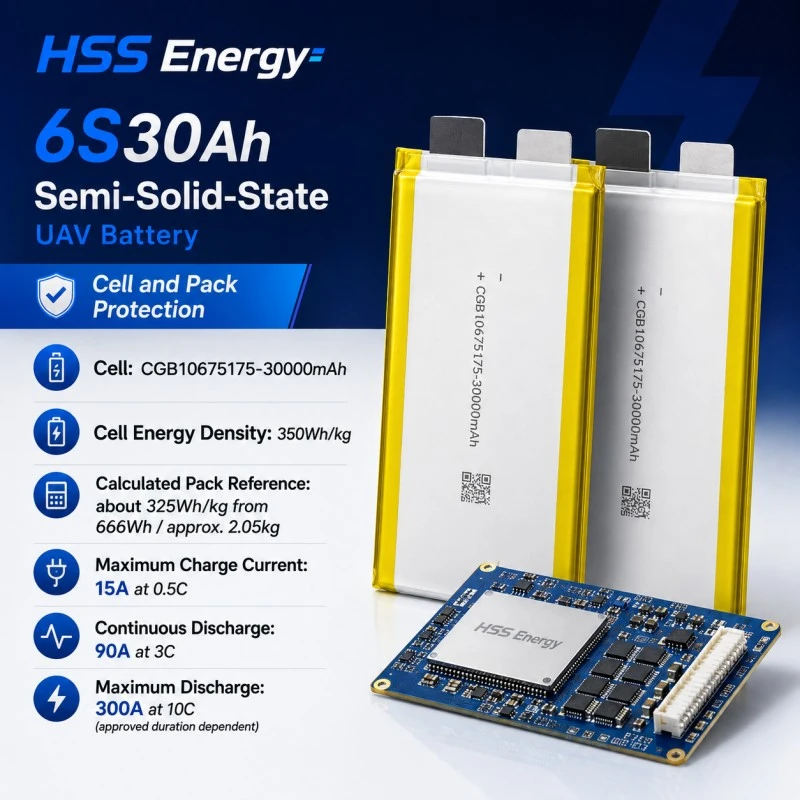
Cell / protection architecture reference visual for the HSS project configuration.
For a 51.8V 105Ah UAV battery, the 1C / 5C product-reference rates correspond to 105A and 525A arithmetic current references. Final continuous and peak limits require the approved pack design, connector, cable gauge, thermal conditions and event duration. Send real flight-current data rather than sizing the system from C-rate multiplication alone.
|
CHOOSE THIS SKU WHEN Choose this SKU for large-aircraft OEM projects where maximum installed energy is more important than minimum battery mass. |
MOVE TO ANOTHER SKU WHEN move to 72Ah when payload margin, CG or bay height cannot support the 105Ah pack; move to 36Ah for a compact 14S architecture. |
The heavy lift UAV battery at this size belongs in an aircraft designed around it, not added as a late capacity upgrade. Typical projects are large industrial, logistics, agricultural and heavy-payload UAVs where the airframe can support the battery mass, mounting and CG requirements.
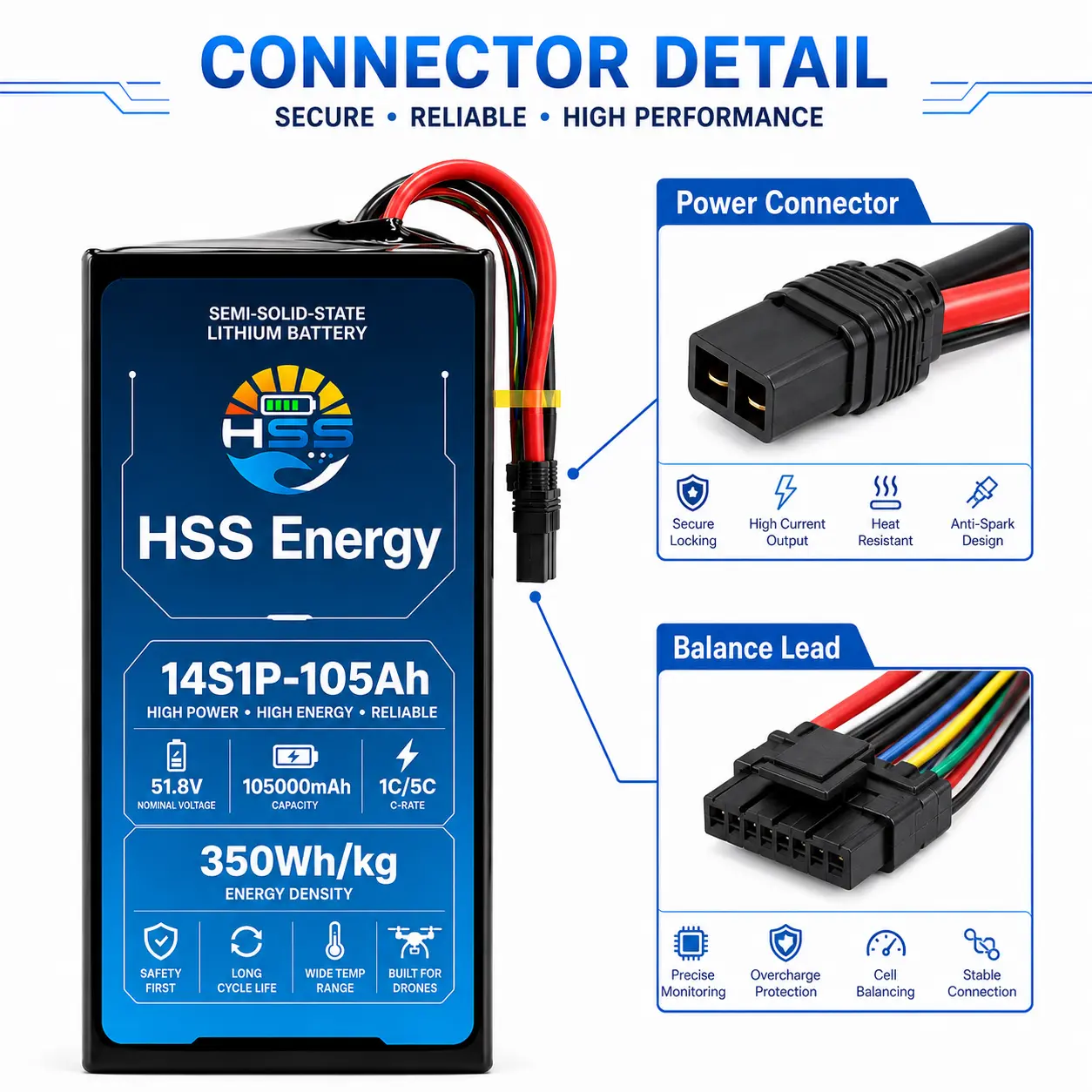
Large-aircraft application reference for the 105Ah OEM platform; structural mounting, CG and current-path validation are mandatory.
For a 105000mAh UAV battery project, HSS Energy should review structural mounting, restraint loads, pack handling, CG target, bay height, cable bend radius, high-current connector access, charger profile, real flight-current logs and expected annual demand. This review is more mechanical- and integration-led than the smaller 14S models.
At 15.6kg, this is not a plug-and-play battery. Before a sample is built, confirm how the pack will be supported, restrained, lifted in and out, where the connector sits and what CG range the aircraft can accept. Review the cable route and service access at the same time.
|
Where Will the Connector Sit? Review mating interface, cable gauge, length, polarity, strain relief and cable exit with measured current. It must remain accessible after mounting. |
Mounting a 15.6kg Pack Define support points, mounting orientation and restraint before sampling. Do not rely on the connector, cables or enclosure surfaces as unintended supports. |
|
Can It Be Removed for Service? Plan how the battery will be lifted, disconnected and removed. Check cable bend space, connector sequence and maintenance clearance. |
Aircraft Data Before Sample Build Provide takeoff mass, battery allowance, payload target, mission duration, current profile, CG window, bay drawing, charger and interface needs. |
|
OEM Label and Project Packing Approved orders can use brand label, model ID, warnings, barcode or QR code, batch ID, carton mark, connector protection and cushioning. |
From Sample to Production Use staged review, sample build, ground validation, aircraft validation and final production release. Record the approved setup before repeat orders. |
WHAT THE AIRCRAFT TEAM SHOULD SEND
Send the bay drawing, mounting concept, battery-mass allowance, CG range, flight-current data, connector and cable needs, charger information, mission target and annual demand.
Using the specified 51.8V nominal voltage and 105Ah capacity, nominal energy is 5439Wh.
The 105Ah model changes the mechanical problem substantially: mass increases to 15.6kg and height to 420mm, so mounting, CG, handling and connector access become central design constraints.
Choose 72Ah when the aircraft needs high endurance but cannot accept the 105Ah model’s mass or envelope, or when energy-to-mass efficiency is the stronger priority.
No. They are arithmetic references from 1C and 5C. HSS Energy confirms continuous/peak current and duration for the approved project configuration.
Before selecting the 105Ah model, provide aircraft voltage limits, real current logs, battery-bay drawing, allowable mass, CG target, mounting concept, connector and cable requirements, charger profile and expected annual demand.
Address
A3, 1204-1, 1142 Jimei North Avenue, Software Park Phase III, Xiamen Torch High-tech Zone, Xiamen, China
Tel