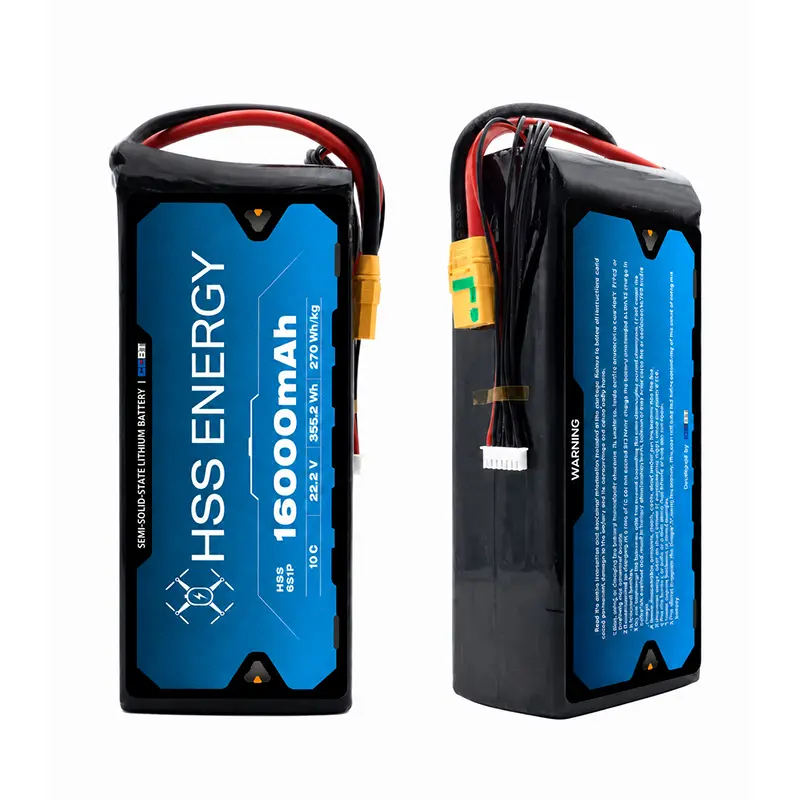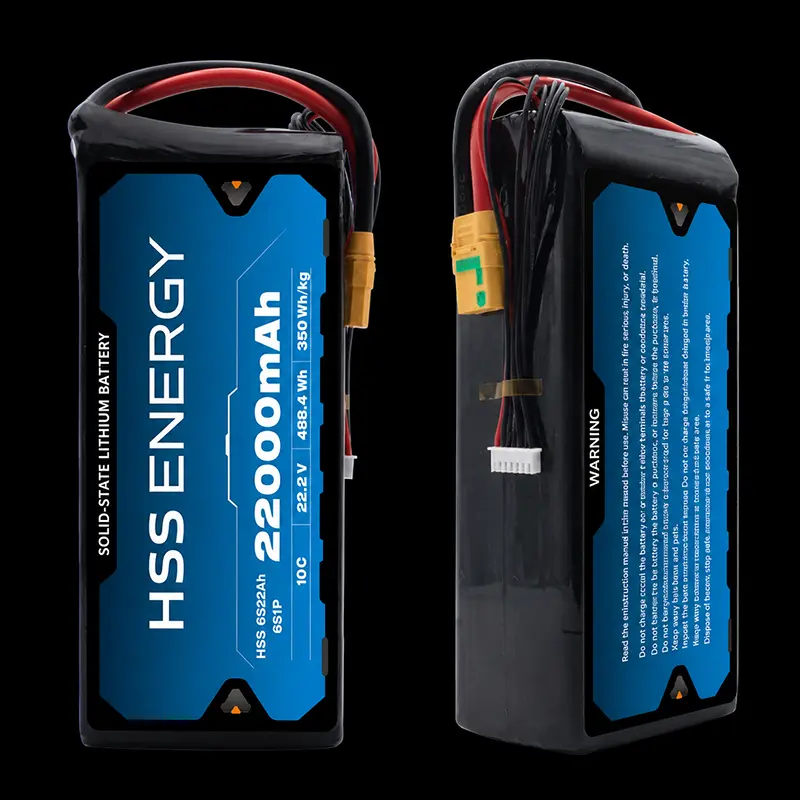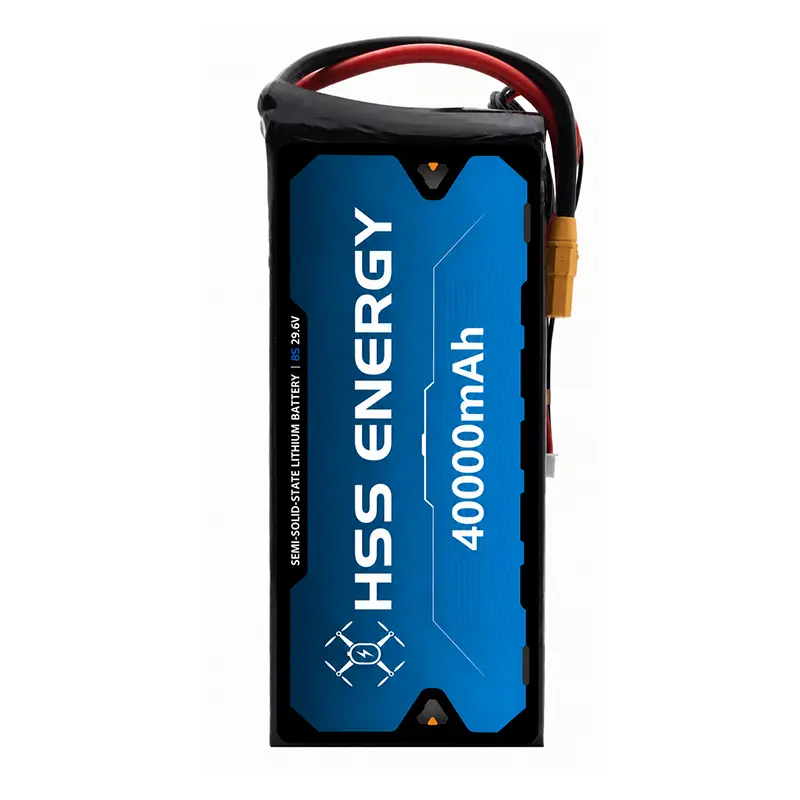
HSS Energy's China 8S 40000mAh UAV Battery uses a 29.6V nominal 8S architecture with 40Ah capacity and 1184Wh nominal energy. The finished pack is approximately 3.44kg, giving a calculated complete-pack reference of about 344Wh/kg from the supported energy and mass values. This model is positioned above HSS 6S 40Ah platforms when the aircraft electrical architecture requires an 8S window rather than simply more capacity.
|
29.6V / 34.0V Window Nominal voltage and specified charge cutoff are the first aircraft and charger compatibility gates. |
1184Wh Nominal Energy Use for installed-energy, reserve and pack-mass planning - not as a guaranteed flight-time claim. |
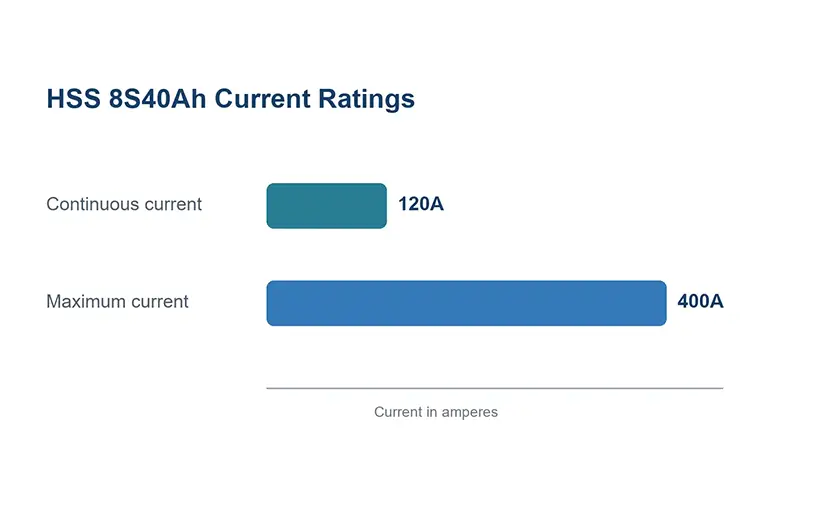
120A Continuous Pack-level continuous-discharge reference for sustained-load screening. |
The HSS 8S40Ah reference configuration should be approved as one electrical-mechanical system: voltage window, charge profile, current demand, battery-bay envelope, cable, connector, polarity, cooling and operating temperature should be confirmed before sample use.
|
Parameter |
Specification |
|
Product model |
HSS 8S40Ah |
|
Battery type / cell |
Semi-solid-state lithium battery; CGB10087191NSH-40000mAh |
|
Configuration |
8S |
|
Nominal voltage |
29.6V |
|
Nominal capacity |
40000mAh / 40Ah |
|
Nominal energy |
1184Wh, calculated from 29.6V x 40Ah |
|
Energy density |
350Wh/kg individual-cell value; about 344Wh/kg calculated complete-pack reference |
|
Maximum charge current |
20.0A at 0.5C |
|
Charge cutoff voltage |
34.0V |
|
Discharge cutoff voltage |
20.0V |
|
Continuous discharge |
120A at 3C |
|
Maximum discharge |
400A at 10C; applicable duration follows the approved battery configuration and operating conditions |
|
Cycle life reference |
Approx. 200-400 cycles; available capacity typically declines to about 80% of initial rated capacity by the end of this range under specified conditions¹ |
|
Working temperature |
-20°C to 55°C |
|
Storage conditions |
-20°C to 40°C; below 85% RH |
|
Dimensions (W x T x H) |
93 x 90 x 205mm; tolerance +/-5mm |
|
Weight |
Approx. 3440g |
¹ Approx. 200-400 cycles is the current HSS Energy general planning reference when no separate approved pack-level cycle report is applied. By the end of this range, available capacity typically declines to about 80% of initial rated capacity under specified conditions. Actual results vary with charge/discharge rate, depth of discharge, temperature, storage practice and end-of-life criteria.
The 8S 40Ah UAV battery has a distinct engineering role within the HSS 40Ah family compared with the 6S high-energy and high-current configurations. Selection starts with the aircraft electrical architecture: 29.6V nominal, 34.0V charge cutoff and 20.0V discharge cutoff. At nominal voltage, 120A continuous is an arithmetic reference of about 3.55kW, while 400A maximum corresponds to about 11.84kW; neither value is a guaranteed aircraft-output claim, and the applicable maximum-current duration follows the approved configuration.
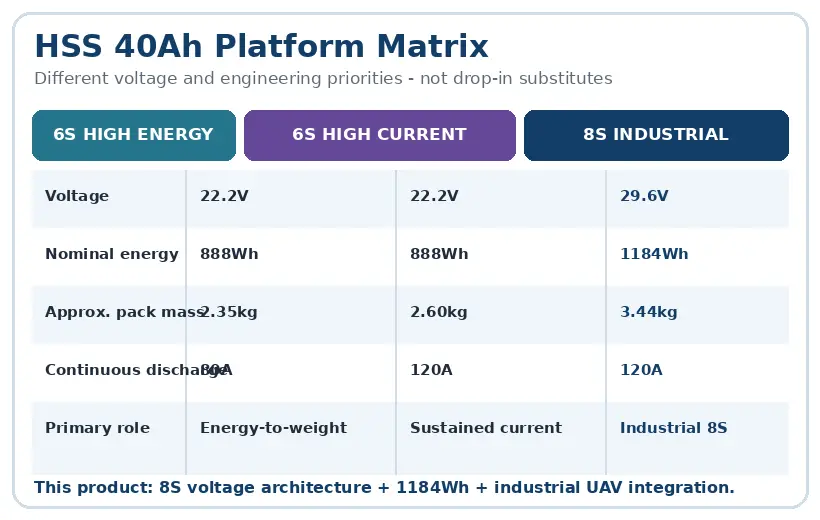
120A is the continuous rating; the 400A maximum-discharge duration depends on the approved configuration.
HSS matrix selection: 8S industrial architecture is a different procurement problem from 6S energy-to-weight or 6S sustained-current platforms.
Maximum charge current is 20A at 0.5C with a 34.0V charge cutoff. Confirm average current, maximum-current duration, cable and connector temperature, charger control, cooling, reserve policy and aircraft voltage acceptance before sample approval.
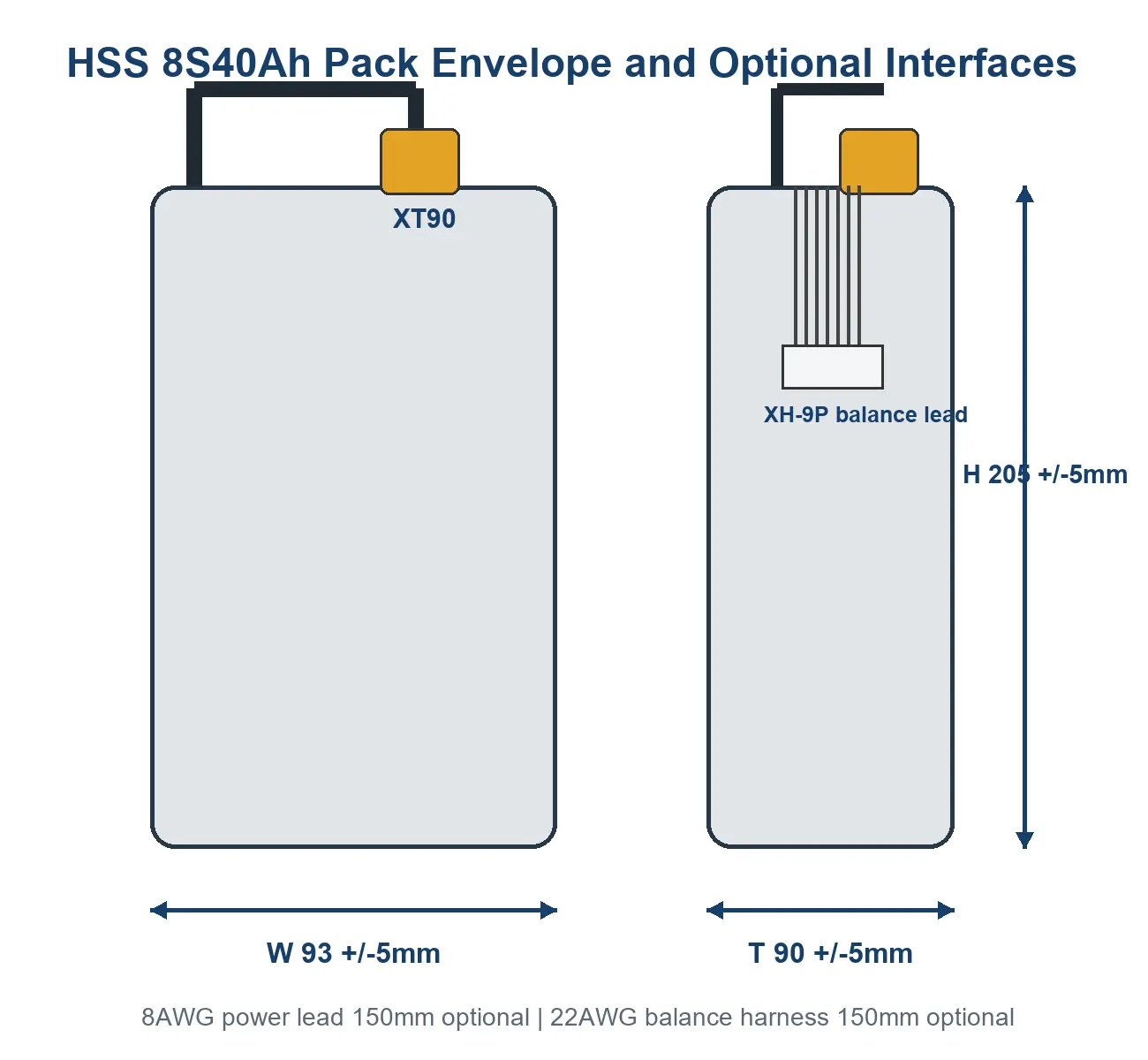
HSS 8S40Ah reference envelope and optional interfaces. For a long endurance drone battery evaluation, final dimensions, pack mass, cable length, polarity, connector exit direction and tolerances should be controlled by the approved order drawing.
|
Interface |
Reference configuration |
|
Pack size (W x T x H) |
93 x 90 x 205mm; tolerance +/-5mm |
|
Power lead |
8AWG, 150mm, optional |
|
Power connector |
XT90, optional |
|
Balance harness |
22AWG, 150mm, optional |
|
Balance connector |
XH-9P for B0 through B8, optional |
For a semi solid state drone battery, mechanical-abuse behavior is an important customers question because a large-energy pack can experience puncture, crush, impact or structural damage during handling or aircraft incidents. Compared with conventional liquid-electrolyte cell designs, semi-solid-state electrolyte architectures can provide a higher safety margin after external-force damage by reducing reliance on free-flowing liquid electrolyte, lowering leakage tendency and improving mechanical-abuse tolerance in appropriately designed cells. This is a technology-level advantage, not a universal guarantee: actual response depends on cell design, state of charge, temperature, damage mode and test method.
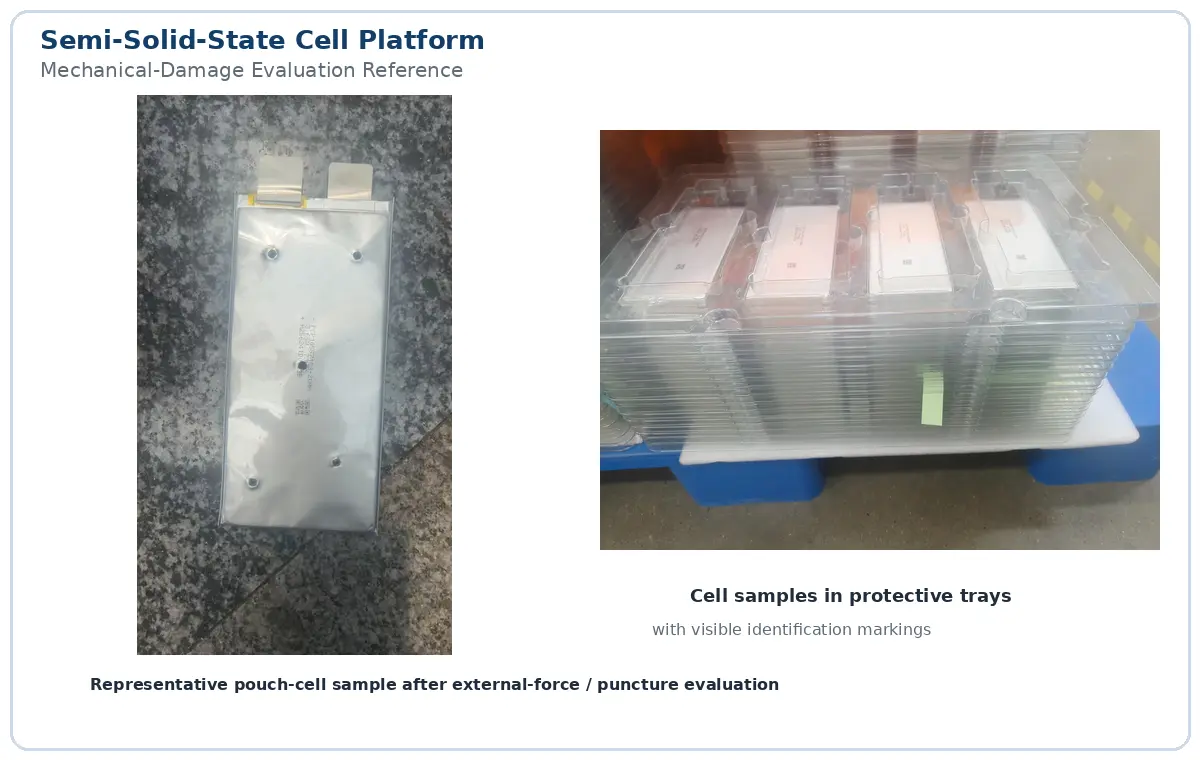
Representative semi-solid-state cell-platform validation imagery. The damaged pouch-cell sample illustrates external-force / puncture evaluation; exact test method, state of charge, temperature, acceptance criteria and applicability to the finished 8S pack are confirmed against the relevant test record.
To evaluate this 8S platform, provide the following information so electrical, mechanical and safety boundaries can be reviewed together:
|
UAV model / platform |
Average and peak current |
|
Mission profile / reserve policy |
Maximum battery weight |
|
Battery compartment size |
Connector and charger requirement |
|
Sample quantity |
Operating temperature and payload |
|
Share Your Aircraft Data SEND YOUR UAV REQUIREMENTS |
|
Primary applications include custom mapping, surveying and infrastructure-inspection aircraft that accept the defined 8S voltage window. As a 29.6V 40000mAh UAV battery, the 1184Wh energy class and 120A continuous rating support engineering review for sustained professional missions. For customers comparing an 8S drone battery, this platform is differentiated by its 29.6V architecture and 1184Wh installed energy rather than by a 6S long-range or 6S high-current configuration. Secondary applications can include corridor inspection and medium-lift route evaluation, but final compatibility requires aircraft-level validation.
|
1 VOLTAGE 29.6V nominal / 34.0V cutoff |
2 CURRENT 120A continuous / 400A maximum |
3 FIT 93 x 90 x 205mm envelope |
4 VALIDATE Sample + approved order drawing |
|
|
|
||
|
Is 400A the continuous discharge rating? |
|
No. Continuous discharge is 120A at 3C. The 400A value is a maximum-discharge boundary; applicable duration and temperature conditions follow the approved battery configuration. |
|
Why can semi-solid-state cells provide a higher safety margin after external-force damage? |
|
Semi-solid-state electrolyte designs reduce dependence on free-flowing liquid electrolyte. Compared with conventional liquid-electrolyte cell designs, this can reduce leakage tendency and improve mechanical-abuse tolerance under puncture, crush or impact conditions. Actual behavior still depends on the cell design, state of charge, temperature and test method. |
|
Does the damaged-cell image prove that this exact finished 8S pack passes a puncture test? |
|
No. The image is representative cell-platform validation evidence. Finished-pack safety statements must follow the test record applicable to the exact cell, pack configuration, state of charge and test conditions. |
|
What charge settings are specified? |
|
Maximum charge current is 20A with a 34.0V charge cutoff. Use the approved 8S charger profile, balance connection and polarity for the final configuration. |
|
Can the connector and cable length be customized? |
|
XT90, wire gauge, cable length, polarity and exit direction can be reviewed for the ordered configuration. |
|
What information is needed before sample recommendation? |
|
Provide the UAV model, average and peak current, mission profile, payload, weight limit, compartment size, connector, charger, operating temperature and sample quantity. |
Send your aircraft voltage window, average and peak current, mission profile, payload, weight limit, compartment size, connector, charger, operating temperature and sample quantity. HSS Energy will review the information for an 8S configuration recommendation, sample plan and quotation.
Address
A3, 1204-1, 1142 Jimei North Avenue, Software Park Phase III, Xiamen Torch High-tech Zone, Xiamen, China
Tel