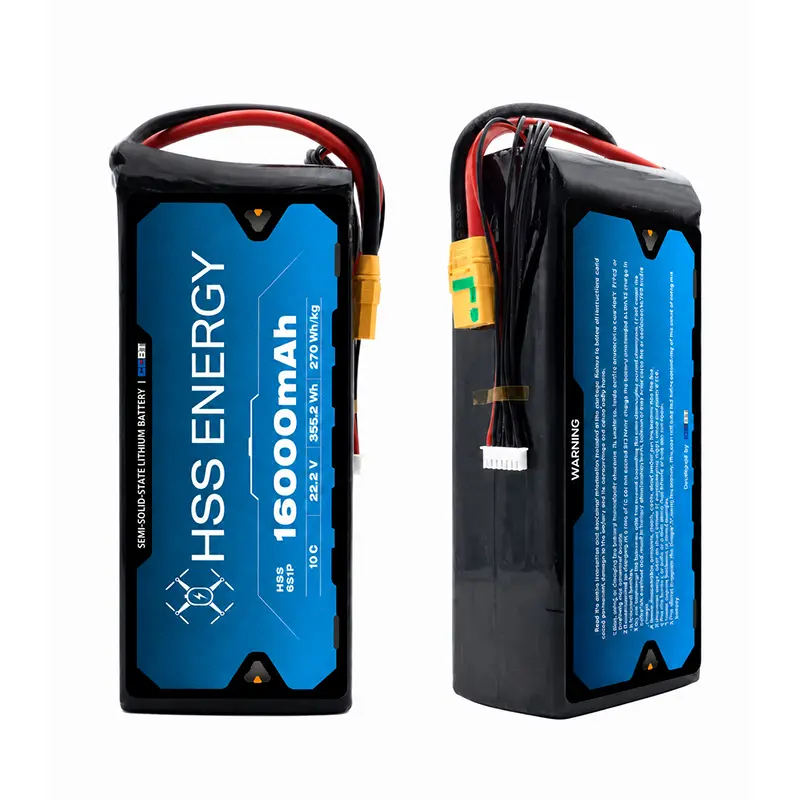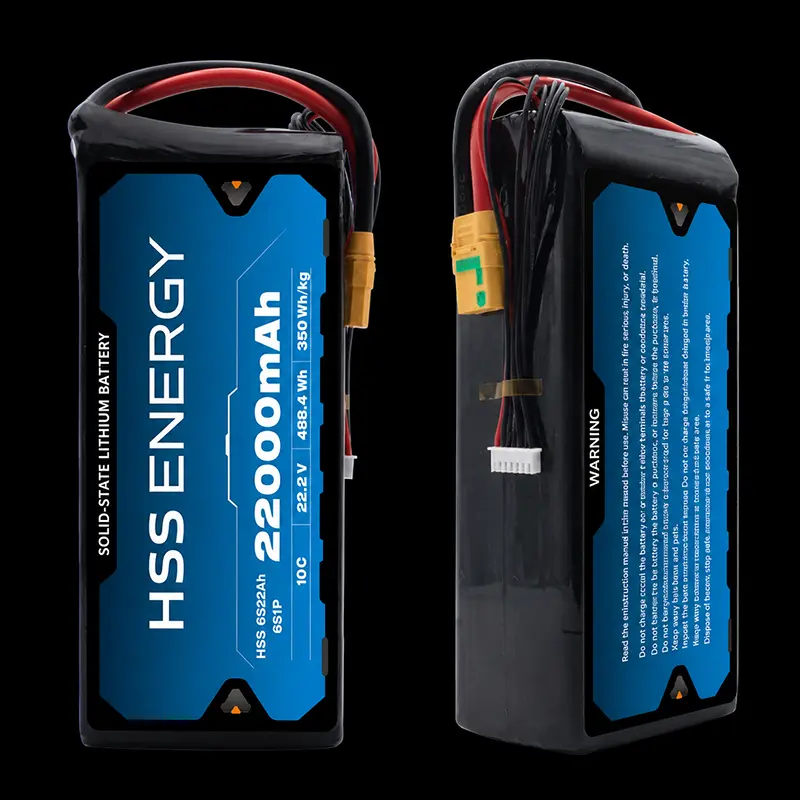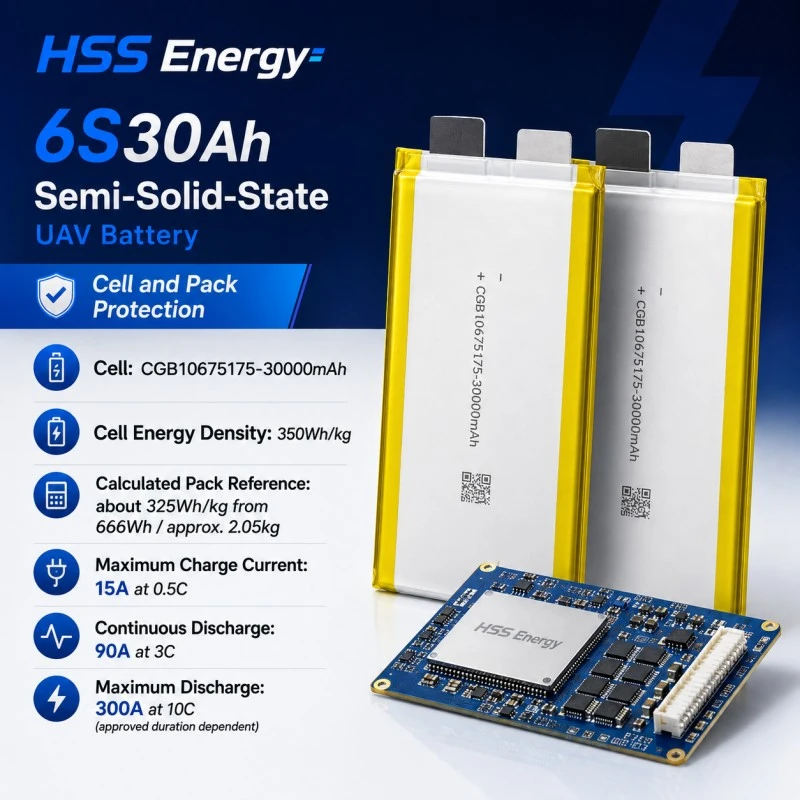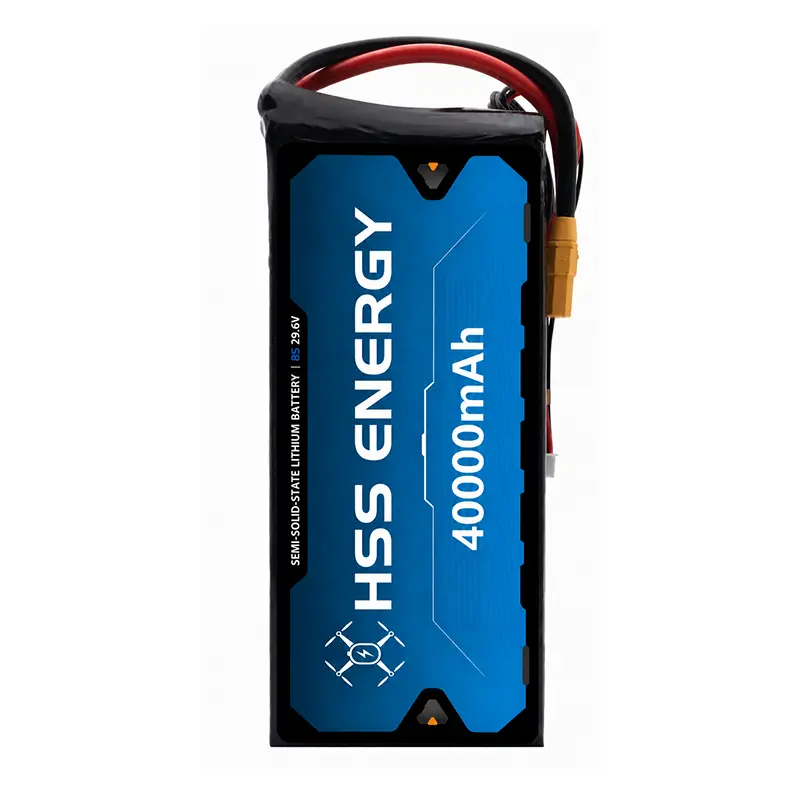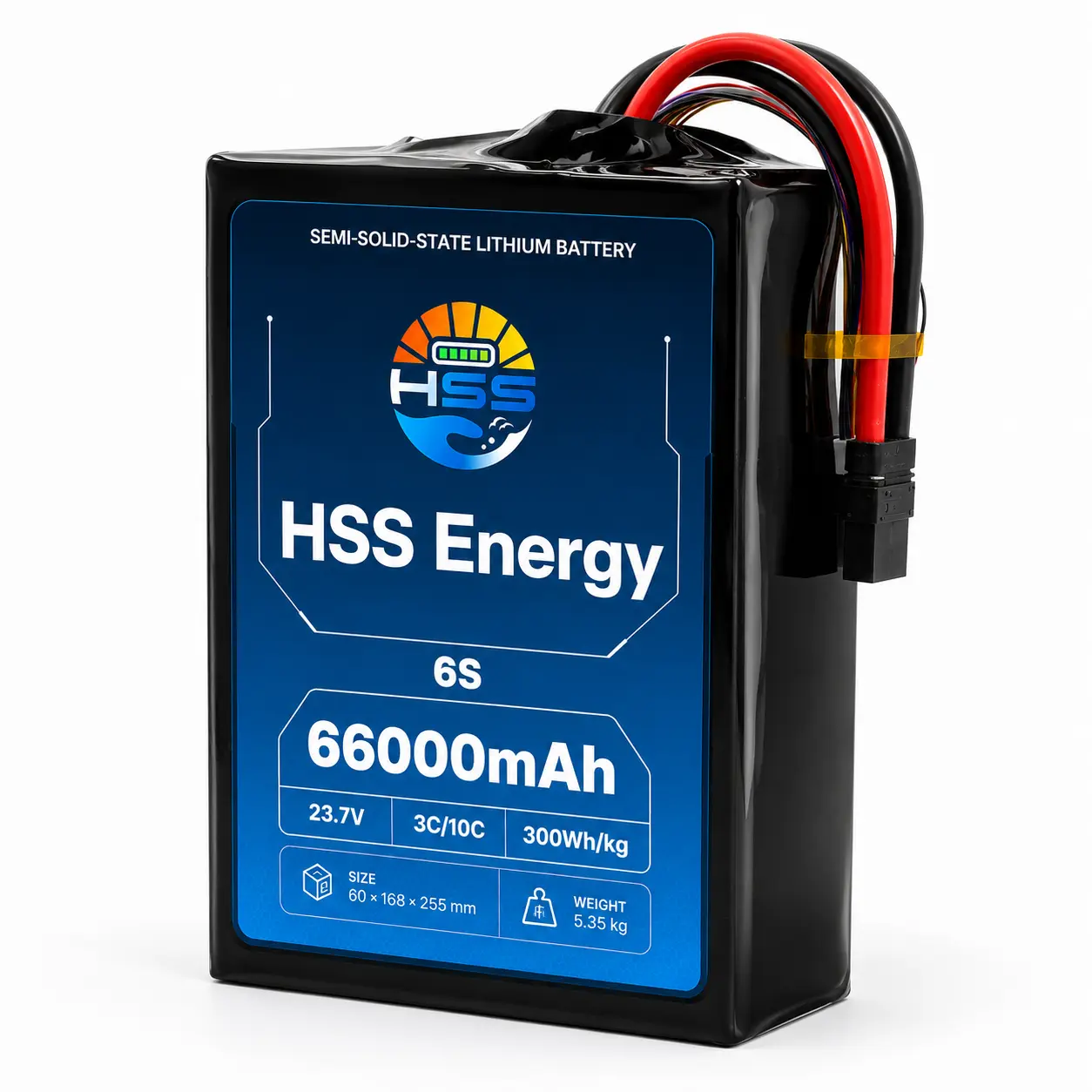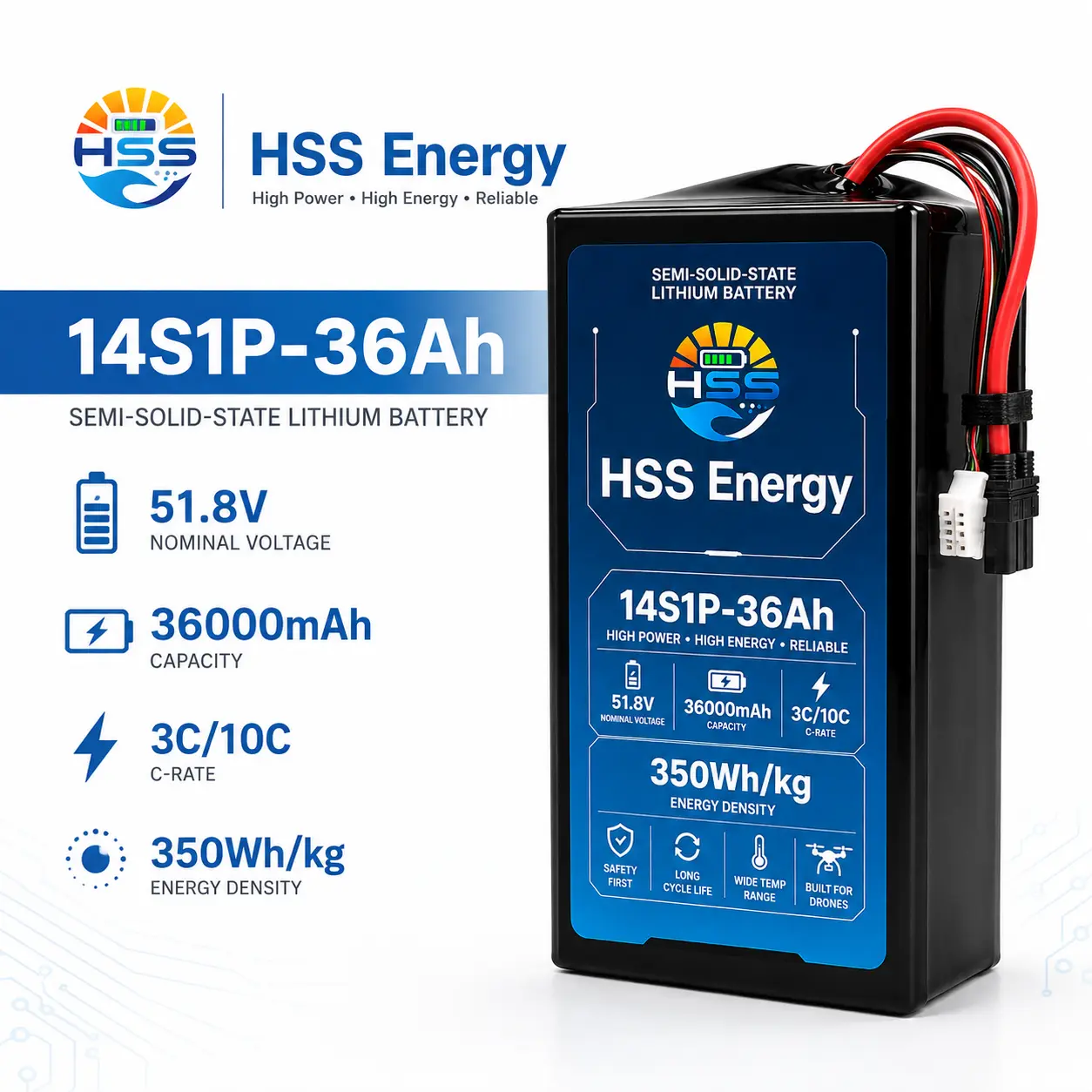
The 14S 36000mAh UAV battery supplied by HSS Energy factory is the compact high-voltage entry in the current HSS Energy 14S family. Its role is not “more capacity than 6S”; it is to offer about 1.865kWh of nominal energy at 51.8V in a 5.6kg package. That makes it a useful architecture alternative to very large 6S packs when the aircraft electrical system is designed for a higher series voltage.
|
Parameter |
Specification |
|
Product model |
HSS 14S1P-36Ah |
|
Product category |
Semi-solid-state lithium UAV battery |
|
Configuration |
14S1P |
|
Nominal voltage |
51.8V |
|
Nominal capacity |
36000mAh / 36Ah |
|
Nominal energy |
1864.8Wh |
|
Published energy density |
350Wh/kg value shown on supplied product reference |
|
Calculated pack reference |
333Wh/kg (1864.8Wh / 5.6kg) |
|
Pack weight |
Approx. 5.6kg |
|
Pack size (L x W x H) |
155 x 90 x 205mm |
|
Discharge rate shown |
3C / 10C shown on product reference |
|
Arithmetic current reference |
108A at 3C; 360A at 10C (arithmetic references only, not verified pack limits) |
|
Power / balance interface |
High-current power lead and balance interface shown; final mating connector and cable configuration confirmed for the approved order |
|
Charging profile |
Matched series-count charging; charge voltage/current and charger workflow confirmed for the final configuration |
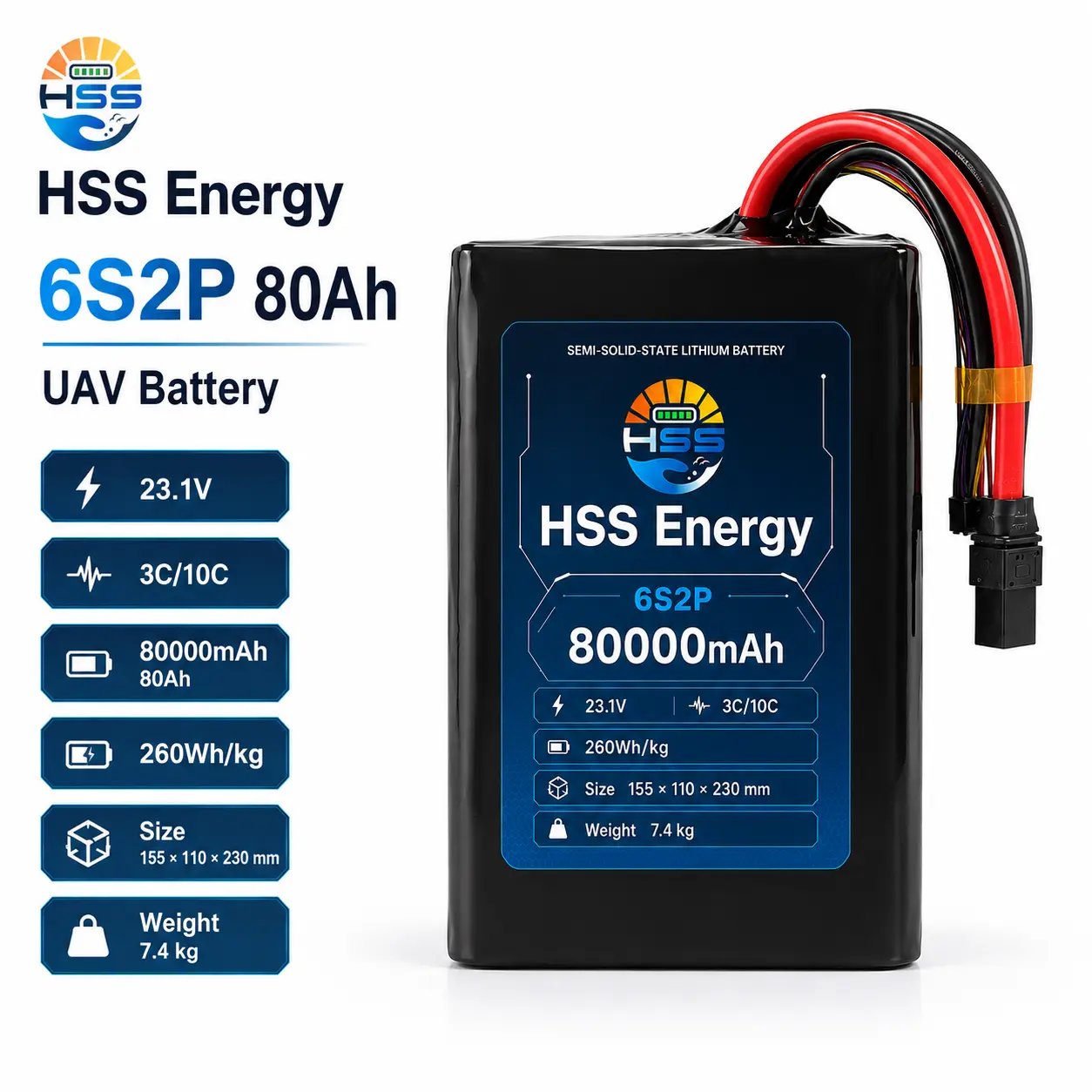
The 14S 36Ah drone battery makes sense when the aircraft is being built around 14S and needs roughly the same nominal energy as the 6S80 pack in a lighter, higher-voltage configuration. Start with ESC, charger and voltage limits before comparing bay size or connector details.
|
Architecture |
6S2P 80Ah |
14S1P 36Ah |
|
Nominal energy |
1848Wh |
1864.8Wh |
|
Nominal voltage |
23.1V |
51.8V |
|
Capacity |
80Ah |
36Ah |
|
Pack mass |
7.4kg |
5.6kg |
|
Primary decision |
Stay in 6S branch |
Move to high-voltage platform |
A 51.8V 36Ah UAV battery must be matched as a 14S electrical system, not treated as a simple replacement for a 6S pack. Confirm ESC or controller maximum voltage, motor and propulsion design, charger output range, low-voltage thresholds, connector system and wiring insulation before sample approval.
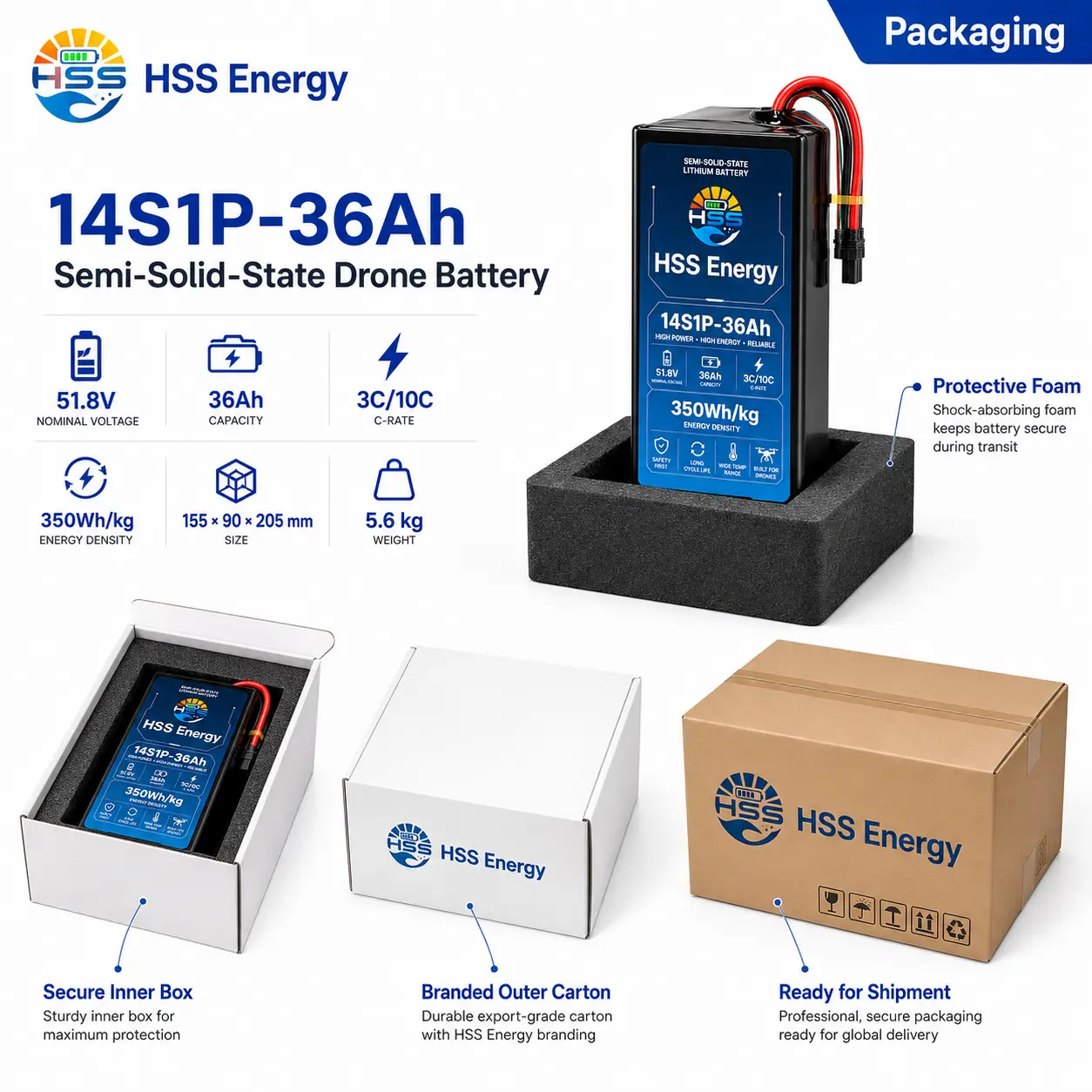
14S electrical-architecture snapshot for the compact 36Ah platform; voltage compatibility comes before capacity comparison.
|
14S1P CONFIGURATION |
51.8V VOLTAGE |
155 x 90 x 205mm PACK SIZE |
5.6kg PACK MASS |
Compact 14S Mechanical Integration
The 14S1P 36Ah UAV battery uses a 155 x 90 x 205mm envelope and a 5.6kg pack mass, making it the most compact position in the current HSS 14S range. customers should still verify the bay drawing, mounting orientation, cable bend radius, connector access, removal path and center-of-gravity effect.
|
CHOOSE THIS SKU WHEN Moving to 14S changes more than the battery label. |
MOVE TO ANOTHER SKU WHEN move to 6S80Ah when the aircraft must remain in the 6S branch; move to 72Ah when more 14S endurance is required and the aircraft can accept additional mass. |
The 51.8V 36000mAh drone battery can be evaluated for industrial multirotors, inspection platforms, mapping aircraft and other professional UAVs designed around a 14S electrical architecture. Application fit depends on propulsion voltage, real load profile, mass allowance and mechanical integration.
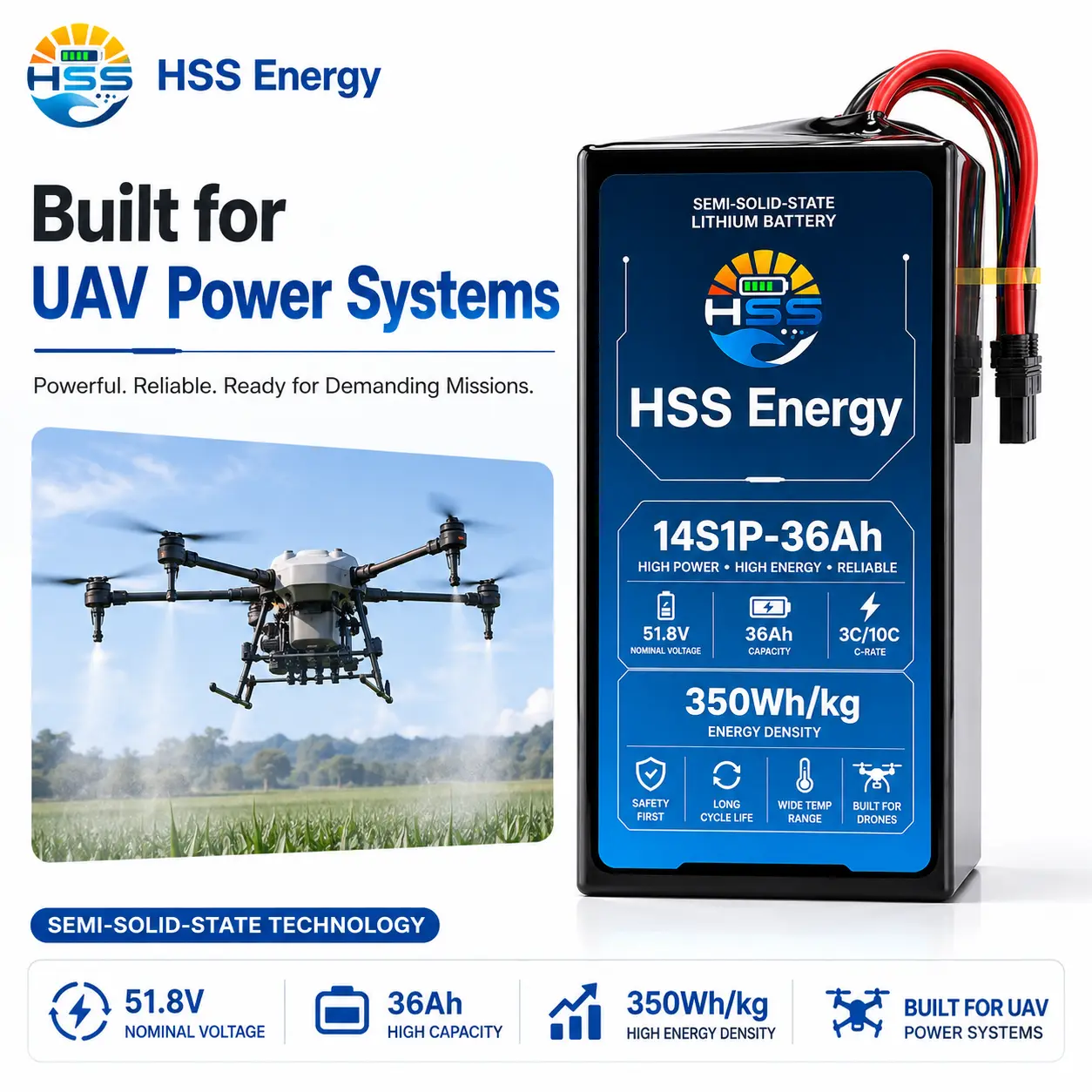
14S professional-UAV application reference; suitability depends on propulsion-voltage, load-profile, mass and bay validation.
For a compact 14S project, HSS Energy should review the ESC voltage ceiling, charger profile, low-voltage thresholds, mating connector, cable insulation, bay geometry and current log before building a sample. This is an architecture-migration review first and a capacity selection second.
If the aircraft is moving from 6S or another lower-voltage system, capacity is not the first question. Confirm that the ESC, charger, wiring and low-voltage settings are ready for 14S, then check the connector, cable route and battery-bay fit.
|
Confirm 14S Before Choosing Capacity Check controller maximum voltage, propulsion limits, charger range, low-voltage thresholds and wiring. Similar Wh does not make 6S and 14S interchangeable. |
Connector and Harness Conversion Confirm the mating connector, polarity, cable gauge, length, balance interface, insulation and bend radius with the pack in its real mounting position. |
|
Keep the Compact Advantage The 155 x 90 x 205mm envelope helps only if cables and connectors still fit. Check mounting direction, cable exit, removal path and CG. |
Prototype Before Fleet Use The sample should pass static fit, connector mating, charger and balance checks, ground electrical checks and controlled aircraft operation. |
|
OEM Label and Packing Approved orders can use model ID, warnings, barcode or QR code, batch tracking, carton marks, connector protection and cushioning. |
Record What Was Approved After validation, document charger settings, connector, cable layout, pack orientation, label and packaging for later production batches. |
START WITH THE AIRCRAFT ELECTRICAL DATA
Send ESC or controller voltage limits, charger profile, low-voltage thresholds, current log, bay drawing, allowable mass, connector and balance-interface details, cable routing and sample quantity.
Not directly. Similar energy does not mean electrical compatibility. The propulsion controller, charger, wiring and voltage thresholds must all be designed for 14S.
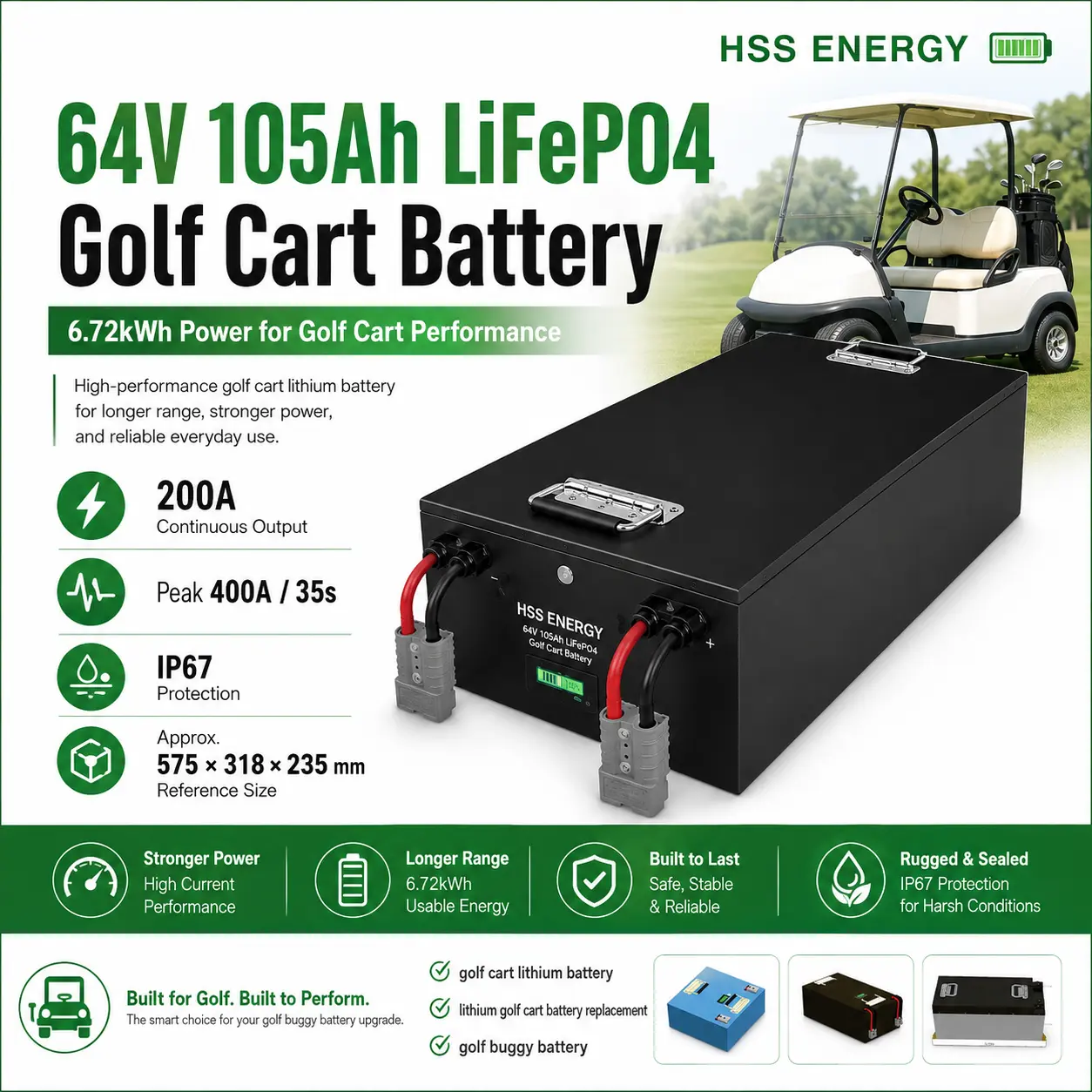
It provides the compact high-voltage entry before moving to the much larger 72Ah and 105Ah capacity classes.
For this 350Wh/kg UAV battery, 350Wh/kg is the published energy-density value shown for the product. The calculated finished-pack reference is about 333Wh/kg from 1864.8Wh and 5.6kg.
Provide average current, maximum current, event duration, controller limits and connector requirement. The 3C/10C figures are not used as verified pack-current limits without final validation.
Confirm 14S voltage compatibility, charger profile, bay dimensions, allowable mass, CG, connector/cable layout and mission duty cycle.
Address
A3, 1204-1, 1142 Jimei North Avenue, Software Park Phase III, Xiamen Torch High-tech Zone, Xiamen, China
Tel