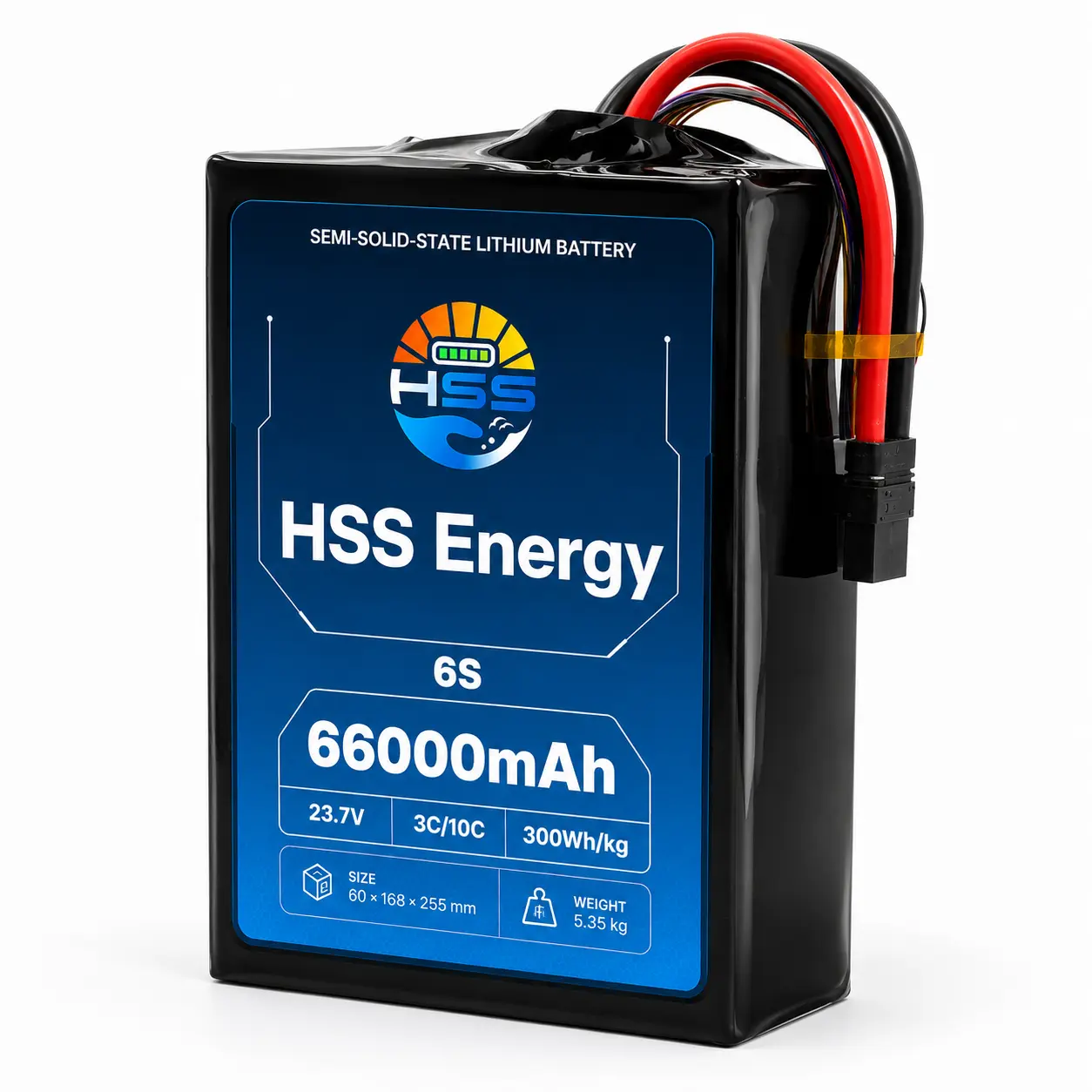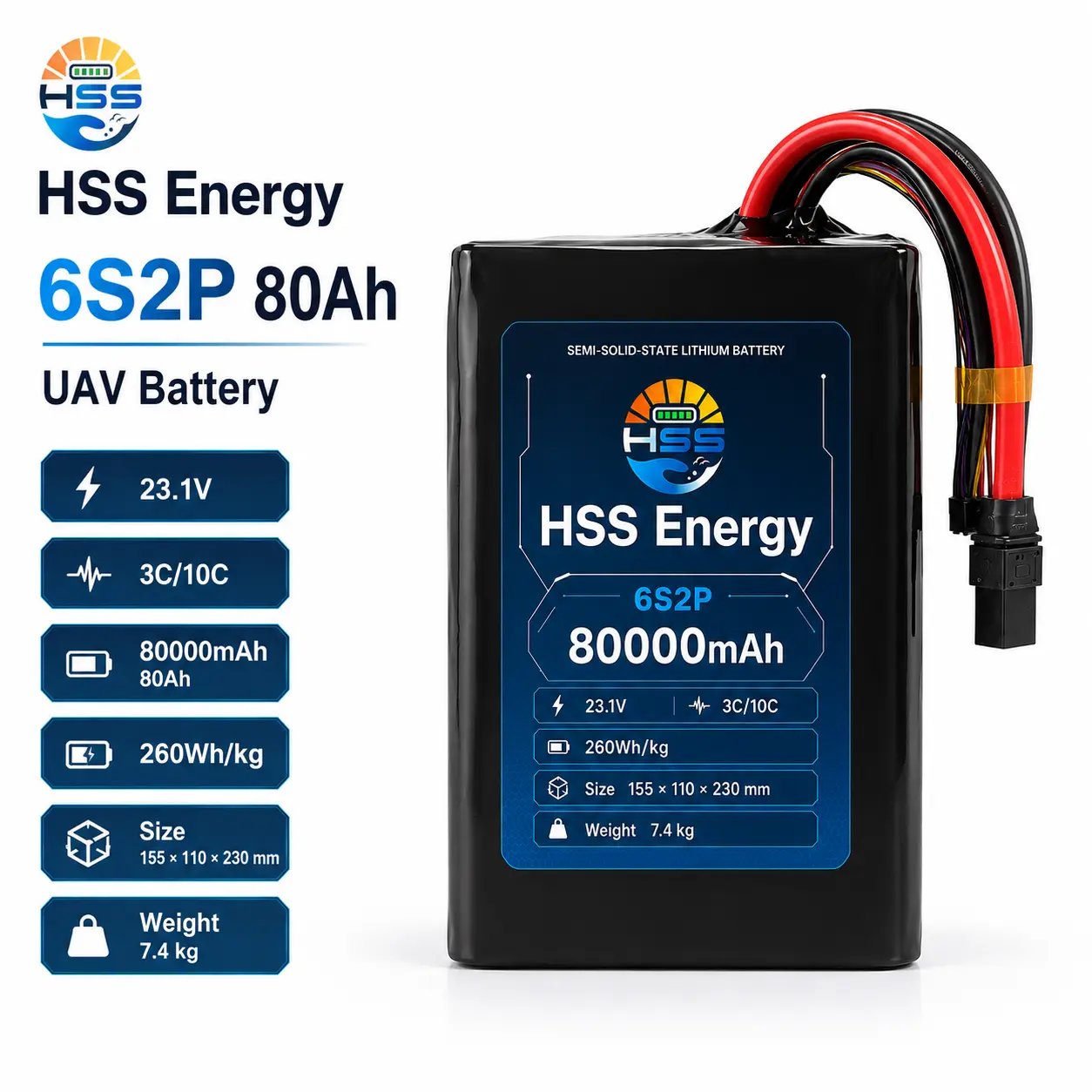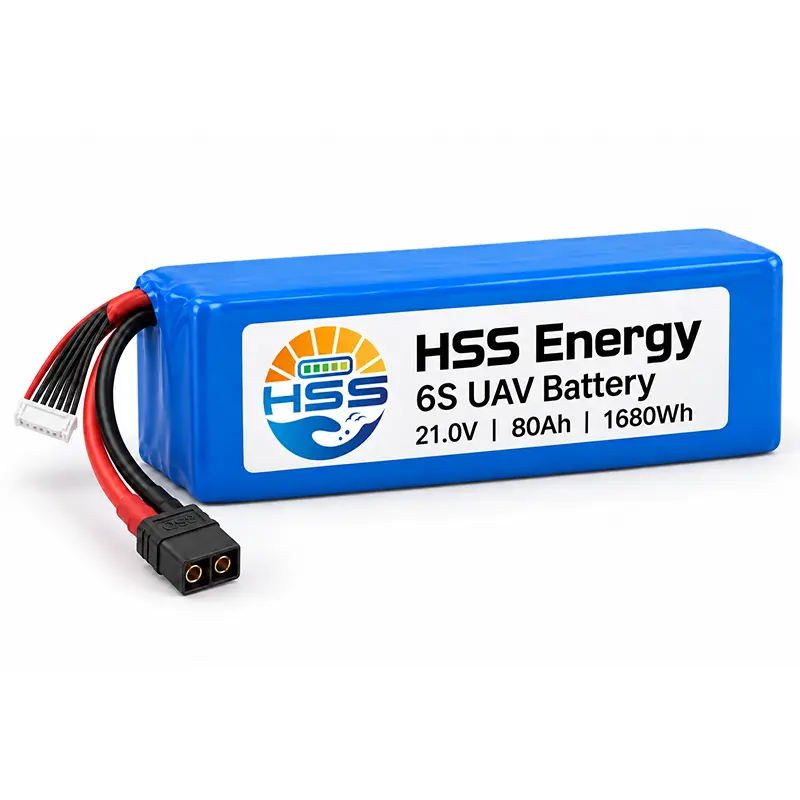
Start a sizing inquiry for the HSS Energy 6S 80Ah UAV Drone Battery with the available bay cross-section. Its 75mm width does not make the whole pack a 75mm-square format: the body is 117mm thick and 350mm long. Plan restraints along the body and leave room at the short end for the power connector and balance harness. This makes it a candidate to assess where width, rather than length, controls the layout. Contact our sales team for a quotation, detailed battery specifications, and bulk order pricing to assess whether this model fits your installation requirements.
The 6S 80000mAh UAV battery is a complete six-series pouch-cell battery, not a single 80Ah cell. It combines the cells, insulation, external wrap and connection leads into an installation-ready format for engineering evaluation. The nominal energy describes the pack; the cell-density figure describes its cell platform.
A 6S 80Ah battery pack is worth comparing when a long battery bay has limited width. The short-end lead exit leaves the long sides available for support and restraint. That layout advantage is useful only if the remaining thickness, mounting clearance and aircraft balance also work.
Its continuous-current rating gives the propulsion designer a separate operating limit from the short pulse allowance. Select against the actual flight load, including takeoff and recovery, rather than treating the largest current printed on a specification as the normal operating point.
|
Parameter |
Specification |
|
Model |
6S80Ah |
|
Cell designation |
107110300-80000mAh |
|
Cell type |
Semi solid |
|
Series configuration |
6S |
|
Nominal voltage |
21.0V |
|
Capacity |
80Ah / 80000mAh |
|
Nominal energy |
1680Wh (nominal voltage × capacity) |
|
Cell energy density |
400Wh/kg (cell value) |
|
Maximum charge current |
80A (1C) |
|
Charge cutoff voltage |
25.8V |
|
Discharge cutoff voltage |
15.0V at T ≥ 0°C; 13.2V at T < 0°C |
|
Continuous discharge current |
240A (3C) |
|
Maximum discharge current |
800A (10C), 10 seconds, SOC > 50% |
|
Condition |
Specification |
|
Working temperature |
-40 to 55°C |
|
Storage temperature |
-20 to 40°C |
|
Storage humidity |
<85% RH |
|
Cycle-life reference |
500 cycles |
|
Mechanical item |
Specification |
|
Body dimensions (W × T × H) |
75 × 117 × 350mm; each ±5mm |
|
Approximate body weight |
4.4kg |
|
Optional interface |
Configuration |
|
Main cable and connector |
6AWG, 150mm; QS8 |
|
Balance harness and connector |
22AWG, 150mm; XH-7P (B0–B6) |
Nominal energy is voltage multiplied by capacity. Cell energy density is not finished-pack energy density. Working-temperature limits do not establish charging-temperature permission.
Consider the 6S 80Ah UAV Drone Battery for survey or inspection platforms whose electrical input, payload budget and battery bay match this configuration. The useful question is whether the complete aircraft can perform its intended route with an appropriate landing reserve—not whether a battery photograph resembles its existing pack.
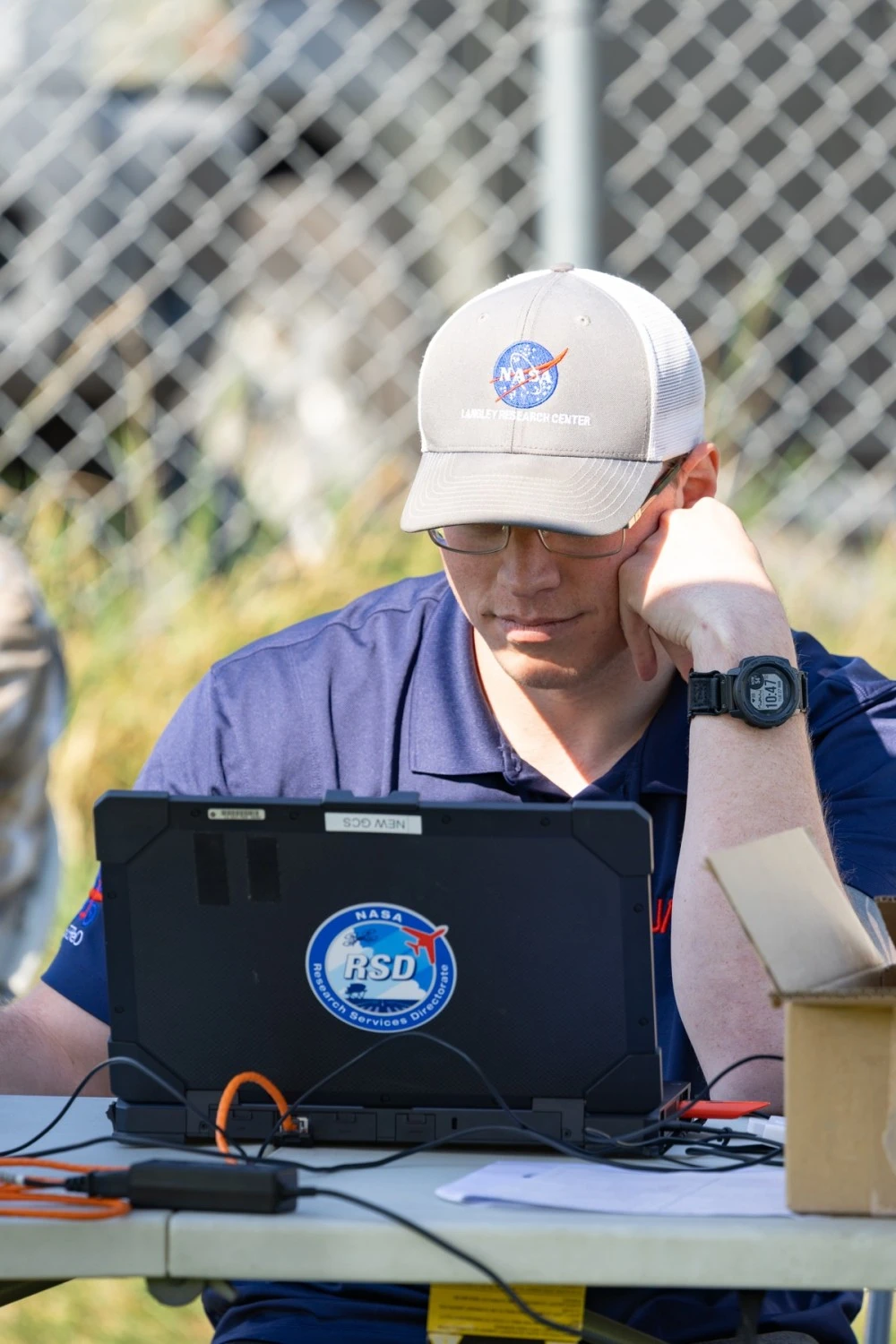
NASA’s FireSense work in Montana provides an independent example of field preparation and flight monitoring. The photographs are credited to NASA ARC/Milan Loiacono and show that project, not an HSS-powered aircraft. For your own evaluation, check restraint, connector access and cable clearance before progressing from bench checks to an aircraft-approved flight test.
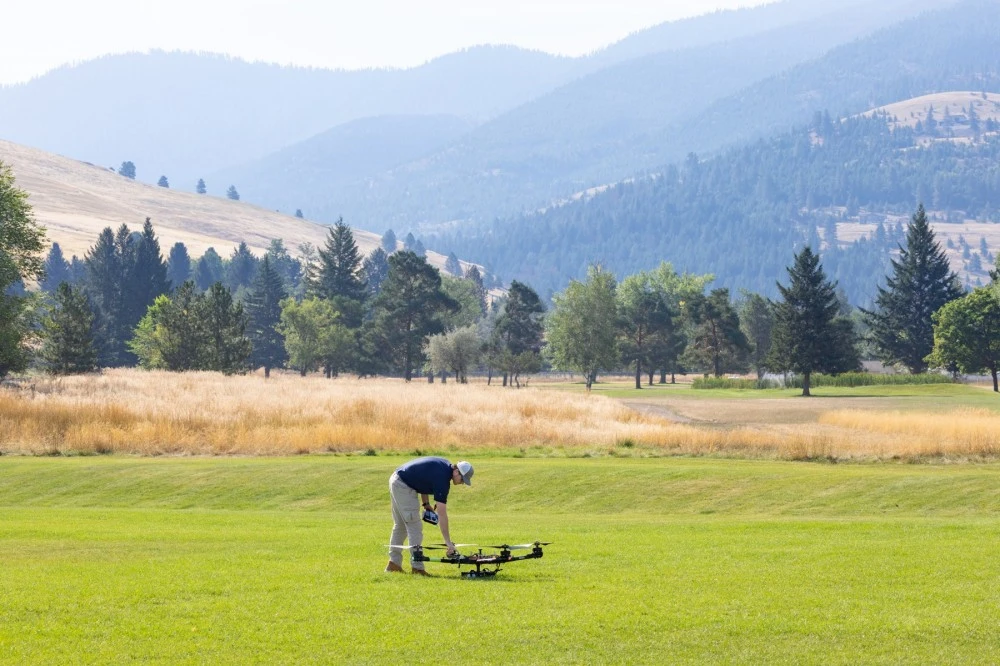
When assessing an 80000mAh UAV battery pack, record payload, weather, flight duration and voltage under load together. A longer flight on a lighter payload is not an equivalent comparison. These observations help distinguish an energy limitation from a mounting, connection or propulsion mismatch.
HSS Energy uses cells from commercial supply partners. Their manufacturing photographs provide visibility into the supply chain behind pouch-cell products; they are not presented as a production record for this individual 80Ah configuration. Procurement should connect the selected cell platform to the agreed pack drawing and acceptance requirements.
For an 80Ah semi solid battery, the material designation alone does not disclose an electrolyte recipe or manufacturing tolerance. The partner images show mixing and roll-processing equipment. These stages illustrate upstream cell manufacture, while the specific formulation and process settings remain separate from the published pack specification.
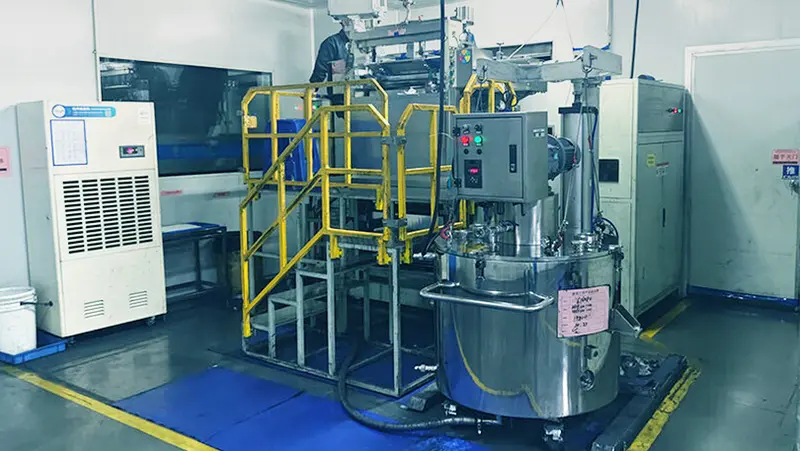
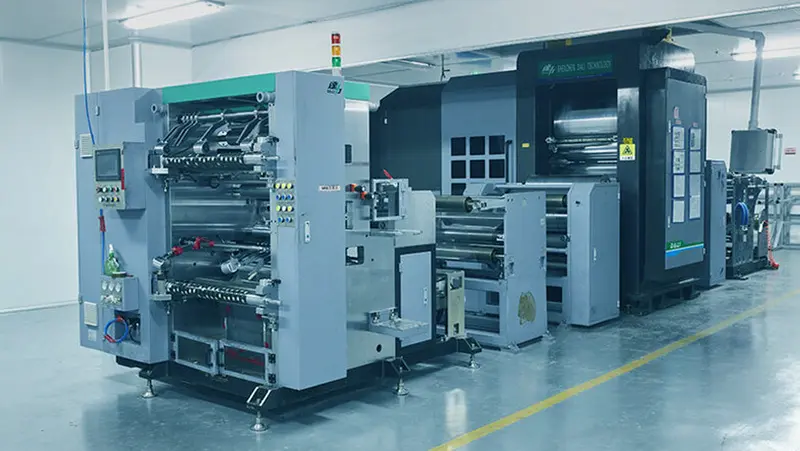
Cell manufacture and finished-pack assembly are different stages. The enclosed production equipment belongs to the cell-manufacturing context. For the ordered pack, the configuration review should identify the cell designation, series arrangement, connection layout and insulation requirements before the exterior and interfaces are finalized.

Treat the 21V UAV battery charger profile as part of that configuration, not as an accessory selected from series count alone. Changes to the cell platform, connectors or envelope should be reflected in the final technical agreement so that the sample and repeat order are evaluated on the same basis.
Send HSS Energy the usable bay dimensions, aircraft voltage range, load profile and intended quantity for a configuration quotation. Include the space needed to connect and remove the pack, not just the nominal cavity size.
Not on the basis of “6S” alone. Compare the complete voltage window, charger profile, load requirements, body envelope and connection arrangement. This model uses a 25.8V charge cutoff; an existing six-series setup must be checked against that value before a replacement is approved.
The nominal width is 75mm, but a bay with exactly the same width leaves no allowance for manufacturing tolerance, installation or restraint. Check all three body dimensions and the agreed dimensional tolerances, then add the space needed for padding, mounting and the short-end cables.
Nominal energy does not determine flight time by itself. Average aircraft power, payload, flight profile, temperature and landing reserve affect usable mission duration. Use measured power and controlled sample flights to evaluate the route; no fixed flight-minute claim is attached to this pack.
The specified maximum is 800A for 10 seconds at SOC above 50%. Continuous discharge is 240A. Cable, connector and aircraft limits also need to match the intended load.
No. A pack-level pulse rating is not a connector approval. The selected connector, mating contacts, wire route and connection quality must be reviewed for the actual current profile. Specify the complete interface instead of selecting a connector by its name alone.
No. 400Wh/kg is the specified cell energy density. The nominal pack energy is 1680Wh, calculated from 21.0V and 80Ah. These values describe different quantities.
Submit the required drawing and mating interface for review. A cable or connector request is different from a change to cell arrangement or body size; the latter may affect mass, electrical limits and documentation. The quotation should identify the approved configuration rather than promise every change within the standard envelope.
Check the actual mounting clearance, restraint and connector access first. Then evaluate the charging setup and aircraft load against the agreed electrical limits. Record the accepted cable, connector and drawing revision so that a repeat order refers to the same configuration rather than only the same capacity label.
For the 6S 80Ah UAV Drone Battery, provide a bay drawing, supported voltage range, continuous and transient loads, connector polarity and target quantity. Add the operating environment and any requested documents. This lets the quotation address installation and interface choices as well as the battery itself.
Address
A3, 1204-1, 1142 Jimei North Avenue, Software Park Phase III, Xiamen Torch High-tech Zone, Xiamen, China
Tel