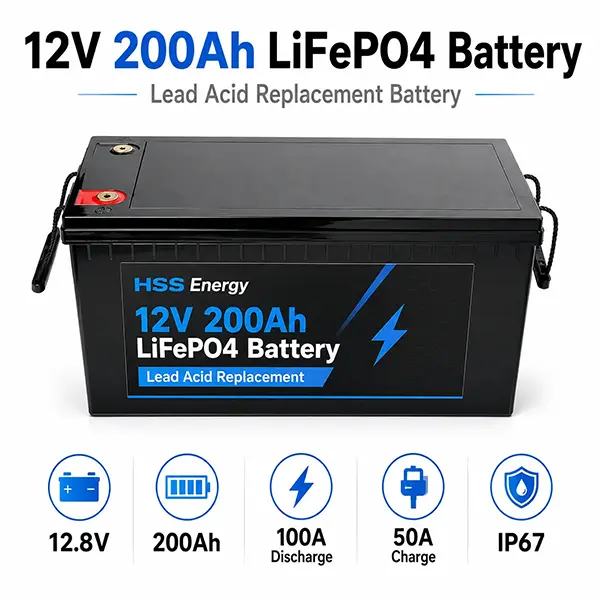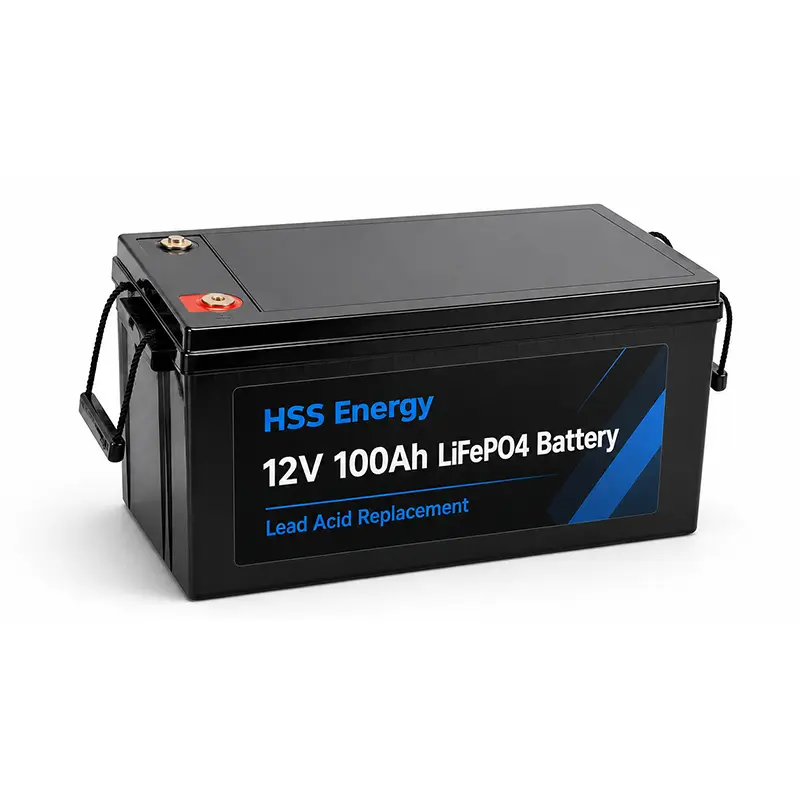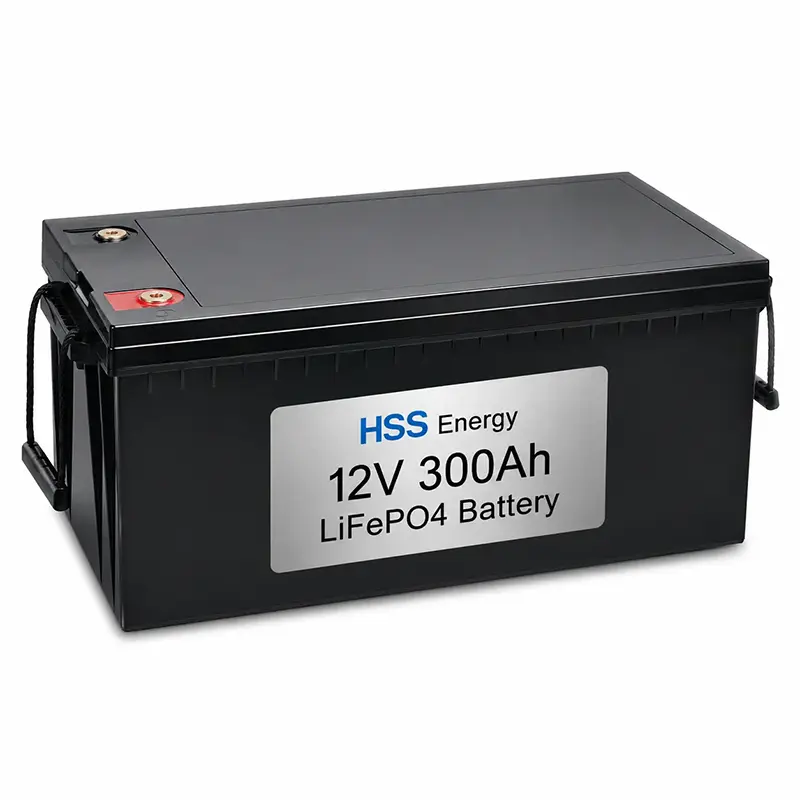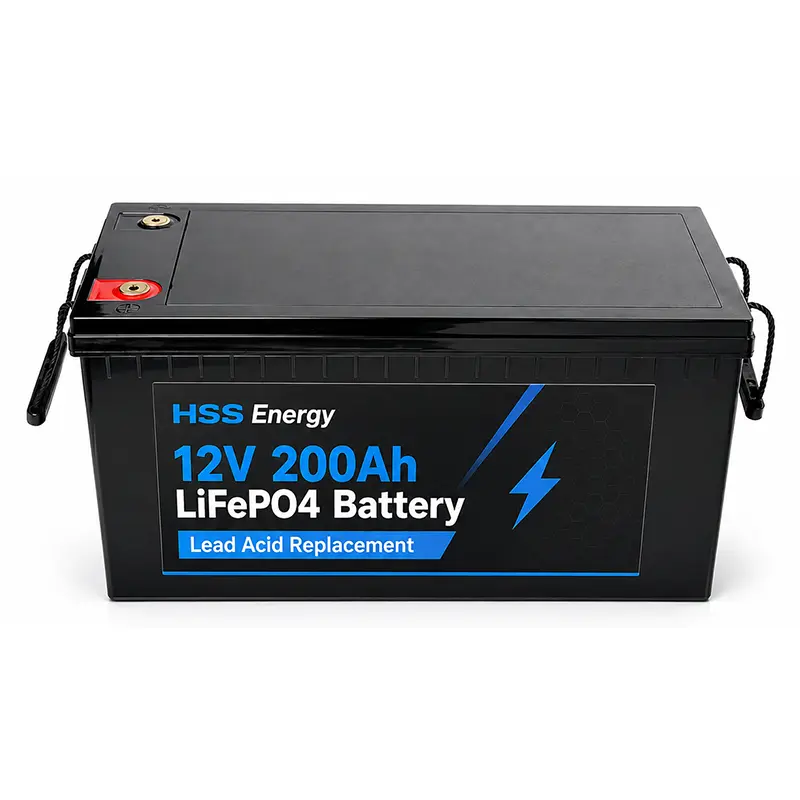
The 12V 200Ah LiFePO4 Battery gives HSS Energy manufacturer a higher-capacity 12.8V nominal platform for 12V-class house-bank and auxiliary-power projects where reserve capacity matters more than the 100Ah entry tier. Selection should confirm charger profile, sustained and transient load demand, fuse and cable sizing, terminal layout, compartment space, low-temperature charging behavior, parallel approval and the approved BMS configuration before production.
200Ah increases stored charge capacity; it does not increase the source-listed 100A maximum discharge limit.
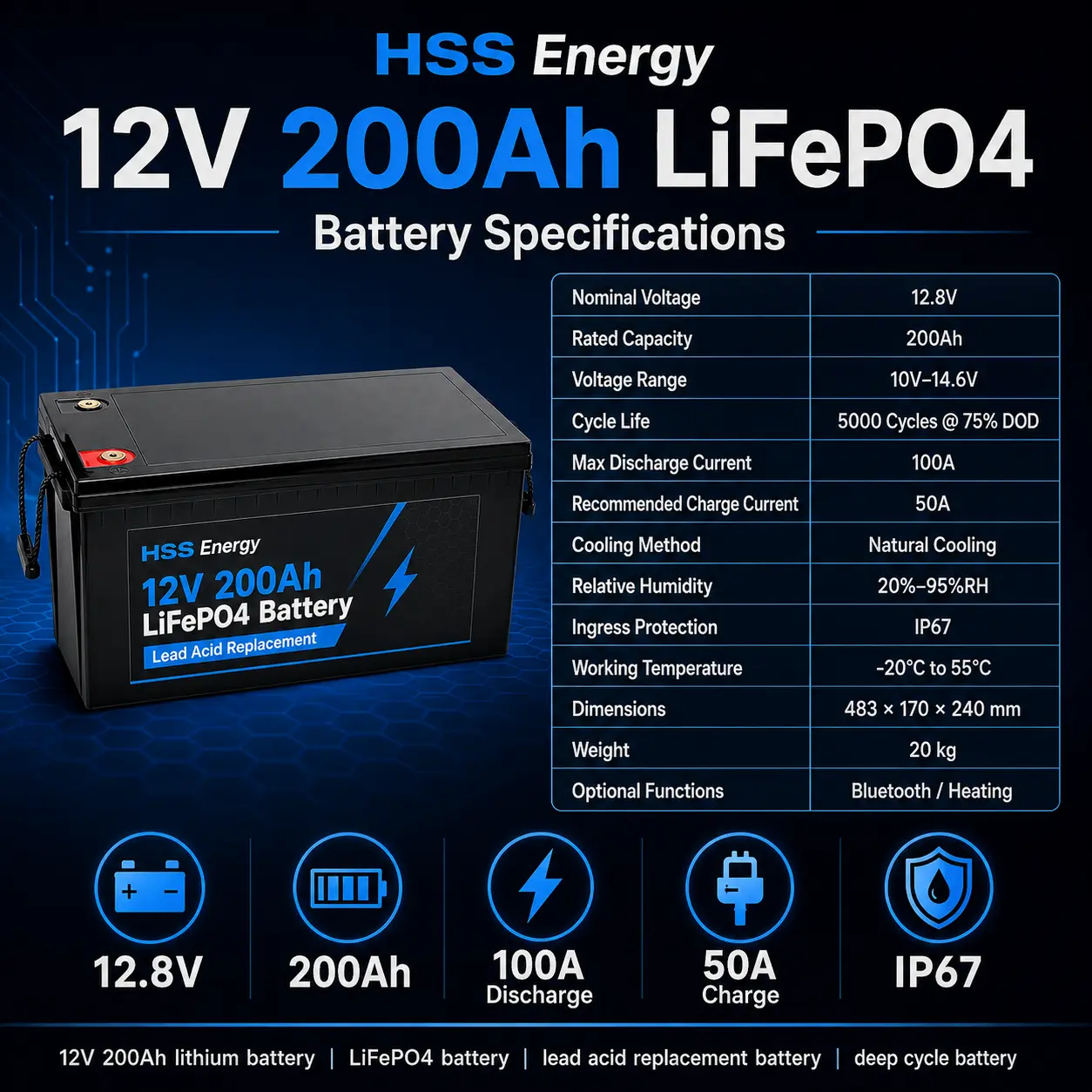
Source-listed values for the supplied 12V 200Ah reference configuration
|
Parameter |
Reference value |
|
Product / market class |
12V 200Ah |
|
Nominal voltage |
12.8V |
|
Rated capacity |
200Ah |
|
Voltage range |
10.0 - 14.6V |
|
Cycle life |
5,000 cycles @ 75% DOD (source-listed) |
|
Max discharge current |
100A |
|
Recommended charge current |
50A |
|
Cooling method |
Natural cooling |
|
Relative humidity |
20% - 95% RH |
|
Ingress protection |
IP67 (source-listed) |
|
Working temperature |
-20C to 55C |
|
Dimensions |
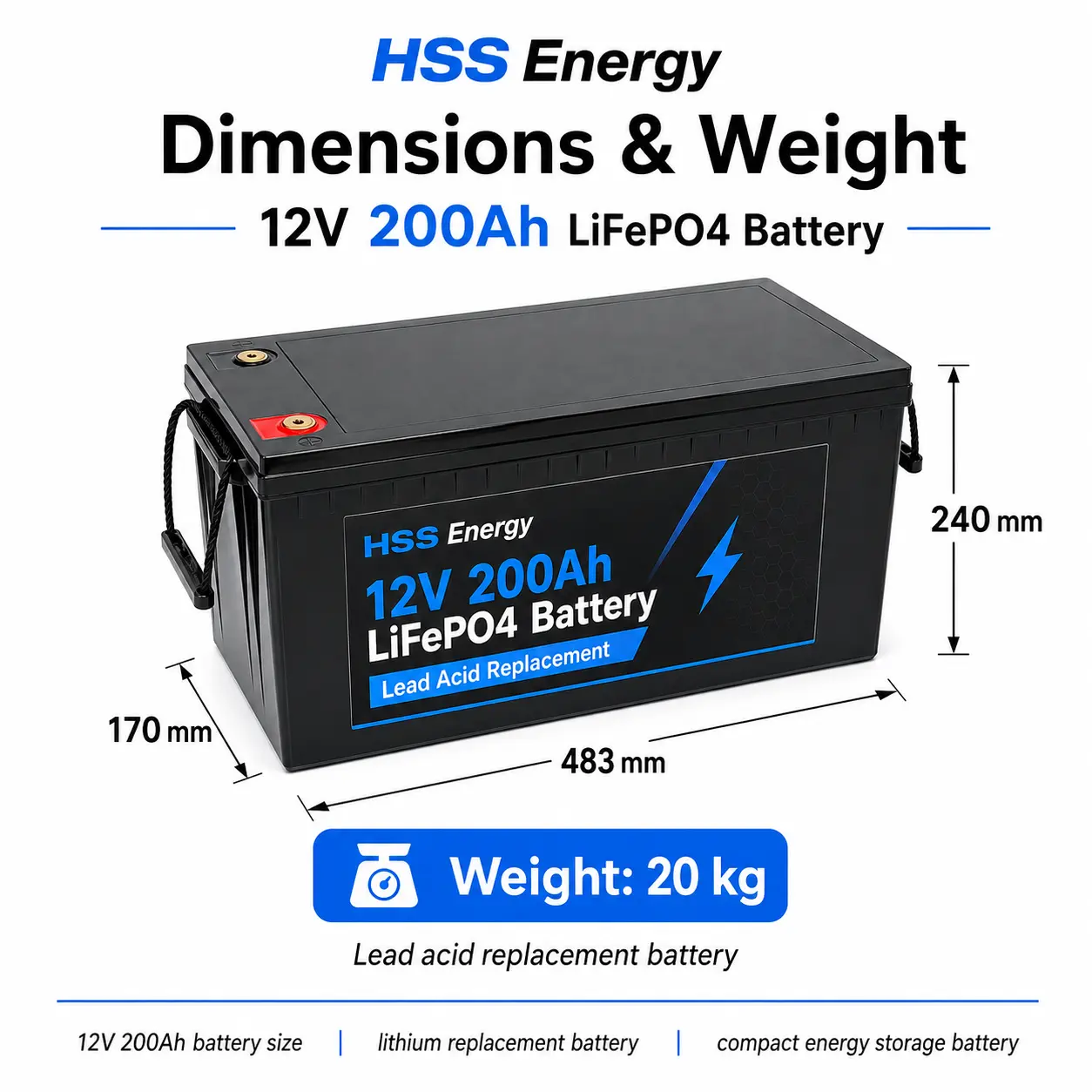
483 x 170 x 240 mm |
|
Weight |
20 kg |
|
Optional functions |
Bluetooth / Heating |
|
Series / parallel limits |
Confirm for approved configuration |
When evaluating a 12.8V 200Ah LiFePO4 battery, customers should separate capacity from power capability: the source lists 200Ah capacity but the same 100A maximum-discharge figure used in the supplied family data. Inverter and DC-load demand must therefore be checked independently from runtime expectations.
● 12V is the market/system class; the supplied LiFePO4 reference configuration is 12.8V nominal.
● The 200Ah capacity gives more stored charge than a 100Ah-class pack, but actual runtime still depends on load profile, usable SOC window, charging opportunity, temperature and conversion losses.
● The source lists 100A maximum discharge. Confirm continuous load, inverter demand, transient loads, BMS limits and protection before approval.
● The 50A figure is the source-listed recommended charge current. Charger voltage and charging profile still require compatibility review.
● The 483 x 170 x 240 mm enclosure and 20 kg weight make mechanical-fit review more important than on the smaller 100Ah SKU.
● For this 12V 200Ah lithium battery configuration, the supplied IP67 rating and 5,000 cycles @ 75% DOD are source-listed values; model-specific report and warranty scope should follow approved order documentation.
Use 200Ah capacity to plan reserve; use the source-listed 100A figure to plan the power path
Legacy bank map: Record chemistry, Ah rating, battery count, wiring arrangement and the reason the existing bank is being replaced.
Reserve objective: Define the runtime or reserve target first; 200Ah changes stored charge but does not automatically change allowable output current.
Power-path boundary: Check inverter and maximum DC demand against the source-listed 100A maximum-discharge figure and approved BMS behavior.
Charging path: Review charger/converter, solar and alternator/DC-DC behavior; equalization or desulfation modes must not be assumed compatible.
Bank wiring: Verify cable gauge, fuse/disconnect, busbar, polarity, terminal hardware and any approved parallel strategy for the revised layout.
For a 12V 200Ah lithium battery pack used in a lead-acid replacement project, the value of this SKU is not simply a larger Ah number. Review the legacy bank layout, charger behavior, inverter demand, protection and approved BMS current limits as one system before conversion.
|
Decision factor |
Legacy lead-acid bank |
12.8V 200Ah LiFePO4 replacement consideration |
|
Bank layout |
A 12V house bank may use one large battery or multiple lead-acid batteries in parallel. |
A single 200Ah pack may simplify the physical bank, but permitted series/parallel configuration must be confirmed for the approved BMS. |
|
Maintenance |
Flooded batteries may require watering; AGM/GEL are sealed but still need normal system inspection. |
The sealed LiFePO4 pack avoids watering; terminals, cables, protection and mounting still require routine inspection. |
|
Capacity planning |
Ah rating alone does not determine usable runtime. |
200Ah gives a larger charge reservoir, but runtime still depends on real loads, SOC window and charging opportunity. |
|
Output current |
Legacy bank output capability depends on battery type, battery count and condition. |
The supplied configuration lists 100A maximum discharge, so higher Ah must not be read as higher current capability. |
|
Charging |
Existing charger is matched to the lead-acid bank. |
LiFePO4 charge profile compatibility must be verified; do not assume the existing charger can be reused. |
|
Do not promise automatic drop-in replacement, charger reuse or fixed runtime before the approved system-fit review. |
||
Primary SKU role: higher-capacity 12V house bank with a clear charger/inverter review path
|
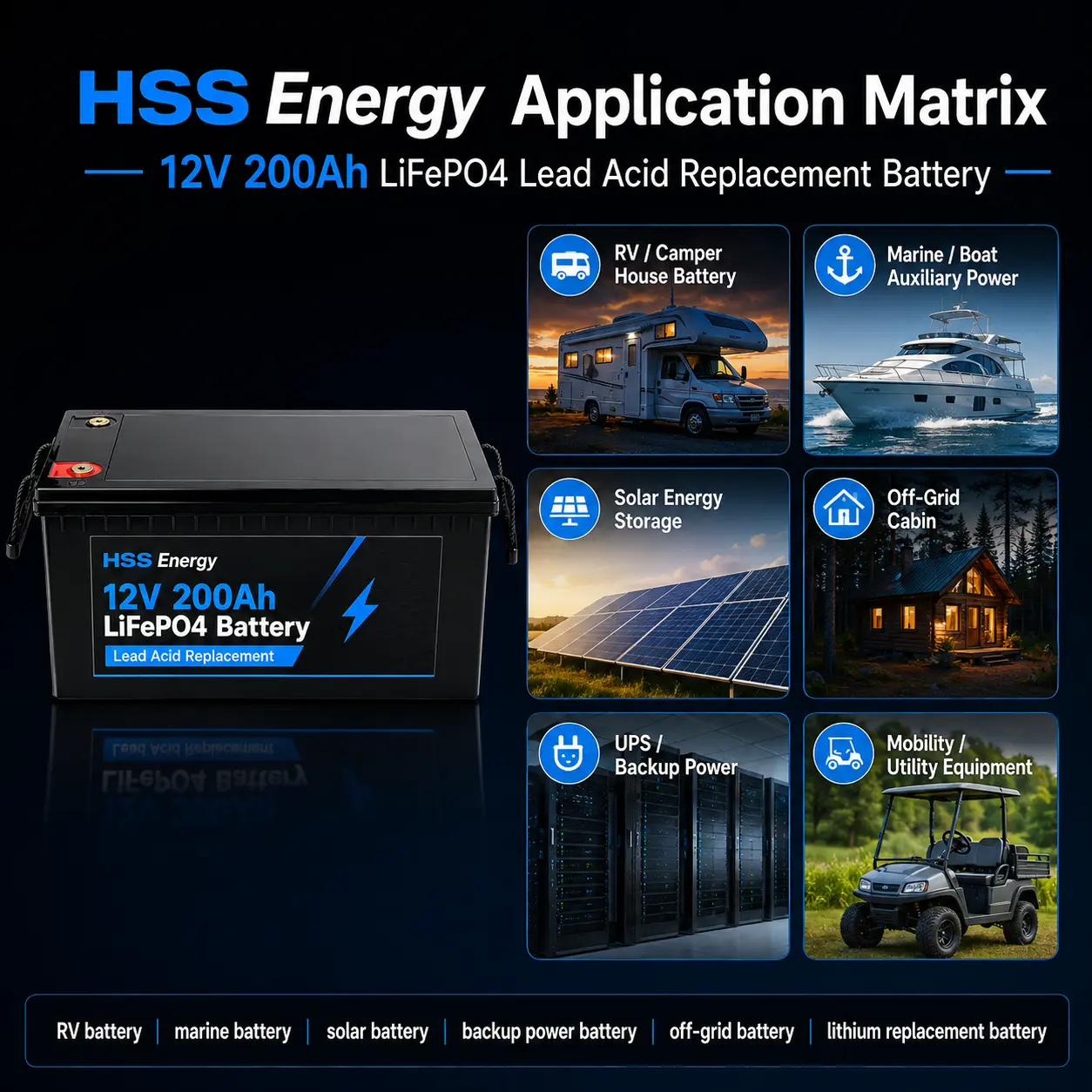
House-bank role A 12V 200Ah LFP battery can support repeated house-load cycling when charger, inverter current, cable/fuse and low-temperature behavior are matched to the approved configuration. |
Chemistry upgrade A 12V 200Ah lithium iron phosphate battery conversion should include shore charger/converter, alternator/DC-DC charging and solar-controller review rather than treating Ah as the only replacement criterion. |
|
Solar / off-grid charging Use an LFP-compatible MPPT/solar controller and size the bank from daily Wh demand, reserve margin and actual charging opportunity. The source-listed 200Ah value does not equal a fixed number of off-grid days. |
Backup / auxiliary loads Match inverter DC current, standby charging profile, cable/fuse and load priority. The 100A source-listed discharge limit remains a key design boundary even though capacity is 200Ah. |
|
Shore Power |
Alternator / DC-DC |
Solar / MPPT |
12.8V 200Ah LFP |
Fuse / Bus / Disconnect |
12V Loads / Inverter |
|
|
200Ah is the capacity decision. The 100A maximum-discharge figure is the power-path decision. Both must fit the project. |
||||||
Use product evidence and project confirmation to define the approved battery
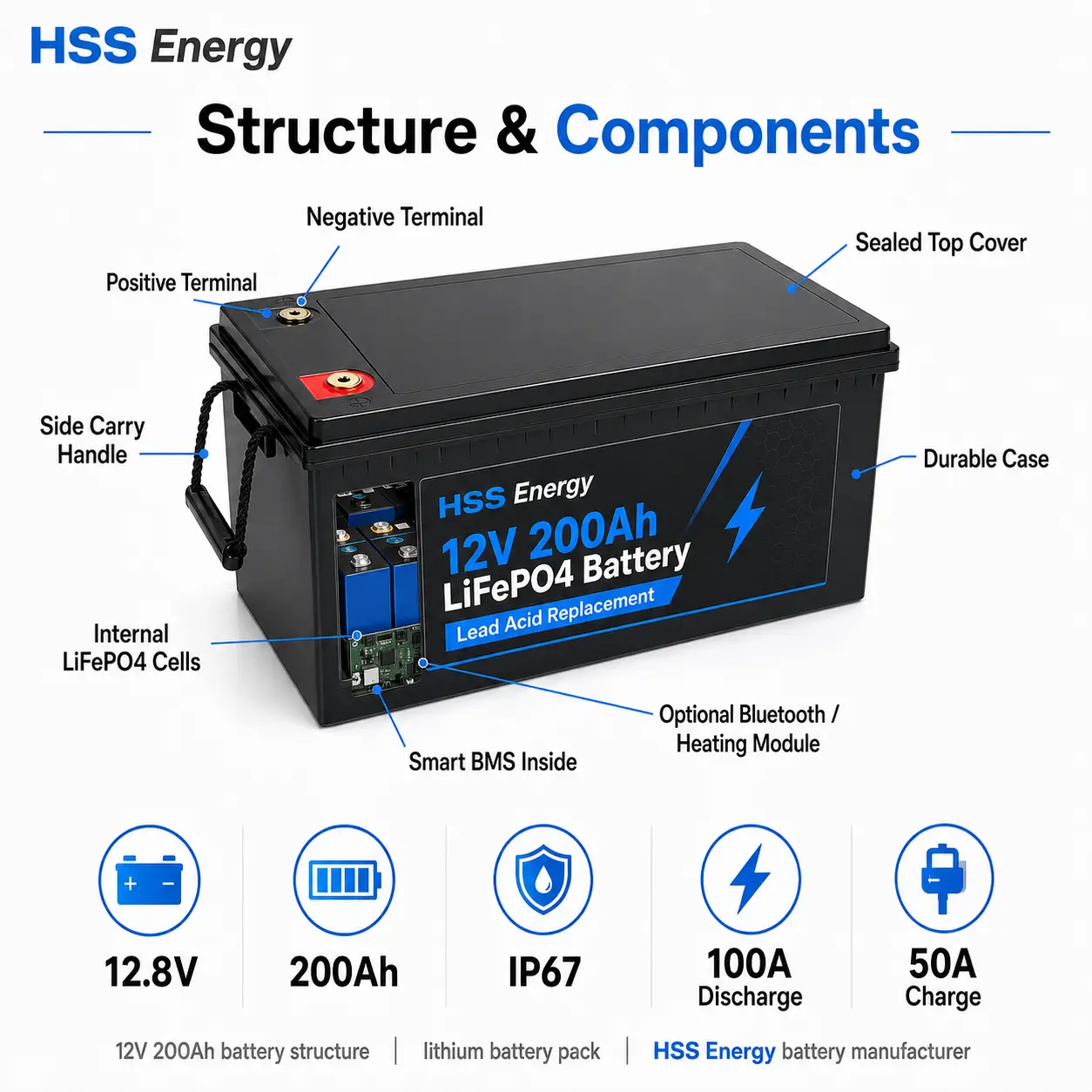
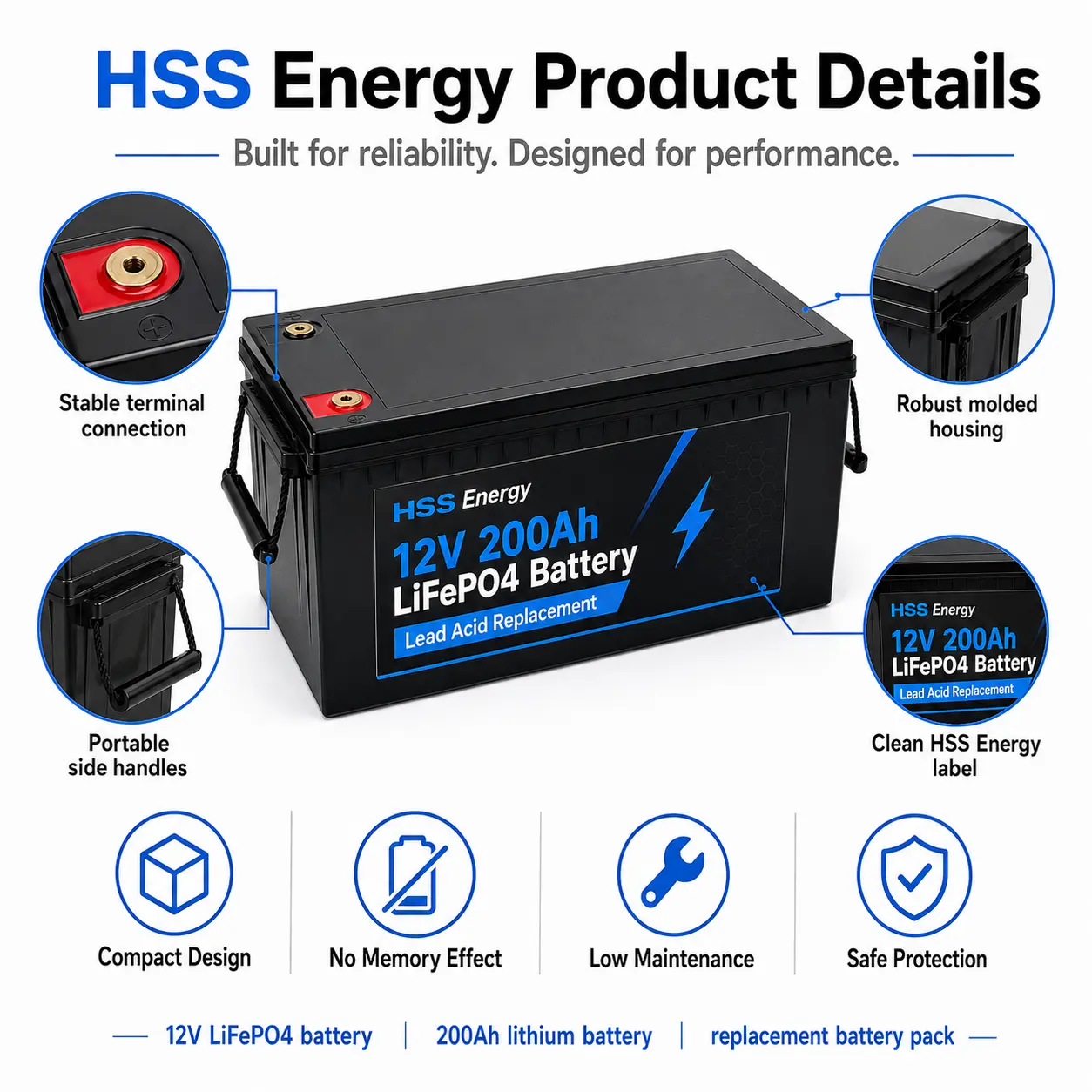
● Terminals and polarity: verify cable lugs, torque requirements, insulation, polarity and service access for the ordered terminal configuration.
● Enclosure and handles: use 483 x 170 x 240 mm and 20 kg for fit review; final approved product drawing should govern production approval.
● BMS: supplied artwork identifies an internal smart BMS. Protection thresholds, current limits and communication functions must follow the approved configuration.
● Optional Bluetooth / heating: treat these as project-selectable options, not automatic standard equipment.
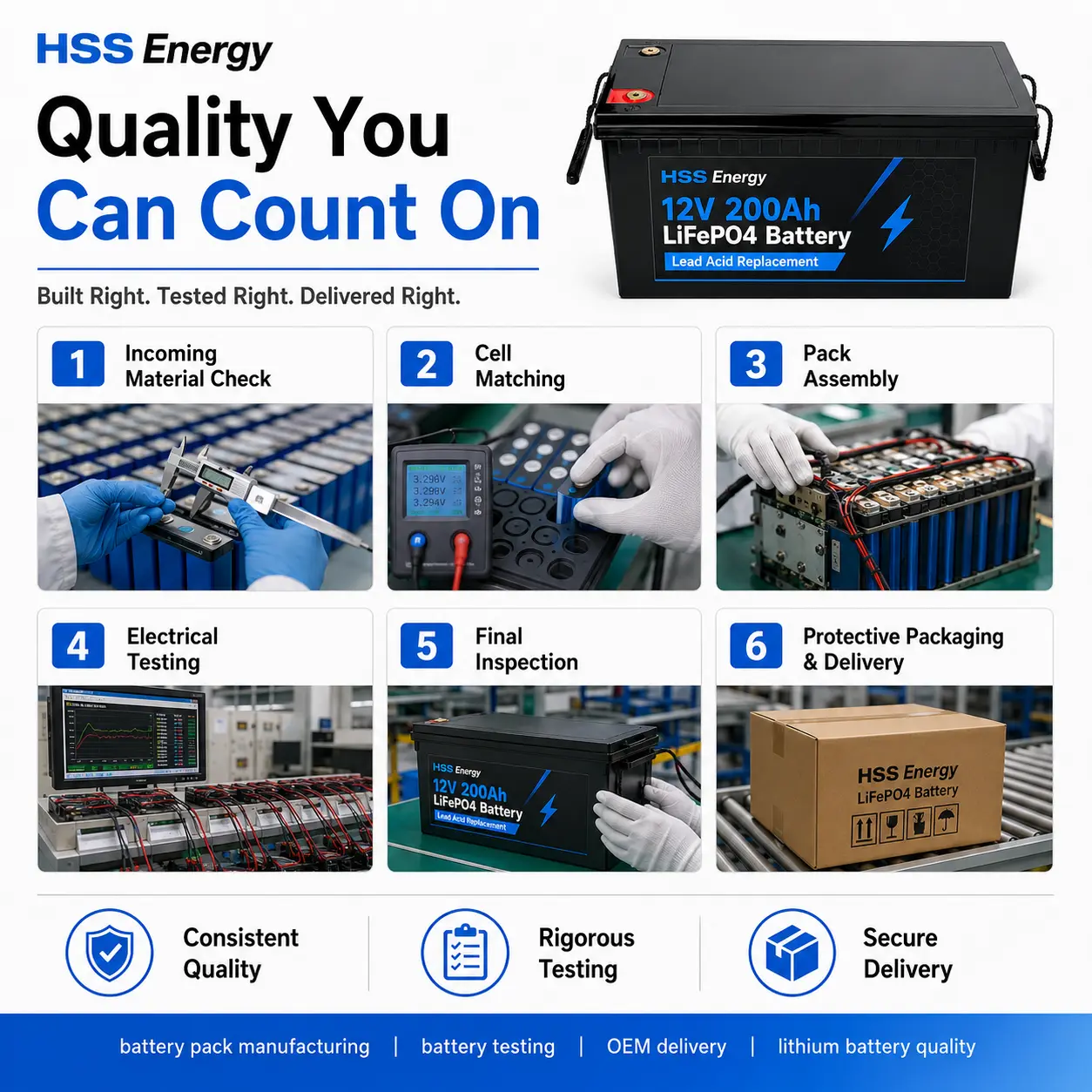
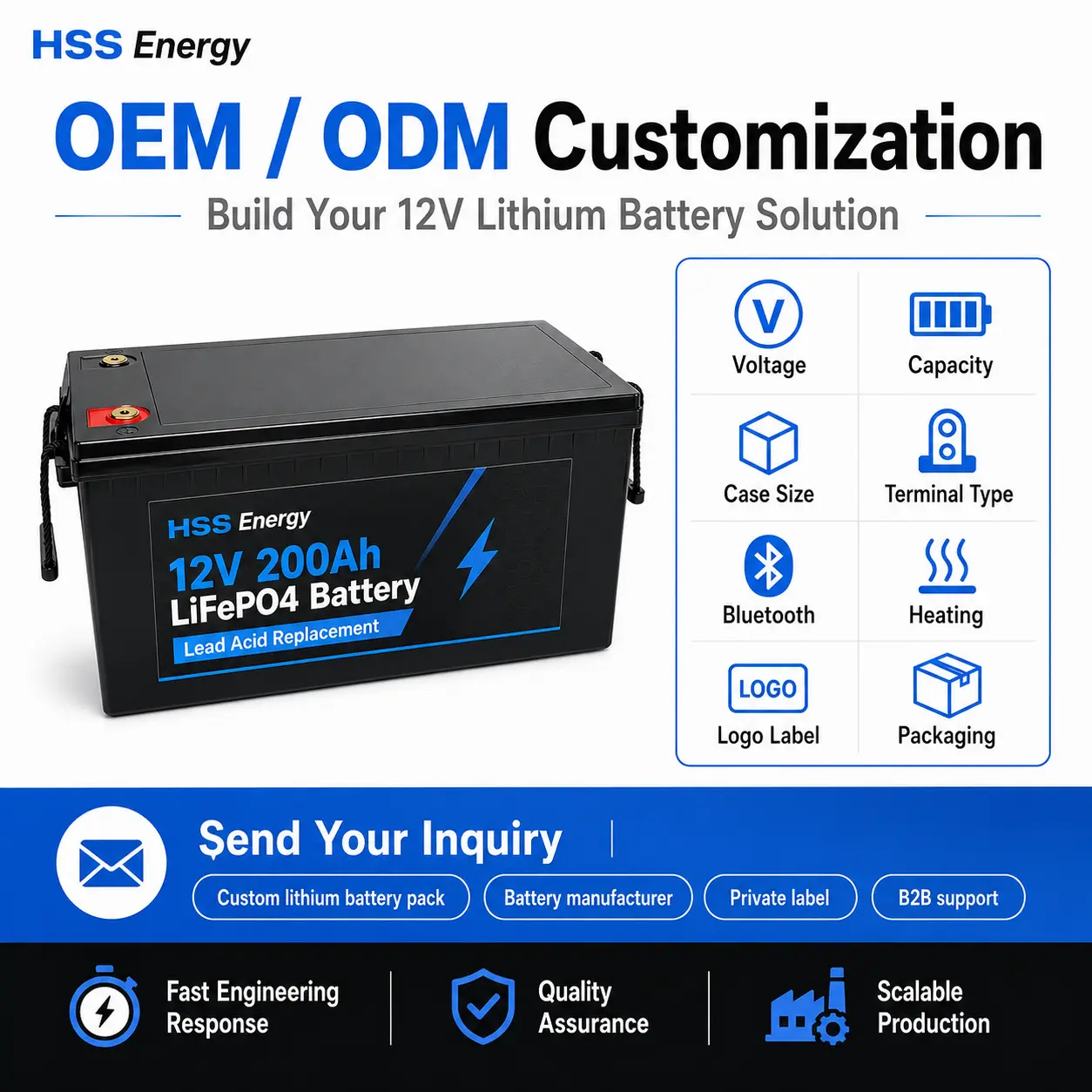
Project-dependent OEM/ODM options may include case and terminal configuration, Bluetooth, heating, private label and packaging. Manufacturing-workflow visuals communicate the supplied production process; model-specific test records, certification scope and final inspection requirements should be confirmed against the approved order.
12V is the market/system class. The supplied LiFePO4 reference configuration is 12.8V nominal, consistent with a four-series LiFePO4 architecture.
Not from the supplied data. This 200Ah reference configuration still lists 100A maximum discharge. Capacity and current capability must be evaluated separately.
Only after checking its charge voltage and operating modes. Equalization or desulfation functions should not be assumed compatible with LiFePO4.
Potentially, but the review must compare total bank voltage, capacity, peak/current demand, charger behavior, compartment layout, cable/fuse and the approved BMS series/parallel limits.
It is a source-listed reference condition. Actual service life depends on charge/discharge current, temperature, SOC window, charger behavior and operating conditions.
Start with daily energy demand, inverter and DC-load current, shore/solar/alternator charging, available installation space and cold-weather charging behavior. Do not convert 200Ah directly into a guaranteed number of operating hours.
Send the legacy battery label/model, chemistry, battery count, compartment dimensions, terminal orientation, charger/converter, inverter or maximum DC load, solar/alternator charging details, operating temperature, quantity and option requirements.
|
SEND YOUR REPLACEMENT REQUIREMENTS |
Include: legacy bank + charger + inverter/load + compartment + terminals + charging sources + quantity + temperature + options |
|
|
FIT REVIEW INPUTS ● Legacy battery chemistry / model / quantity ● Battery-compartment dimensions and terminal orientation ● Charger / converter / solar controller / alternator-DC-DC details ● Maximum DC load or inverter power ● Ambient temperature and whether heating is required ● Bluetooth, label, packaging and order quantity |
Address
A3, 1204-1, 1142 Jimei North Avenue, Software Park Phase III, Xiamen Torch High-tech Zone, Xiamen, China
Tel