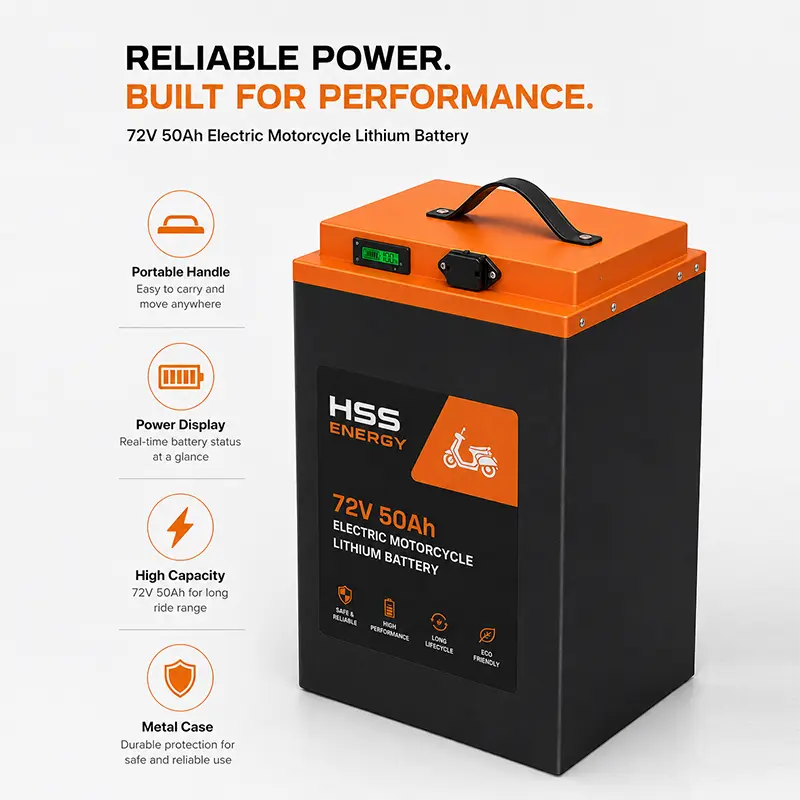
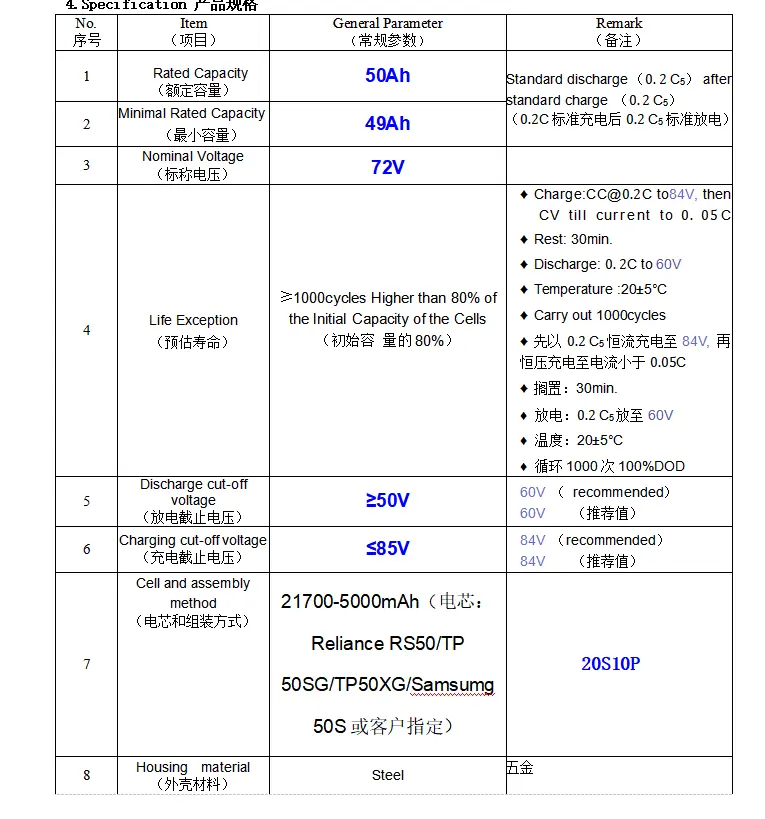
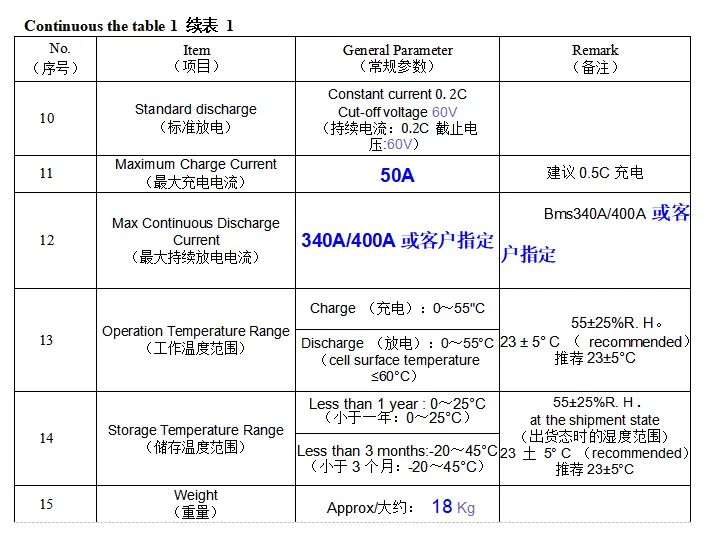
A performance motorcycle battery has to be evaluated as part of the complete vehicle system, not as an isolated box. The 72V 50Ah Electric Motorcycle Lithium Battery uses NCM 21700 cells and a 20S10P architecture to combine a 50Ah energy class with a high-current platform for demanding two-wheel projects. The supplied specification lists 49Ah minimum rated capacity, up to 50A maximum charging current, and 340A / 400A maximum continuous discharge depending on the approved BMS configuration or customer-defined design. For importers, brands and performance builders, the practical advantage is that the electrical platform is already clear while final dimensions, connector position, display requirement, branding and enclosure details can be adapted to the actual motorcycle before sample approval.
|
Item |
Specification |
|
Product Name |
72V 50Ah Electric Motorcycle Lithium Battery |
|
Brand |
HSS Energy |
|
Chemistry |
NCM |
|
Nominal Voltage |
72V |
|
Rated / Minimum Capacity |
50Ah / 49Ah |
|
Cell Format |
21700 5000mAh cylindrical cells |
|
Cell Configuration |
20S10P |
|
Cell Model Reference |
Reliance RS50, TP50SG, TP50XG, Samsung 50S, or customer-designated model; final BOM approval required |
|
Housing Material |
Steel / metal case |
|
Display |
LCD power display shown in supplied product visual |
|
Charge Method |
CC @ 0.2C to 84V, then CV until current falls to 0.05C |
|
Recommended Charge Voltage |
84V |
|
Charge Cut-off Voltage |
≤85V |
|
Maximum Charge Current |
50A; supplied sheet recommends 0.5C charging |
|
Standard Discharge |
0.2C to 60V |
|
Recommended Discharge Cut-off |
60V |
|
Discharge Cut-off Voltage |
≥50V |
|
Maximum Continuous Discharge |
340A / 400A or customer-designated configuration, subject to approved BMS and finished pack design |
|
Operating Temperature |
Charge 0-55°C | Discharge 0-55°C; cell surface temperature ≤60°C |
|
Storage Temperature |
Less than 1 year: 0-25°C | Less than 3 months: -20-45°C |
|
Cycle Life Reference |
>1000 cycles with remaining capacity above 80% of initial capacity under supplied reference conditions |
|
Approx. Weight |
Approx. 18kg |
|
Dimensions |
According to custom requirements / approved project drawing |
|
OEM / ODM |
Available |
The key commercial difference in this 50Ah version is the combination of capacity and discharge headroom. A project targeting 10kW, 12kW or 15kW does not need the full 340A / 400A reference current continuously, but it does need enough battery, BMS, cable and connector margin to support acceleration, hill climbs and short high-load events without excessive voltage sag or thermal stress. At 72V nominal voltage, 10kW is roughly 139A, 12kW about 167A and 15kW about 208A as simple screening values. Actual current changes with loaded voltage, drivetrain efficiency, controller strategy and duty cycle, so final approval remains vehicle-specific.
|
Target System Power |
Approx. Current @ 72V |
Engineering Use |
|
10kW |
~139A |
Performance project screening |
|
12kW |
~167A |
Performance project screening |
|
15kW |
~208A |
Performance project screening |
|
Higher |
Project-specific |
Full electrical and thermal review required |
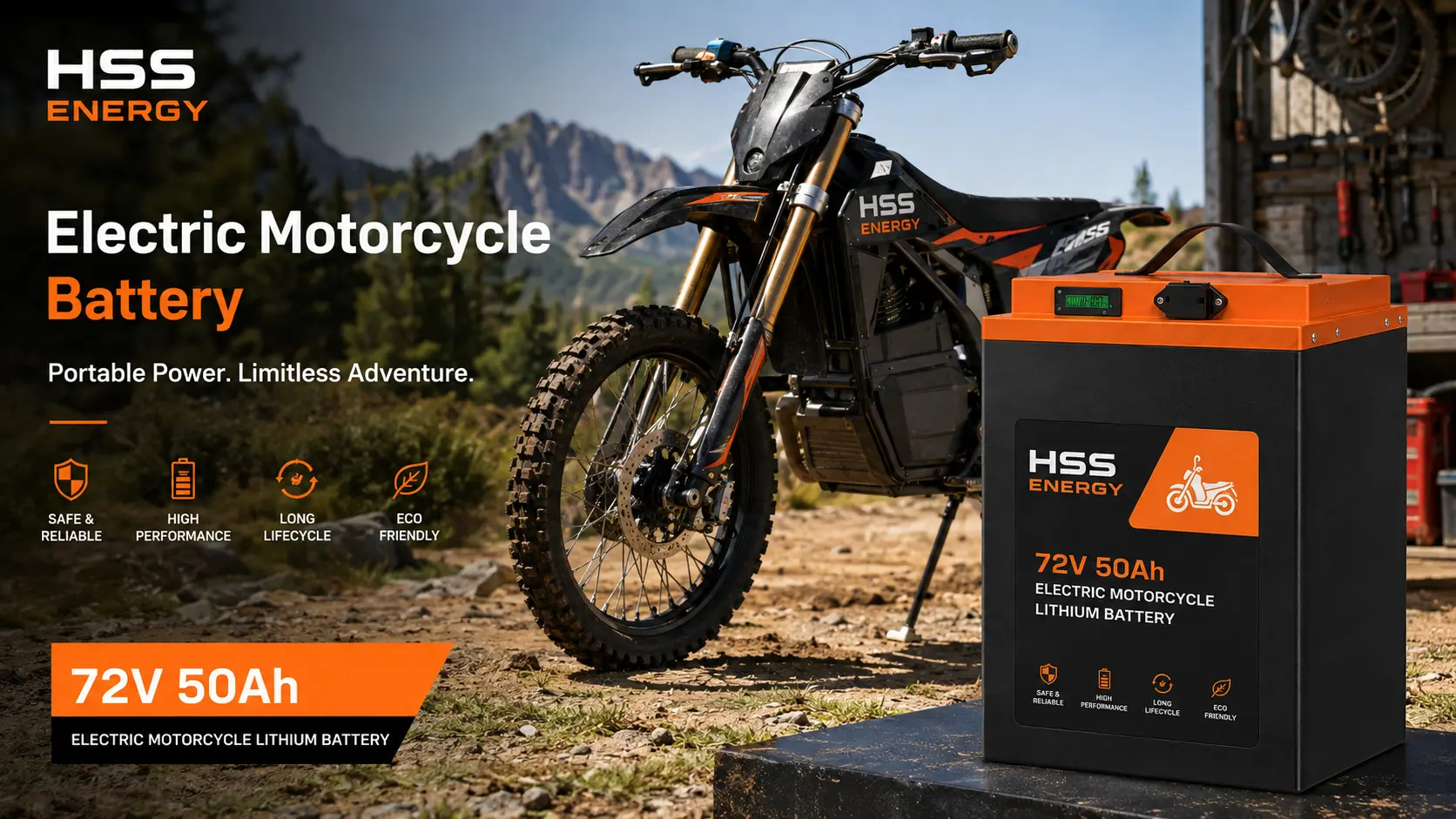
Application-style image for off-road / performance positioning. Final motorcycle compatibility must be confirmed at project level.
When customers compare range and performance, the larger 50Ah capacity becomes valuable when a vehicle needs both strong output and more riding time between charges. In that context, a 72V 50Ah lithium battery gives the project a stronger energy reserve without reducing the decision to a headline range claim. customers should still compare expected average power, riding style, usable SOC, terrain and charging frequency, because repeated acceleration and steep climbing can consume energy quickly even when the nominal route distance is short. For distributors and vehicle brands, the 50Ah platform therefore offers a stronger performance-and-range story than smaller-capacity packs, while still allowing the enclosure to be adapted to the real chassis and weight target.
High-current output is only as strong as the complete discharge path that carries it from the cells to the controller. In a high discharge electric motorcycle battery, the supplied 340A / 400A maximum continuous-discharge configurations are meaningful only when cell selection, BMS design, busbars, cable gauge, connector rating, cooling and the controller current profile are approved together. This is why HSS treats target motor power and controller data as quotation inputs rather than relying on a single current number. For 10kW, 12kW and 15kW enthusiast projects, the goal is to preserve enough electrical and thermal margin for acceleration and sustained riding without turning a laboratory current rating into an unconditional vehicle claim.
Where a project values energy density, strong output and a more compact high-energy package, a 72V NCM electric motorcycle battery can provide a useful balance between capacity and installation volume. In this 20S10P design, the NCM 21700 platform gives the customers a 50Ah-class battery without moving to a much larger low-energy-density enclosure. That can be important on electric motorcycles and off-road motorcycles where battery volume influences frame design, ground clearance and vehicle balance. Chemistry alone does not define the final current capability or cycle life, so the approved cell model, BMS limits and thermal conditions must remain part of the production specification.
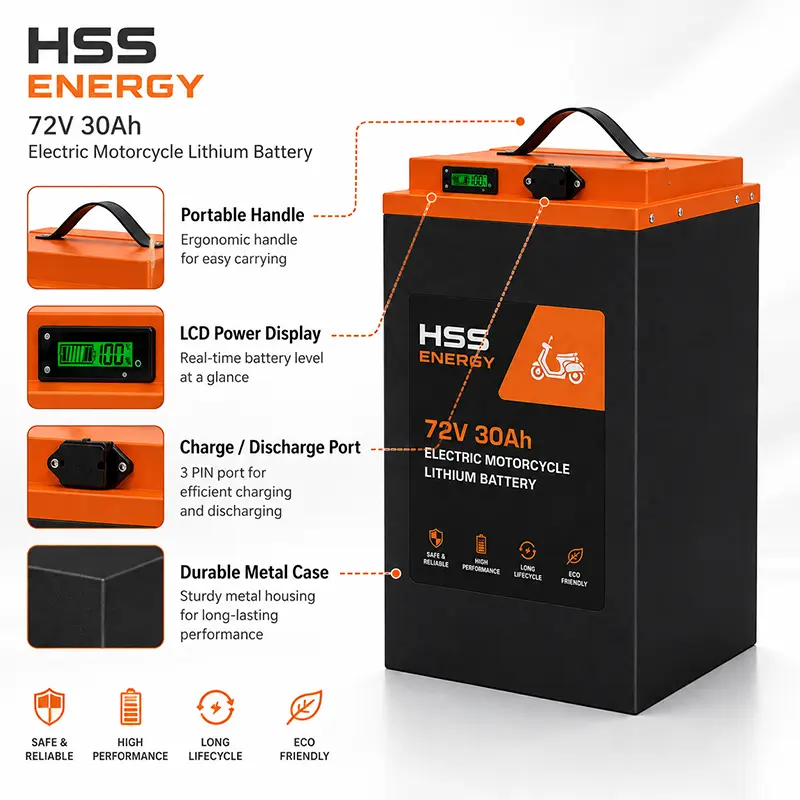
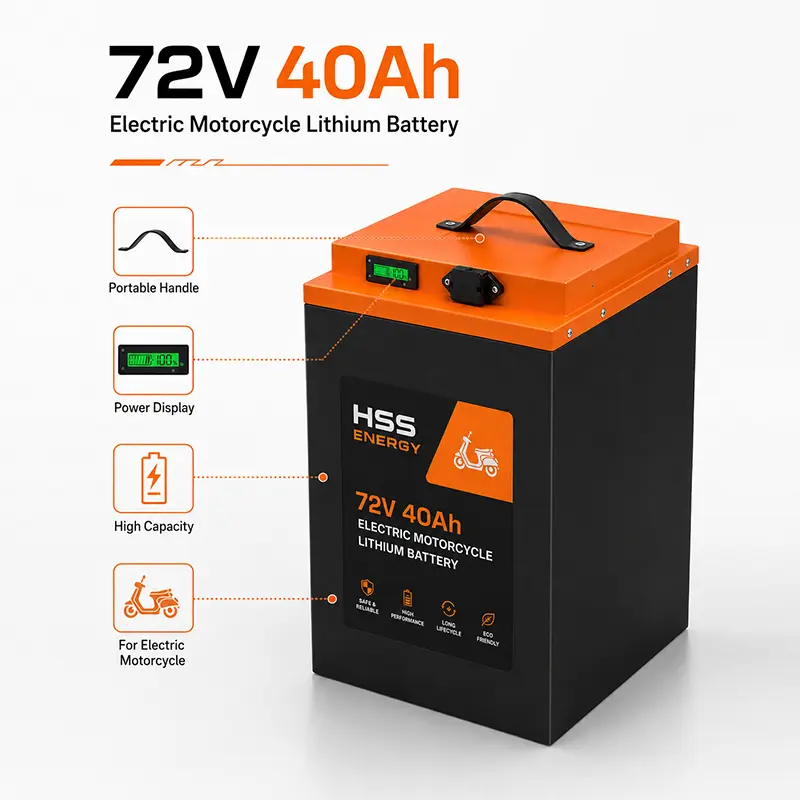
This product is presented as a finished removable module rather than a bare shrink-wrapped pack. For customers sourcing a 72V 50Ah motorcycle battery, the steel enclosure, carry handle, LCD power display and accessible front interface add practical value beyond the electrical specification by making the battery easier to understand, remove, inspect and replace. For importers and motorcycle brands, those details can also make the product easier to present as a complete upgrade solution instead of only an internal component. The final handle, connector location, exterior label and installation clearances should still be frozen from the motorcycle drawing so that the finished battery supports both performance and practical serviceability.
Electrical performance alone does not guarantee a successful motorcycle project; the enclosure must fit, the connector must be correctly positioned and the battery must have a clear installation and removal path. That is why an electric motorcycle battery pack should be reviewed against the actual battery bay before the sample is released. HSS keeps dimensions custom and asks for the mounting direction, access path, cable route and connector requirements as part of that review. This becomes even more important with a higher-capacity pack because weight and enclosure size have greater influence on motorcycle balance and service access. A project-defined drawing gives buyers a clearer quotation, a more meaningful prototype and a better basis for repeat production.
The commercial value of this battery is not limited to the electrical platform. Cell model, BMS configuration, connector family, display requirement, label, housing details and final dimensions can be reviewed as part of one project package. For foreign-trade customers, freezing those items in an approved drawing and technical specification before bulk production reduces the gap between the sample that was tested and the batteries that arrive in later shipments. It also gives distributors and motorcycle brands a more repeatable product they can document, market and support in their local market instead of depending on informal factory notes.
This product is most relevant to performance-oriented electric motorcycle and off-road motorcycle projects rather than low-current commuter platforms. It can be evaluated for road bikes that need stronger acceleration, off-road builds that see repeated hill climbs and uneven terrain, enthusiast conversions where motor and controller power have been upgraded, and OEM projects that want a removable high-energy battery in a finished metal enclosure. The 10kW / 12kW / 15kW positioning should always be connected to the actual controller and motor data, because the same nominal motor power can create very different battery current and heat depending on riding conditions and system efficiency.
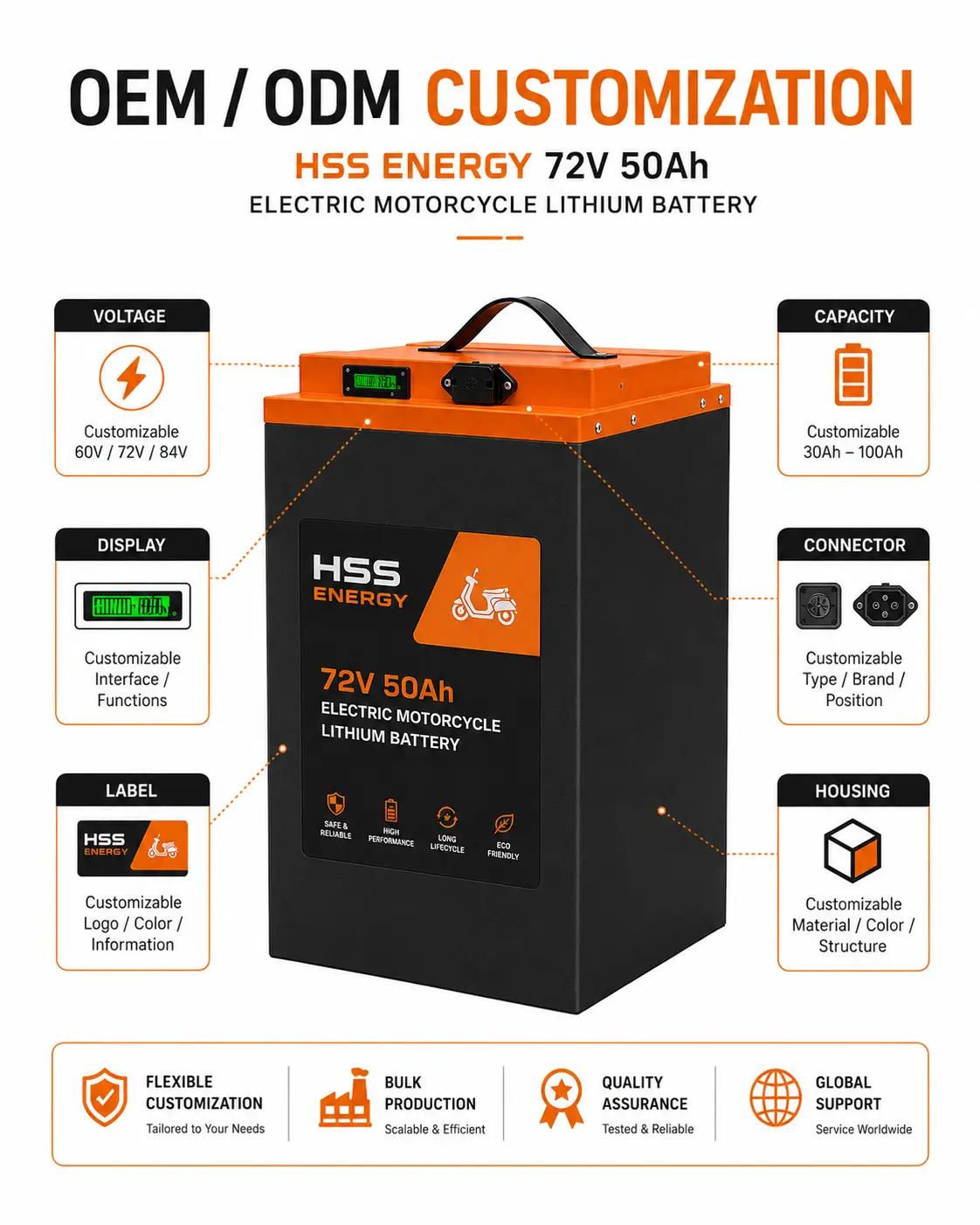
Customization-style product visual supplied for this product series.
· Final battery dimensions according to battery-bay and installation requirements
· Connector type, mating interface, position and cable route
· LCD / display functions and interface requirements
· Label, logo, color and market-facing product information
· Housing details and mechanical structure within the approved design
· Cell model and BMS configuration subject to the approved BOM and electrical target
· Packaging and project documentation according to export-order requirements
|
Good Fit When |
Review Another Configuration When |
|
The vehicle uses a 72V nominal battery architecture and NCM is acceptable for the project. |
The motorcycle requires another nominal voltage or a different chemistry route. |
|
50Ah fits the target riding time, chassis mass and battery-bay allowance. |
The project needs a much smaller or larger capacity class. |
|
The controller and motor can be matched to the approved high-current configuration. |
Current, connector or thermal demand exceeds the approved finished-pack design. |
|
A removable steel-case module improves serviceability and end-user handling. |
The vehicle requires a sealed integrated battery with a different mechanical format. |
|
Custom dimensions and interface details can be approved from the motorcycle drawing. |
The fixed battery bay cannot accept the product format or required service clearances. |
· Motorcycle type, target market and intended use (road / off-road / performance upgrade)
· Battery-bay drawing or maximum allowable dimensions
· Controller continuous current, peak current and target motor power
· Target riding range or energy requirement
· Charger voltage, charge current and connector information
· Preferred discharge connector and installation direction
· Display, branding, housing and label requirements
· Sample quantity, forecast bulk quantity and destination country
For a high-current motorcycle battery, customers confidence depends on more than a specification table. Incoming material checks, controlled assembly, electrical verification and export packaging all influence whether the configuration can be repeated from sample to bulk production. The supplied process visual is used here as supporting manufacturing context: it shows the intended flow from incoming inspection to assembly, final test and packaging. Model-specific test criteria, acceptance limits and any required certification documents should be confirmed separately in the technical agreement or documentation package instead of being assumed from a marketing image.
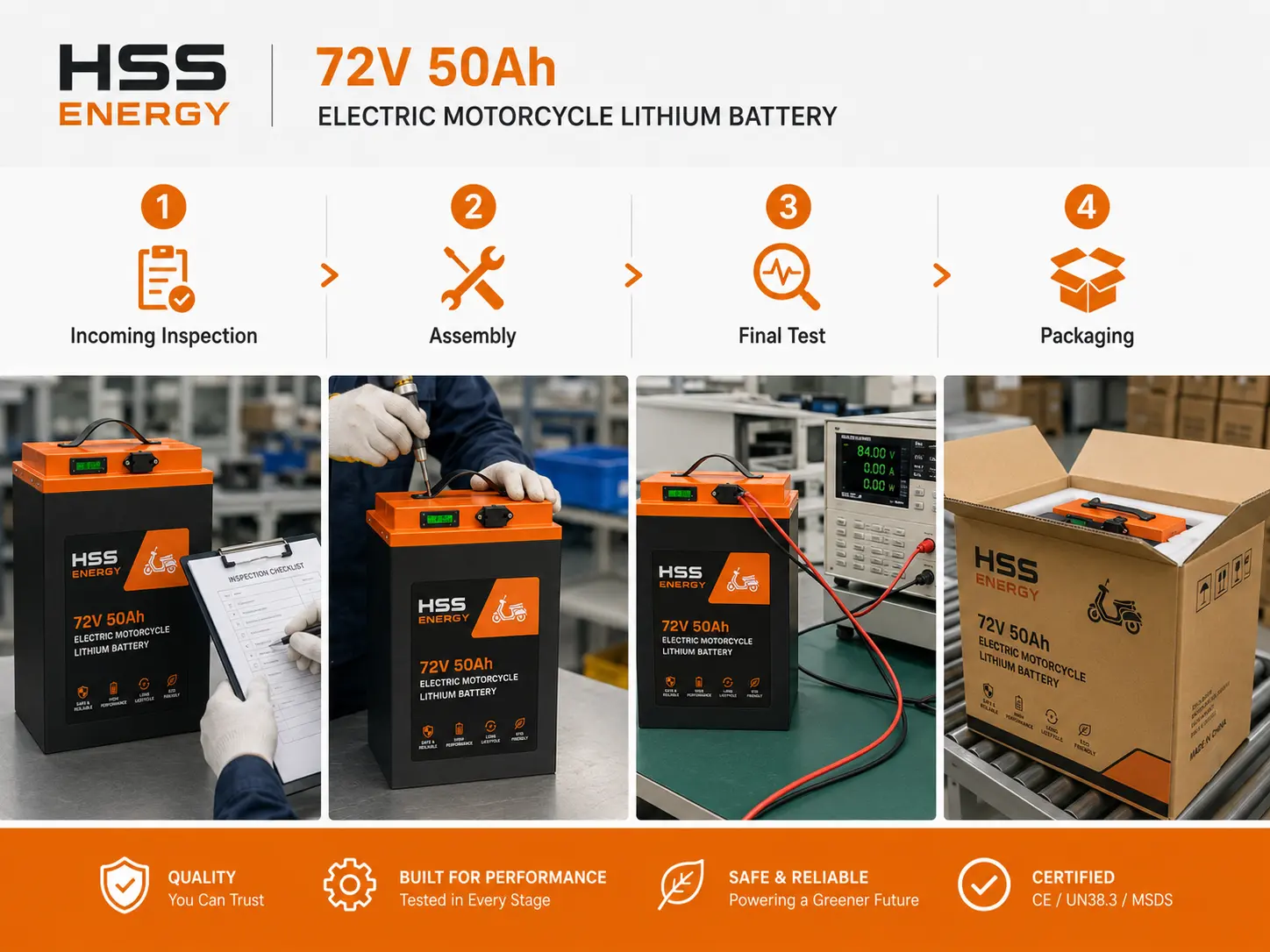
Quality / assembly / final-test / packaging visual supplied for the product series.
Yes. The supplied specification identifies this 72V 50Ah reference configuration as an NCM 21700 battery using a 20S10P structure.
It is positioned for these power classes and potentially higher, but final approval depends on loaded voltage, controller current, motor behavior, BMS, cells, cable, connector and thermal design.
No. The value is tied to the approved BMS and finished pack configuration, and the supplied sheet also allows a customer-designated configuration.
No. Final dimensions should be confirmed according to the motorcycle battery bay, mounting direction, interface and approved project drawing.
Yes. Connector type and position, display requirements, label and enclosure details can be reviewed as part of the OEM / ODM configuration.
The supplied sheet references Reliance RS50, TP50SG, TP50XG and Samsung 50S, with customer-designated options subject to final BOM approval.
Provide the battery-bay dimensions, controller current, motor power, charger information, connector requirements, target quantity and intended riding application.
Address
A3, 1204-1, 1142 Jimei North Avenue, Software Park Phase III, Xiamen Torch High-tech Zone, Xiamen, China
Tel