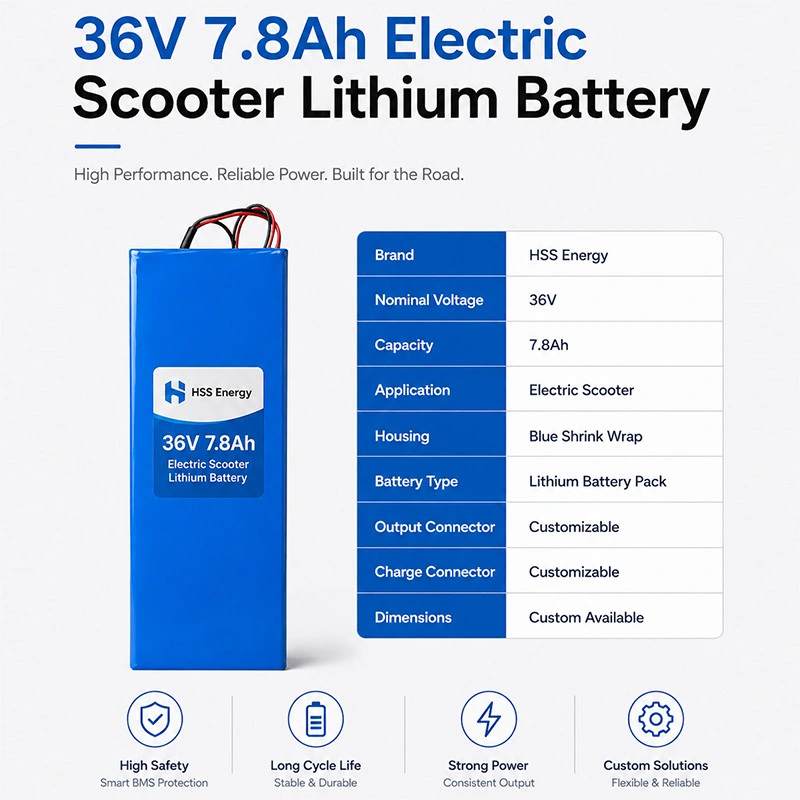
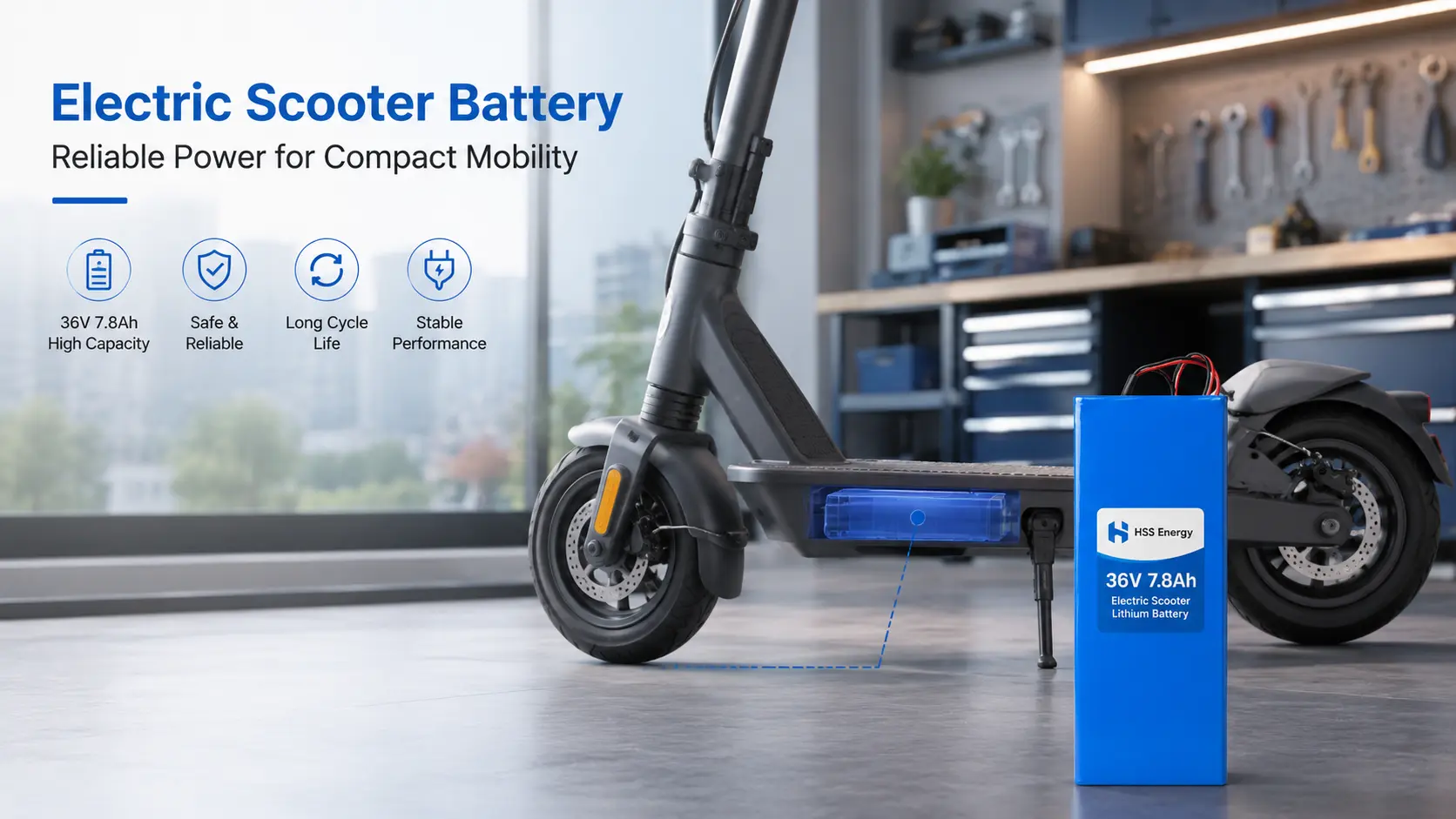
The 36V 7.8Ah Electric Scooter Lithium Battery is HSS Energy factory designed for compact electric scooters that need a larger energy reserve without moving to a completely different voltage platform. The 10S3P structure uses three parallel 2600mAh cells per series group, providing 7.8Ah nominal capacity and approximately 280.8Wh of stored energy. Compared with a smaller-capacity 10S pack, the additional parallel cell group gives the scooter more energy for daily commuting and also shares discharge load across more cells. Regular pack dimensions are 190 x 60 x 68 mm, while XT60 and JST are the most common connector choices. Final BMS current, cable length, polarity, charger and mounting clearance should still be reviewed against the target scooter before the sample is frozen.
|
Item |
Specification |
|
Product Name |
36V 7.8Ah Electric Scooter Lithium Battery |
|
Brand |
HSS Energy |
|
Nominal Voltage |
36V |
|
Rated Capacity |
7.8Ah / 7800mAh |
|
Nominal Energy |
Approx. 280.8Wh |
|
Cell Format |
18650 2600mAh cells |
|
Cell Configuration |
10S3P |
|
Cell Quantity |
30 cells |
|
Full-Charge Reference |
42V for a conventional 10S lithium-ion architecture; final charger must match the approved pack |
|
Regular Size |
190 x 60 x 68 mm |
|
Common Connector Options |
XT60 and JST |
|
Wire Length |
Customized according to scooter wiring and installation |
|
BMS |
Project-specific; current and protection settings confirmed before production |
|
Cycle Life Reference |
500 cycles |
|
Outer Finish |
Shrink-wrap style pack shown in supplied images; final color / label can be customized |
|
Application |
Electric scooters and suitable compact mobility projects after system-level review |
|
OEM / ODM |
Available |
Specification note: the 190 x 60 x 68 mm size is the regular reference for this configuration. Final BMS current, connector pinout, cable length, charger setting, label and other project details should follow the approved drawing, BOM, technical agreement or PI.
A customers upgrading a compact scooter often wants longer usable riding time without redesigning the controller and charger around a higher-voltage system. The 10S3P structure addresses that need by increasing parallel capacity while keeping the same 36V-class architecture. In practical selection, a 36V 7.8Ah scooter battery gives the project 7.8Ah and roughly 280.8Wh of nominal energy, making it a stronger option for daily commuting, longer service intervals between charges or users who simply need more runtime than smaller packs can offer. Final riding distance still depends on motor power, rider weight, speed, road gradient, tire pressure, temperature and usable state of charge, so HSS treats the battery as an energy platform rather than publishing a universal range claim.
Three cells in parallel change more than the Ah number. The parallel structure spreads discharge current across a larger number of cells and creates more stored energy than a 10S2P arrangement using the same individual cell family. When engineering teams evaluate a 36V 7.8Ah battery pack, the main advantage is that the battery can support a longer duty cycle while keeping the same 10-series voltage route. Actual current capability still depends on the selected 18650 cell, BMS, nickel structure, cable and connector, so the controller's continuous and peak current should be supplied before HSS freezes the production design.
This model is defined around 18650 2600mAh cells rather than a mixed or unspecified cell count, which makes the configuration easier to document for OEM and replacement projects. With 30 cells arranged as 10 series groups of 3 parallel cells, the pack reaches the required 7.8Ah capacity in a straightforward architecture. For customers comparing a 36V 7.8Ah lithium ion battery, that structure creates a useful basis for incoming inspection, BOM control and repeat production. The final cell brand or model can be confirmed during the project review, while the 2600mAh cell capacity and 10S3P structure remain the defining electrical layout of this page.
A correct battery can still become unusable if the connector family, polarity or cable exit does not match the scooter. XT60 and JST are the common interface directions for this 7.8Ah model, but the final choice should follow the vehicle-side connector and the current requirement of the actual scooter. When a project specifies a 36V 7800mAh lithium battery, HSS can confirm connector type, pin definition, polarity, wire gauge and lead length before the sample is released. This is particularly important for replacement channels, where two visually similar packs may use different plugs or wire routing even when voltage and capacity are identical.
Cycle life is influenced by cell quality, depth of discharge, charging voltage, temperature, current and storage conditions, so the 500-cycle figure should be treated as the product reference rather than a promise under every riding pattern. For a 7.8Ah electric scooter battery, using the correct charger, avoiding unnecessary over-discharge and keeping the pack away from excessive heat can help preserve usable capacity over time. For OEM customers, HSS can lock the charger requirement and protection settings in the approved technical specification so that the battery, BMS and charging method are evaluated as one system instead of separate components.
The 190 x 60 x 68 mm regular size gives customers a concrete mechanical starting point and is particularly helpful when comparing replacement space or designing a new battery compartment. Even so, overall dimensions alone do not confirm fit. Connector clearance, wire exit, mounting pressure, deck cover clearance and service access must also be checked. For this reason, HSS recommends confirming the battery bay from a drawing or original sample before bulk production, especially when the scooter has a narrow deck or the wiring must exit from a fixed direction.
The 36V 7.8Ah platform is most suitable for compact commuter scooters and replacement projects where the customers wants more energy than a smaller 4.4Ah-class battery but still needs to stay within a relatively narrow battery compartment. It is a practical middle-capacity option for daily commuting, repair channels, rental or service fleets with moderate route length, and OEM scooters that can accommodate the 190 x 60 x 68 mm reference envelope. The correct application should still be verified from controller demand, rider and payload conditions, terrain and charging schedule rather than from capacity alone.
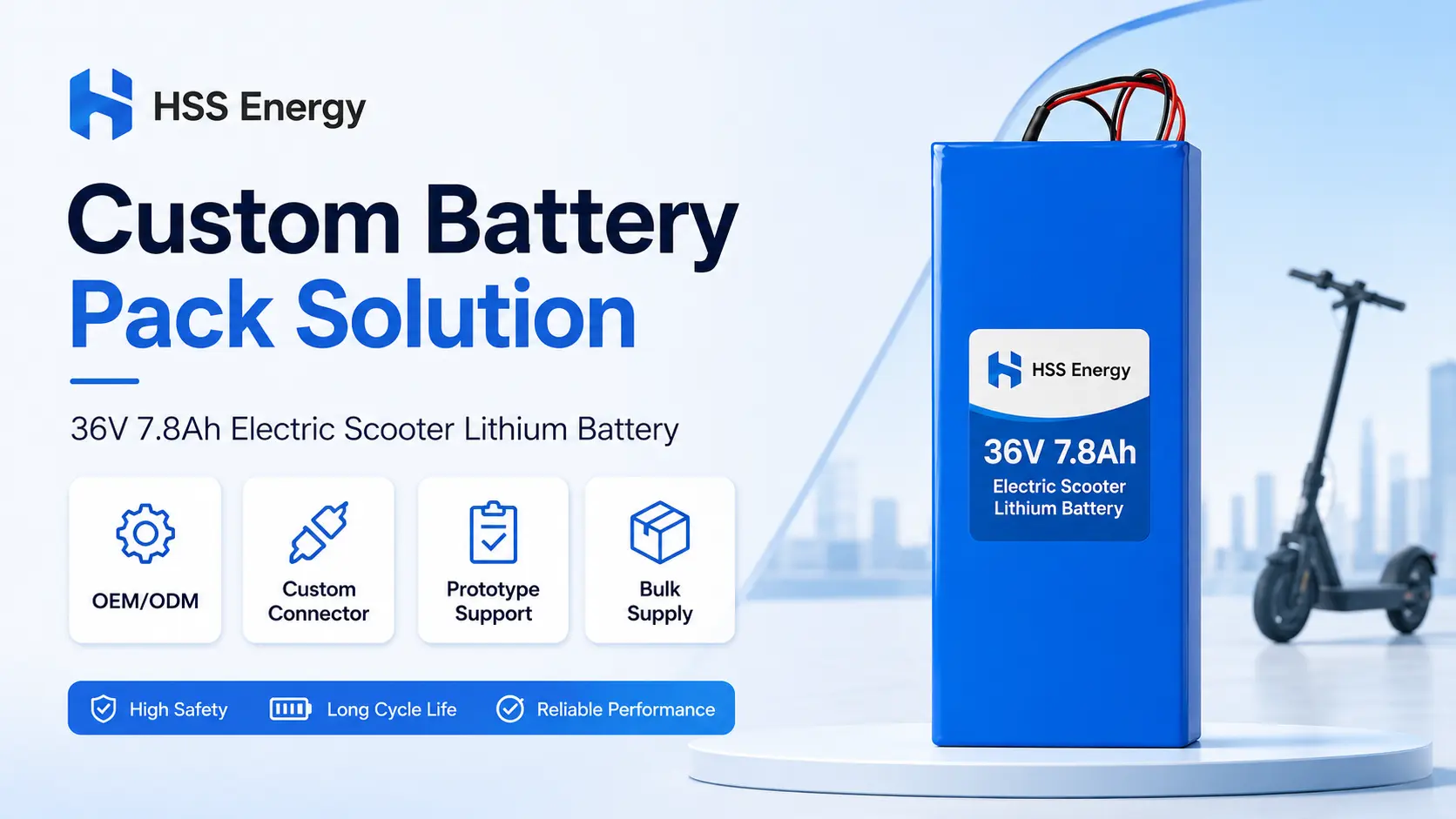
|
Connector XT60 / JST and other project-specific options |
Wire Length Adjusted to scooter wiring and cable route |
BMS Protection and current settings matched to controller |
|
Label / Brand OEM / ODM logo, color and information |
Packaging Project and export packing can be customized |
Dimensions Regular 190 x 60 x 68 mm; other sizes reviewed by project |
|
7.8Ah Is Worth Evaluating When |
Consider Another Configuration When |
|
The scooter needs more runtime than a smaller-capacity 36V battery provides. |
The battery bay cannot accommodate the 190 x 60 x 68 mm regular envelope. |
|
The vehicle already uses a compatible 36V / 10S electrical architecture. |
The charger or controller is designed around a different series architecture. |
|
The project benefits from 280.8Wh nominal energy without moving to a higher voltage. |
The route requires substantially more energy than the 7.8Ah class can provide. |
|
XT60, JST or a project-specific connector can be matched to the scooter. |
The required current exceeds the practical capability of the approved cell/BMS/connector design. |
|
1 Share Scooter Data Battery space, controller, charger, connector, quantity |
2 Confirm Battery Plan 10S3P, BMS, wire length, interface, label |
3 Evaluate Sample Fit, charging, current behavior, runtime |
4 Freeze Production Approved drawing, BOM, QC and packaging |
· Scooter brand / model and destination market
· Battery compartment drawing or maximum available dimensions
· Controller continuous and peak current
· Existing charger voltage / current and connector
· Preferred output connector: XT60, JST or other
· Required wire length and cable exit direction
· Target riding time / range expectation
· Sample quantity and expected bulk quantity
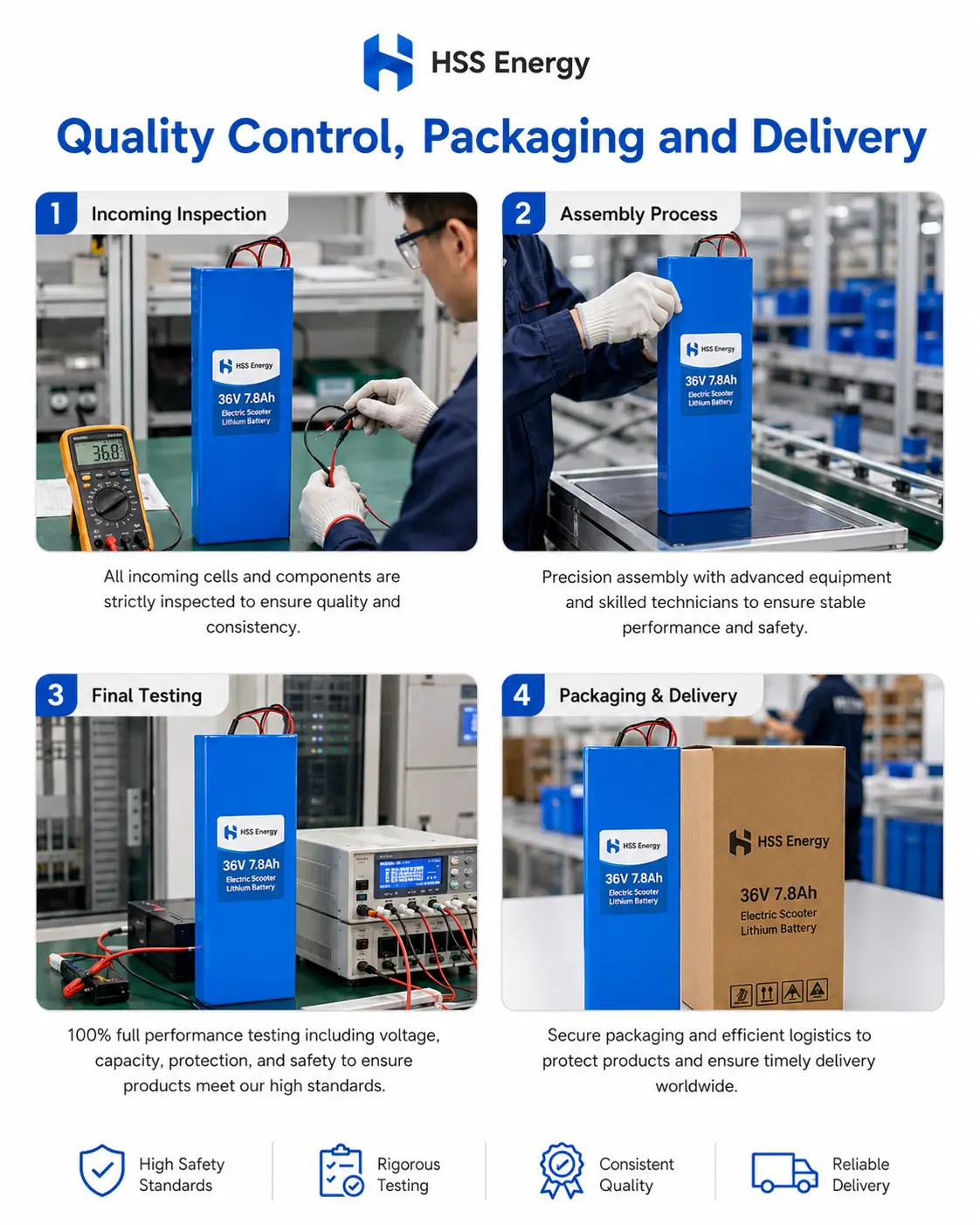
Quality control, assembly, final testing, packaging and delivery visual.
It uses 18650 2600mAh cells in a 10S3P arrangement, for a total of 30 cells and 7.8Ah nominal capacity.
The regular reference size is 190 x 60 x 68 mm. Final fit should still be checked against the scooter battery compartment and connector clearance.
XT60 and JST are the common connector directions for this model. Final connector, polarity, wire gauge and lead length should follow the target scooter.
For a conventional 10S lithium-ion architecture, 42V is the typical full-charge reference. The final charger must match the approved cell and BMS configuration.
The product reference is 500 cycles. Actual cycle life depends on charging, depth of discharge, current, temperature, storage and operating conditions.
No. Voltage and capacity alone do not guarantee compatibility. Battery space, current demand, charger, connector and wiring route all need review.
Address
A3, 1204-1, 1142 Jimei North Avenue, Software Park Phase III, Xiamen Torch High-tech Zone, Xiamen, China
Tel